


 Cart
Cart
 sales@molnova.com



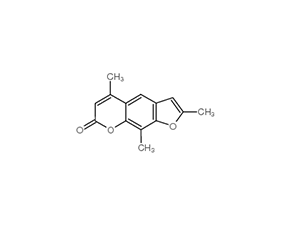
Trioxsalen
CAS No. 3902-71-4
Trioxsalen( NSC71047 | Trioxsalen, trimethylpsoralen )
Catalog No. M18516 CAS No. 3902-71-4
Trioxsalen is a furanocoumarin and a psoralen derivative, in conjunction with UV-A for phototherapy treatment of vitiligo and hand eczema.
Purity : >98% (HPLC)
 COA
Datasheet
HNMR
HPLC
MSDS
Handing Instructions
COA
Datasheet
HNMR
HPLC
MSDS
Handing Instructions
| Size | Price / USD | Stock | Quantity |
| 1 mL x 10 mM in DMSO | 37 | In Stock |


|
| 25MG | 28 | In Stock |
|
| 50MG | 32 | In Stock |
|
| 100MG | 45 | In Stock |
|
| 200MG | Get Quote | In Stock |
|
| 500MG | Get Quote | In Stock |
|
| 1G | Get Quote | In Stock |
|
Biological Information
-
Product NameTrioxsalen
-
NoteResearch use only, not for human use.
-
Brief DescriptionTrioxsalen is a furanocoumarin and a psoralen derivative, in conjunction with UV-A for phototherapy treatment of vitiligo and hand eczema.
-
DescriptionTrioxsalen is a photosenisitizer. It is obtained from several plants, mainly Psoralea corylifolia. Like other psoralens it causes photosensitization of the skin. It is administered either topically or orally in conjunction with UV-A (the least damaging form of ultraviolet light) for phototherapy treatment of vitiligo and hand eczema. After photoactivation it creates interstrand cross-links in DNA, which can cause programmed cell death unless repaired by cellular mechanisms. In research it can be conjugated to dyes for confocal microscopy and used to visualize sites of DNA damage.(In Vitro):Trioxsalen (200 nM) plus 365 nm light produce DNA crosslinks but not breaks in mouse L1210 leukemia cells.Trioxsalen/UVA treatment of HaCaT keratinocytes induces NF-kappaB binding activity, and that this is a synergistic effect.Trioxsalen shows anti-inflammatory capacities in vitro.(In Vivo):Trioxsalen induces dose-dependent depletion of ATPase-positive LCs, with a maximal depletion of 80%, in oral mucous membrane (OMM) with PUVA (UVA doses of 1-8 J/cm2) in rat.
-
In VitroTrioxsalen (200 nM) plus 365 nm light produce DNA crosslinks but not breaks in mouse L1210 leukemia cells.Trioxsalen/UVA treatment of HaCaT keratinocytes induces NF-kappaB binding activity, and that this is a synergistic effect.Trioxsalen shows anti-inflammatory capacities in vitro.
-
In VivoTrioxsalen induces dose-dependent depletion of ATPase-positive LCs, with a maximal depletion of 80%, in oral mucous membrane (OMM) with PUVA (UVA doses of 1-8 J/cm2) in rat.
-
SynonymsNSC71047 | Trioxsalen, trimethylpsoralen
-
PathwayOthers
-
TargetOther Targets
-
RecptorDHFR
-
Research AreaInflammation/Immunology
-
Indication——
Chemical Information
-
CAS Number3902-71-4
-
Formula Weight228.25
-
Molecular FormulaC14H12O3
-
Purity>98% (HPLC)
-
SolubilityDMSO : 6.6 mg/mL 28.92 mM;
-
SMILESCc1cc2cc3c(C)cc(=O)oc3c(C)c2o1
-
Chemical Name2,5,9-trimethyl-7H-furo[3,2-g]chromen-7-one
Shipping & Storage Information
-
Storage(-20℃)
-
ShippingWith Ice Pack
-
Stability≥ 2 years
Reference
1.Hadjipavlou-Litina D,etal.Trioxsalen derivatives with lipoxygenase inhibitory activity.J Enzyme Inhib Med Chem. 2009 Dec;24(6):1351-6.
molnova catalog



related products
-
Nuezhenide
Nuezhenide significantly protects human neuroblastoma SH-SY5Y cells from 6-hydroxydopamine-induced neurotoxicity.
-
Koaburaside monometh...
Koaburaside monomethyl ether is a natural product of Croton, Euphorbiaceae. Koaburaside monomethyl ether can be used as a reference standard.
-
3-Isopropenyl-alphaa...
3-Isopropenyl-alphaalpha-dimethylbenzyl isocyanate is a bioactive chemical.
