


 Cart
 sales@molnova.com




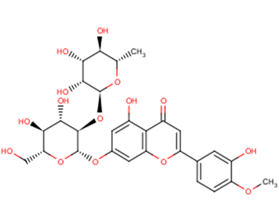
Neodiosmin
CAS No. 38665-01-9
Neodiosmin( —— )
Catalog No. M18505 CAS No. 38665-01-9
Neodiosmin has poor aqueous solubility but exerts a good debittering effect and is a strong antioxidant with potential applications in foods, beverages, and pharmaceutical preparations.
Purity : >98% (HPLC)
 COA
Datasheet
HNMR
HPLC
MSDS
Handing Instructions
| Size | Price / USD | Stock | Quantity |
| 1 mL x 10 mM in DMSO | 37 | In Stock |


|
| 10MG | 29 | In Stock |
|
| 25MG | 49 | In Stock |
|
| 50MG | 72 | In Stock |
|
| 100MG | 114 | In Stock |
|
| 200MG | Get Quote | In Stock |
|
| 500MG | Get Quote | In Stock |
|
| 1G | Get Quote | In Stock |
|
Biological Information
-
Product NameNeodiosmin
-
NoteResearch use only, not for human use.
-
Brief DescriptionNeodiosmin has poor aqueous solubility but exerts a good debittering effect and is a strong antioxidant with potential applications in foods, beverages, and pharmaceutical preparations.
-
DescriptionNeodiosmin has poor aqueous solubility but exerts a good debittering effect and is a strong antioxidant with potential applications in foods, beverages, and pharmaceutical preparations.
-
In Vitro——
-
In Vivo——
-
Synonyms——
-
PathwayChromatin/Epigenetic
-
TargetSirtuin
-
RecptorAntioxidant
-
Research Area——
-
Indication——
Chemical Information
-
CAS Number38665-01-9
-
Formula Weight608.54
-
Molecular FormulaC28H32O15
-
Purity>98% (HPLC)
-
SolubilityIn Vitro:?DMSO : 250 mg/mL (410.82 mM)
-
SMILESCC1C(C(C(C(O1)OC2C(C(C(OC2OC3=CC(=C4C(=C3)OC(=CC4=O)C5=CC(=C(C=C5)OC)O)O)CO)O)O)O)O)O
-
Chemical Name——
Shipping & Storage Information
-
Storage(-20℃)
-
ShippingWith Ice Pack
-
Stability≥ 2 years
Reference
molnova catalog

related products
-
4-bromo-Resveratrol
4'-bromo-Resveratrolis a potent inhibitor of the deacetylases sirtuin 1 (SIRT1) and 3 (SIRT3).
-
SirReal1
A novel potent, selective Sirt2 inhibitor with IC50 of 3.745 uM.
-
MC3482
MC3482 is a potent, specific SIRT5 inhibitor, increases the ammonia content in cells leading to autophagy and mitophagy, shows selective SIRT5 inhibition vs SIRT1-3.
