


 Cart
Cart
 sales@molnova.com



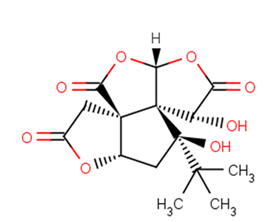
Bilobalide
CAS No. 33570-04-6
Bilobalide( (-)-Bilobalide | Bilobalide | Bilobalid )
Catalog No. M18435 CAS No. 33570-04-6
Bilobalide, a bioactive from Gingko Biloba, is active on hypoxia-induced alterations.
Purity : >98% (HPLC)
 COA
Datasheet
HNMR
HPLC
MSDS
Handing Instructions
COA
Datasheet
HNMR
HPLC
MSDS
Handing Instructions
| Size | Price / USD | Stock | Quantity |
| 1 mL x 10 mM in DMSO | 29 | In Stock |


|
| 25MG | 96 | In Stock |
|
| 50MG | 143 | In Stock |
|
| 100MG | Get Quote | In Stock |
|
| 200MG | Get Quote | In Stock |
|
| 500MG | Get Quote | In Stock |
|
| 1G | Get Quote | In Stock |
|
Biological Information
-
Product NameBilobalide
-
NoteResearch use only, not for human use.
-
Brief DescriptionBilobalide, a bioactive from Gingko Biloba, is active on hypoxia-induced alterations.
-
DescriptionBilobalide is a biologically active terpenic trilactone present in Ginkgo biloba. Bilobalide is important for producing several of the effects of Gingko biloba extracts. It has neuroprotective effects, as well as effects inducing the liver enzymes CYP3A1 and 1A2, which may be partially responsible for interactions between gingko and other herbal medicines or pharmaceutical drugs. Bilobalide has recently been found to be a negative allosteric modulator at the GABAA and GABAA-rho receptors. Of GABAA, it may possibly be selective for the subunits predominantly implicated in cognitive and memory functioning such as α1.
-
In VitroBilobalide (1-100 μM) completely suppresses the NMDA-evoked release of choline in a concentration-dependent manner with IC50 value of 2.3 μM.Bilobalide (1, 5 and 10 μM) alone for 24 h does not affect cell viability of SH-SY5Y cells. Pre-treatment of cells with Bilobalide concentration-dependently prevents Aβ 1-42-, H2O2- and serum deprivation-induced decrease of cell viability, with the best protective effect obtained at 10 μM. Bilobalide (5 and 10 μM; 24 h) treatment dose-dependently increases levels of p-Akt (Ser473 and Thr308) in SH-SY5Y cells. Western Blot Analysis Cell Line:SH-SY5Y cells Concentration:5 and 10 μM Incubation Time:24 hours Result:Induced a significant increase in levels of p-Akt (Ser473 and Thr308).
-
In VivoBilobalide (20 mg/kg) completely suppresses the NMDA-induced release of choline in vivo while basal choline levels were not significantly affected. NMDA causes a release of choline in vivo when infused into the hippocampus of freely moving rats by retrograde dialysis. Bilobalide (20 mg/kg i.p.) completely inhibits the effect induced by NMDA. Animal Model:Male Wistar rats (250-350 g)Dosage:20 mg/kg Administration:I.p. injection 60 min before NMDA infusion Result:Lowered basal choline efflux only slightly (by 7%) but fully antagonized the NMDA-induced increase of choline release. The convulsive effect of NMDA was almost completely suppressed.
-
Synonyms(-)-Bilobalide | Bilobalide | Bilobalid
-
PathwayEndocrinology/Hormones
-
TargetAChR
-
RecptorOthers
-
Research AreaNeurological Disease
-
Indication——
Chemical Information
-
CAS Number33570-04-6
-
Formula Weight326.3
-
Molecular FormulaC15H18O8
-
Purity>98% (HPLC)
-
SolubilityDMSO : ≥ 100 mg/mL; 306.47 mM
-
SMILESC1(=O)O[C@H]2[C@@]3([C@]41[C@H](C[C@@]3(O)C(C)(C)C)OC(=O)C4)[C@H](C(=O)O2)O
-
Chemical Name4H,5aH,9H-Furo(2,3-b)furo(3',2':2,3)cyclopenta(1,2-c)furan-2,4,7(3H,8H)-trione, 9-(1,1-dimethylethyl)-10,10a-dihydro-8,9-dihydroxy-, (5aR-(3aS*,5aalpha,8beta,8aS*,9alpha,10aalpha))-
Shipping & Storage Information
-
Storage(-20℃)
-
ShippingWith Ice Pack
-
Stability≥ 2 years
Reference
1. Lu L, et al. Clin Exp Dermatol. 2015 Jul 14.
molnova catalog



related products
-
Cladribine
Cladribine is an adenosine deaminase inhibitor used to treat hairy cell leukemia and multiple sclerosis.
-
Clidinium bromide
Clidinium is a synthetic anticholinergic agent which has been shown in experimental and clinical studies to have a pronounced antispasmodic and antisecretory effect on the gastrointestinal tract.
-
Oxybutynin
Oxybutynin is an anticholinergic medication used to relieve urinary and bladder difficulties.
