


 Cart
Cart
 sales@molnova.com



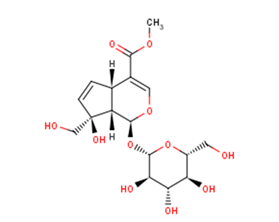
Gardenoside
CAS No. 24512-62-7
Gardenoside( —— )
Catalog No. M18303 CAS No. 24512-62-7
Gardenoside can inhibit the secretion of gastric juice and reduce the role of pancreatic amylase.
Purity : >98% (HPLC)
 COA
Datasheet
HNMR
HPLC
MSDS
Handing Instructions
COA
Datasheet
HNMR
HPLC
MSDS
Handing Instructions
| Size | Price / USD | Stock | Quantity |
| 1 mL x 10 mM in DMSO | 182 | In Stock |


|
| 5MG | 158 | In Stock |
|
| 10MG | 234 | In Stock |
|
| 25MG | 376 | In Stock |
|
| 50MG | 517 | In Stock |
|
| 100MG | Get Quote | In Stock |
|
| 200MG | Get Quote | In Stock |
|
| 500MG | Get Quote | In Stock |
|
| 1G | Get Quote | In Stock |
|
Biological Information
-
Product NameGardenoside
-
NoteResearch use only, not for human use.
-
Brief DescriptionGardenoside can inhibit the secretion of gastric juice and reduce the role of pancreatic amylase.
-
DescriptionGardenoside has laxative, cholagogic activities. Gardenoside has anti-inflammatory, analgesic activities. Gardenoside can treat soft tissue damage.Gardenoside can inhibit the secretion of gastric juice and reduce the role of pancreatic amylase.
-
In Vitro——
-
In Vivo——
-
Synonyms——
-
PathwayApoptosis
-
TargetApoptosis
-
RecptorOthers
-
Research AreaInflammation/Immunology
-
Indication——
Chemical Information
-
CAS Number24512-62-7
-
Formula Weight404.36
-
Molecular FormulaC17H24O11
-
Purity>98% (HPLC)
-
SolubilityIn Vitro:?DMSO : 100 mg/mL (247.30 mM)
-
SMILESCOC(=O)C1=COC(C2C1C=CC2(CO)O)OC3C(C(C(C(O3)CO)O)O)O
-
Chemical Name——
Shipping & Storage Information
-
Storage(-20℃)
-
ShippingWith Ice Pack
-
Stability≥ 2 years
Reference
molnova catalog



related products
-
D609
D609 (Tricyclodecan-9-yl-Xanthogenate) has a wide range of biological activities including antioxidant, antiapoptotic, anticholinergic, antitumor, anti-inflammatory, antiviral, antiproliferative, and neuroprotective activities.
-
TJ08
TJ08 is a 1,2,5-trisubstituted benzimidazole derivative with anticancer properties that effectively induces G1/S phase blockade while promoting apoptotic effects in a variety of cancer cells.
-
LCS3
LCS3 is a reversible and non-competitive synergistic inhibitor of glutathione disulfide reductase (GSR) and thioredoxin reductase 1 (TXNRD1) with IC50s of 3.3 μM and 3.8 μM, respectively.
