


 Cart
Cart
 sales@molnova.com



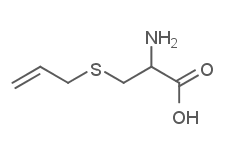
S-allyl-L-cysteine
CAS No. 21593-77-1
S-allyl-L-cysteine( —— )
Catalog No. M18241 CAS No. 21593-77-1
S-Allyl cysteine (SAC) is an organic compound that is a natural constituent of fresh garlic. It is a derivative of the amino acid cysteine in which an allyl group has been added to the sulfur atom.
Purity : >98% (HPLC)
 COA
Datasheet
HNMR
HPLC
MSDS
Handing Instructions
COA
Datasheet
HNMR
HPLC
MSDS
Handing Instructions
| Size | Price / USD | Stock | Quantity |
| 10MG | 29 | In Stock |


|
| 25MG | 49 | In Stock |
|
| 50MG | 60 | In Stock |
|
| 100MG | 83 | In Stock |
|
| 200MG | Get Quote | In Stock |
|
| 500MG | Get Quote | In Stock |
|
| 1G | Get Quote | In Stock |
|
Biological Information
-
Product NameS-allyl-L-cysteine
-
NoteResearch use only, not for human use.
-
Brief DescriptionS-Allyl cysteine (SAC) is an organic compound that is a natural constituent of fresh garlic. It is a derivative of the amino acid cysteine in which an allyl group has been added to the sulfur atom.
-
DescriptionS-Allyl cysteine (SAC) is an organic compound that is a natural constituent of fresh garlic. It is a derivative of the amino acid cysteine in which an allyl group has been added to the sulfur atom.
-
In VitroIt is found that S-Allyl-L-cysteine could protect against amyloid-protein (A)-and tunicamycin-induced cell death in differentiated PC12 cells. Simultaneously applied S-Allyl-L-cysteine (1 μM) suppresses the cell death induced by Aβ25-35 and Aβ1-40 in a concentration-dependent manner, and neuronal integrity is almost completely retained. Simultaneously applied S-Allyl-L-cysteine significantly decreases the Aβ-induced level of ROS. The TEAC value of S-Allyl-L-cysteine is lower than that of oxidized GSH, and no antioxidant activity is observed. Intracellular GSH levels remains unaffected by treatment of neurons with S-Allyl-L-cysteine for 24 h. Furthermore, the increase in caspase-12 protein expression is suppressed by simultaneously adding 1 μM S-Allyl-L-cysteine . S-Allyl-L-cysteine up to a concentration 1.0 mM does not exhibit any cytotoxic impact on morphology of myoblast and myotubes in culture observed under bright field microscope. TNF treatment leads to a significant decrease in the intracellular CK activity while S-Allyl-L-cysteine pre-treatment to TNF treated myotubes decreases the release of CK in media. S-Allyl-L-cysteine pre-treatment decreases the level of active form of this enzyme in S-Allyl-L-cysteine+TNF group. Similar observations are recorded at mRNA level for caspase-3. These results illustrate that S-Allyl-L-cysteine regulates apoptotic signals via suppressing the transcription and thus protein expression of caspase-3.
-
In Vivo——
-
Synonyms——
-
PathwayOthers
-
TargetOther Targets
-
RecptorOthers
-
Research Area——
-
Indication——
Chemical Information
-
CAS Number21593-77-1
-
Formula Weight161.22
-
Molecular FormulaC6H11NO2S
-
Purity>98% (HPLC)
-
SolubilityH2O : 33.33 mg/mL 206.74 mM
-
SMILESOC(=O)[C@@H](N)CSCC=C
-
Chemical Name——
Shipping & Storage Information
-
Storage(-20℃)
-
ShippingWith Ice Pack
-
Stability≥ 2 years
Reference
1. Xu X, et al. J Food Sci Technol. 2015 Mar;52(3):1724-9.
molnova catalog



related products
-
11-Deoxyalisol B
11-Deoxyalisol B, a triterpene, shows the potent inhibitory activity on Lipopolysaccharide (LPS)-induced nitric oxide (NO) production.
-
3-Hydroxytectorigeni...
3′-Hydroxytectorigenin-7-O-β-D-xylosyl-(1→6)-β-D-glucopyranoside is an antioxidant that can be found in Pueraria montana var. lobata. It exhibits DPPH radical scavenging activity, with an IC50 value of 42 μg/mL.
-
Dipalmitin
Dipalmitin has templating effects on soft palm mid fraction crystals.
