


 Cart
Cart
 sales@molnova.com



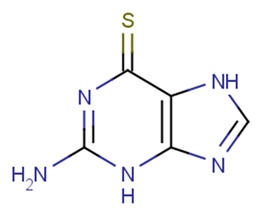
Thioguanine
CAS No. 154-42-7
Thioguanine( —— )
Catalog No. M18075 CAS No. 154-42-7
Thioguanine is an antineoplastic compound which also has antimetabolite action. The drug is used in the therapy of acute leukemia.
Purity : >98% (HPLC)
 COA
Datasheet
HNMR
HPLC
MSDS
Handing Instructions
COA
Datasheet
HNMR
HPLC
MSDS
Handing Instructions
| Size | Price / USD | Stock | Quantity |
| 1 mL x 10 mM in DMSO | 48 | In Stock |


|
| 50MG | 37 | In Stock |
|
| 100MG | 45 | In Stock |
|
| 200MG | Get Quote | In Stock |
|
| 500MG | 67 | In Stock |
|
| 1G | Get Quote | In Stock |
|
Biological Information
-
Product NameThioguanine
-
NoteResearch use only, not for human use.
-
Brief DescriptionThioguanine is an antineoplastic compound which also has antimetabolite action. The drug is used in the therapy of acute leukemia.
-
DescriptionTioguanine (INN, BAN), or thioguanine (AAN, USAN), commonly referred to as 6-thioguanine (6-TG) is a medication used to treat a number of types of leukemia. It has been used less frequently in recent years because of safety concerns. However, it is becoming more widely used for treating ulcerative colitis and some autoimmune diseases.(In Vitro):6-Thioguanine (Thioguanine; 2-Amino-6-purinethiol) is an anti-leukemia and immunosuppressant agent, acts as an inhibitor of SARS and MERS coronavirus papain-like proteases (PLpros) and also potently inhibits USP2 activity, with IC50s of 25 μM and 40 μM for Plpros and recombinant human USP2, respectively. 6-Thioguanine (Thioguanine) affects the methylation of cytosine residues by purified DNA methyltransferases including human DNMT1 and bacterial HpaII methylase. 6-Thioguanine (Thioguanine) (1 or 3 μM) decreases global cytosine methylation in Jurkat T cells and cytosine methylation in human cells at 3 μM. 6-Thioguanine (Thioguanine) (18.75, 37.50, or 75.00 μM) adversely affects cell viability, but with no effect on LDH or ALT activity.
-
In Vitro6-Thioguanine (Thioguanine; 2-Amino-6-purinethiol) is an anti-leukemia and immunosuppressant agent, acts as an inhibitor of SARS and MERS coronavirus papain-like proteases (PLpros) and also potently inhibits USP2 activity, with IC50s of 25 μM and 40 μM for Plpros and recombinant human USP2, respectively. 6-Thioguanine (Thioguanine) affects the methylation of cytosine residues by purified DNA methyltransferases including human DNMT1 and bacterial HpaII methylase. 6-Thioguanine (Thioguanine) (1 or 3 μM) decreases global cytosine methylation in Jurkat T cells and cytosine methylation in human cells at 3 μM. 6-Thioguanine (Thioguanine) (18.75, 37.50, or 75.00 μM) adversely affects cell viability, but with no effect on LDH or ALT activity.
-
In Vivo——
-
Synonyms——
-
PathwayOthers
-
TargetOther Targets
-
RecptorDNMT1
-
Research AreaCancer
-
Indication——
Chemical Information
-
CAS Number154-42-7
-
Formula Weight167.2
-
Molecular FormulaC5H5N5S
-
Purity>98% (HPLC)
-
SolubilityDMSO : 10 mg/mL 59.81 mM
-
SMILESc1nc2c([nH]1)c(=S)nc([nH]2)N
-
Chemical Name2-amino-1H-purine-6(7H)-thione
Shipping & Storage Information
-
Storage(-20℃)
-
ShippingWith Ice Pack
-
Stability≥ 2 years
Reference
1. Krynetskaia NF, et al. FASEB J,2000, 14(14), 2339-2344.
molnova catalog



related products
-
2,3-Dehydrokievitone
2,3- Dehydrokievitone exhibits strong cytotoxic activity and induces apoptosis efficiently in cancer cells.
-
25-Dimethylpyrazine
25-Dimethylpyrazine is present in asparagus wheat bread crispbread Swiss cheeses black or green tea soya malt raw shrimp and squid. 25-Dimethylpyrazine is used as flavor additive and odorant in foods.
-
Acid Red 73
Acid red 73 is a red dye.
