


 Cart
Cart
 sales@molnova.com



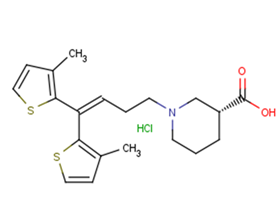
Tiagabine hydrochloride
CAS No. 145821-59-6
Tiagabine hydrochloride( NO050328 hydrochloride | NO328 hydrochloride )
Catalog No. M18034 CAS No. 145821-59-6
Tiagabine Hydrochloride is the hydrochloride salt form of tiagabine, a nipecotic acid derivative with anticonvulsant property.
Purity : >98% (HPLC)
 COA
Datasheet
HNMR
HPLC
MSDS
Handing Instructions
COA
Datasheet
HNMR
HPLC
MSDS
Handing Instructions
| Size | Price / USD | Stock | Quantity |
| 1 mL x 10 mM in DMSO | 45 | In Stock |


|
| 10MG | 48 | In Stock |
|
| 25MG | 60 | In Stock |
|
| 50MG | 105 | In Stock |
|
| 100MG | 189 | In Stock |
|
| 200MG | 308 | In Stock |
|
| 500MG | Get Quote | In Stock |
|
| 1G | Get Quote | In Stock |
|
Biological Information
-
Product NameTiagabine hydrochloride
-
NoteResearch use only, not for human use.
-
Brief DescriptionTiagabine Hydrochloride is the hydrochloride salt form of tiagabine, a nipecotic acid derivative with anticonvulsant property.
-
DescriptionTiagabine Hydrochloride is the hydrochloride salt form of tiagabine, a nipecotic acid derivative with anticonvulsant property. A selective gamma-aminobutyric acid (GABA) reuptake inhibitor.
-
In Vitro——
-
In Vivo——
-
SynonymsNO050328 hydrochloride | NO328 hydrochloride
-
PathwayOthers
-
TargetOther Targets
-
RecptorGABA uptake
-
Research AreaNeurological Disease
-
Indication——
Chemical Information
-
CAS Number145821-59-6
-
Formula Weight412.01
-
Molecular FormulaC20H25NO2S2·HCl
-
Purity>98% (HPLC)
-
SolubilityDMSO : ≥ 53 mg/mL; 128.64 mM
-
SMILESCl.CC1=C(SC=C1)C(=CCCN1CCC[C@H](C1)C(O)=O)C1=C(C)C=CS1
-
Chemical Name——
Shipping & Storage Information
-
Storage(-20℃)
-
ShippingWith Ice Pack
-
Stability≥ 2 years
Reference
molnova catalog



related products
-
N-Desmethyltrimipram...
N-Desmethyltrimipramine is a biochemical.
-
Zinc phthalocyanine
Zinc phthalocyanine are photosensitiveis commonly applied in industry (catalysts photoconductors) and biomedical (photodynamic therapy).
-
L-822179
L-822179 (α5IA) is a selective inverse agonist for the Α5 subtype of GABAA receptor with higher intrinsic activity at the A5 subtype than other drugs.
