


 Cart
Cart
 sales@molnova.com



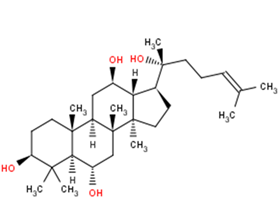
Protopanaxatriol
CAS No. 1453-93-6
Protopanaxatriol( 20(R)-APPT )
Catalog No. M18030 CAS No. 1453-93-6
Protopanaxatriol, a major ginseng constituent, is a novel PPARγ antagonist.
Purity : >98% (HPLC)
 COA
Datasheet
HNMR
HPLC
MSDS
Handing Instructions
COA
Datasheet
HNMR
HPLC
MSDS
Handing Instructions
| Size | Price / USD | Stock | Quantity |
| 1 mL x 10 mM in DMSO | 80 | In Stock |


|
| 5MG | 64 | In Stock |
|
| 10MG | 104 | In Stock |
|
| 25MG | 187 | In Stock |
|
| 50MG | 300 | In Stock |
|
| 100MG | 449 | In Stock |
|
| 200MG | Get Quote | In Stock |
|
| 500MG | Get Quote | In Stock |
|
| 1G | Get Quote | In Stock |
|
Biological Information
-
Product NameProtopanaxatriol
-
NoteResearch use only, not for human use.
-
Brief DescriptionProtopanaxatriol, a major ginseng constituent, is a novel PPARγ antagonist.
-
DescriptionProtopanaxatriol, a major ginseng constituent, is a novel PPARγ antagonist.
-
In Vitro20(R)-Protopanaxatriol is a natural aglycone of ginsenosides Re, Rf, Rg1, Rg2 and Rh.
-
In Vivo——
-
Synonyms20(R)-APPT
-
PathwayOthers
-
TargetOther Targets
-
RecptorPPARγ
-
Research AreaMetabolic Disease
-
Indication——
Chemical Information
-
CAS Number1453-93-6
-
Formula Weight476.73
-
Molecular FormulaC30H32O4
-
Purity>98% (HPLC)
-
SolubilityDMSO : ≥ 32 mg/mL; 67.12 mM
-
SMILESC1C[C@@H](C([C@@H]2[C@H](C[C@]3([C@@]4(CC[C@@H]([C@H]4[C@@H](C[C@@H]3[C@@]12C)O)[C@@](C)(CCC=C(C)C)O)C)C)O)(C)C)O
-
Chemical Name——
Shipping & Storage Information
-
Storage(-20℃)
-
ShippingWith Ice Pack
-
Stability≥ 2 years
Reference
1. Zhang Y, et al. Protopanaxatriol, a novel PPARγ antagonist from Panax ginseng, alleviates steatosis in mice. Sci Rep. 2014 Dec 9;4:7375.
molnova catalog



related products
-
Ac-Gly-Ala-Lys(Ac)-A...
Ac-Gly-Ala-Lys(Ac)-AMC is a fluorogenic substrate for the determination of protease activity. Ac-Gly-Ala-Lys(Ac)-AMC undergoes hydrolysis and releases the fluorescent product 7-amino-4-methylcoumarin (AMC). AMC is fluorescent under UV light and can emit a fluorescent signal.
-
Propyl heptanoate
Propyl heptanoate is an important chemical raw material and an organic solvent in the industrial field. It can be used in synthetic fragrances, nylon fibers and advanced plastics.
-
JG26
JG26 is a potent inhibitor of ADAM17, which can inhibit ADAM8, ADAM17, ADAM10 and MMP-12, with IC50 values of 12 nM, 1.9 nM, 150 nM and 9.4 nM, respectively.
