


 Cart
Cart
 sales@molnova.com



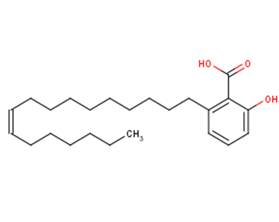
Ginkgolic acid C17:1
CAS No. 111047-30-4
Ginkgolic acid C17:1( —— )
Catalog No. M17819 CAS No. 111047-30-4
Ginkgolic acid C17:1 can significantly inhibit enterohemorrhagic Escherichia coli O157:H7(EHEC) biofilm formation on the surfaces of polystyrene and glass, and on nylon membranes.
Purity : >98% (HPLC)
 COA
Datasheet
HNMR
HPLC
MSDS
Handing Instructions
COA
Datasheet
HNMR
HPLC
MSDS
Handing Instructions
| Size | Price / USD | Stock | Quantity |
| 1 mL x 10 mM in DMSO | 246 | In Stock |


|
| 5MG | 209 | In Stock |
|
| 10MG | 309 | In Stock |
|
| 25MG | 521 | In Stock |
|
| 50MG | 733 | In Stock |
|
| 100MG | 1004 | In Stock |
|
| 200MG | Get Quote | In Stock |
|
| 500MG | 2027 | In Stock |
|
| 1G | Get Quote | In Stock |
|
Biological Information
-
Product NameGinkgolic acid C17:1
-
NoteResearch use only, not for human use.
-
Brief DescriptionGinkgolic acid C17:1 can significantly inhibit enterohemorrhagic Escherichia coli O157:H7(EHEC) biofilm formation on the surfaces of polystyrene and glass, and on nylon membranes.
-
DescriptionGinkgolic acid C17:1 can significantly inhibit enterohemorrhagic Escherichia coli O157:H7(EHEC) biofilm formation on the surfaces of polystyrene and glass, and on nylon membranes.
-
In Vitro——
-
In Vivo——
-
Synonyms——
-
PathwayEndocrinology/Hormones
-
TargetEstrogen Receptor/ERR
-
RecptorOthers
-
Research AreaOthers-Field
-
Indication——
Chemical Information
-
CAS Number111047-30-4
-
Formula Weight374.56
-
Molecular FormulaC24H38O3
-
Purity>98% (HPLC)
-
SolubilityIn Vitro:?DMSO : 100 mg/mL (266.98 mM)
-
SMILESCCCCCCC=CCCCCCCCCCC1=C(C(=CC=C1)O)C(=O)O
-
Chemical Name——
Shipping & Storage Information
-
Storage(-20℃)
-
ShippingWith Ice Pack
-
Stability≥ 2 years
Reference
molnova catalog



related products
-
Diarylpropionitrile
Diarylpropionitrile (DPN) is a non-steroidal estrogen receptor β(ERβ) selective ligand.
-
Palazestrant
Palazestrant (OP-1250) is an orally available and highly potent estrogen receptor antagonist and selective ER degrader with antitumor activity.
-
Fluticasone propiona...
Fluticasone propionate is a high affinity, selective GR (glucocorticoid receptor) agonist which is derived from fluticasone used to treat asthma and allergic rhinitis.
