


 Cart
Cart
 sales@molnova.com



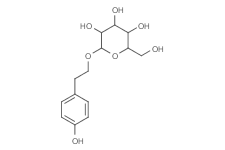
Salidroside
CAS No. 10338-51-9
Salidroside( Rhodioloside )
Catalog No. M17765 CAS No. 10338-51-9
Salidroside is a bioactive phenolic glycoside compound isolated from Rhodiola crenulata. It is a prolyl endopeptidase Inhibitor.
Purity : >98% (HPLC)
 COA
Datasheet
HNMR
HPLC
MSDS
Handing Instructions
COA
Datasheet
HNMR
HPLC
MSDS
Handing Instructions
| Size | Price / USD | Stock | Quantity |
| 1 mL x 10 mM in DMSO | 50 | In Stock |


|
| 2MG | 29 | In Stock |
|
| 5MG | 46 | In Stock |
|
| 10MG | 74 | In Stock |
|
| 25MG | 132 | In Stock |
|
| 50MG | 184 | In Stock |
|
| 100MG | 276 | In Stock |
|
| 200MG | 421 | In Stock |
|
| 500MG | Get Quote | In Stock |
|
| 1G | Get Quote | In Stock |
|
Biological Information
-
Product NameSalidroside
-
NoteResearch use only, not for human use.
-
Brief DescriptionSalidroside is a bioactive phenolic glycoside compound isolated from Rhodiola crenulata. It is a prolyl endopeptidase Inhibitor.
-
DescriptionSalidroside is a bioactive phenolic glycoside compound isolated from Rhodiola crenulata. It is a prolyl endopeptidase Inhibitor.(In Vitro):Salidroside (100 μM) inhibits prolyl endopeptidase (PEP) activity (10.6±1.9%). Prolyl endopeptidase is an enzyme that plays a role in the metabolism of proline-containing neuropeptidase which is recognized to be involved in learning and memory. Salidroside, one of the major phenylpropanoid glycosides found in R. rosea L, is consumed almost daily as a nutritional supplement in many countries and has been identified possessing potential anti-fatigue and anoxia,anti-aging, and anti-Alzheimer's disease activities. Salidroside can improve muscle nutrition via increasing mTOR, p-mTOR, and MyHC expression. SH-SY5Y cells are exposed to 0-600 μM MPP+ for 12-48 h and the results show that MPP+ results in a significant decrease of cell viability in a concentration and time-dependent manner. Cells are pretreated with 25-100 μM Salidroside (Sal) for 24 h and then exposed to 500 μM MPP+ for an additional 24 h. Salidroside concentration-dependently prevents MPP+-induced decrease of cell viability. Annexin V/PI staining is a common method for the detection of apoptotic cell. Salidroside significantly decreases the number of Annexin V/PI-stained cells treated by MPP+ which is in a concentration-dependent manner. Apoptotic cell could also be morphologically evaluated by Hoechst staining. In Hoechst staining, apoptotic cells are characterized by reduced nuclear size, chromatin condensation, intense fluorescence, and nuclear fragmentation. Salidroside notably inhibits MPP+-induced increase of chromatin condensation, intense fluorescence, and nuclear fragmentation in SH-SY5Y cells.(In Vivo):Salidroside is a natural antioxidant extracted from medicinal food plant Rhodiola rosea. Salidroside (100 mg/kg/day) shows strong glucose lowering effect on db/db mice which is similar to effect of Metformin (200 mg/kg/day). For this reason, the dose of 100 mg/kg/day salidroside is used.
-
In Vitro——
-
In Vivo——
-
SynonymsRhodioloside
-
PathwayAngiogenesis
-
Targetc-Met/HGFR
-
RecptorOthers
-
Research AreaOthers-Field
-
Indication——
Chemical Information
-
CAS Number10338-51-9
-
Formula Weight300.3
-
Molecular FormulaC14H20O7
-
Purity>98% (HPLC)
-
SolubilityH2O : ≥ 100 mg/mL; 333.00 mM
-
SMILESc1cc(ccc1CCO[C@H]1[C@@H]([C@H]([C@@H]([C@H](O1)CO)O)O)O)O
-
Chemical Name——
Shipping & Storage Information
-
Storage(-20℃)
-
ShippingWith Ice Pack
-
Stability≥ 2 years
Reference
1. Hu X, et al. Cell Biol Toxicol, 2010, 26(6), 499-507.
molnova catalog



related products
-
Savolitinib
Savolitinib (AZD-6094) is a potent, highly selective, and orally bioavailable c-Met inhibitor with IC50s of 5 nM and 3 nM for c-Met and p-Met.
-
AMG-458
AMG-458 (AMG458) is a potent, selective, orally bioavailable c-Met inhibitor with Ki of 1.2 nM.
-
Tyrosine kinase inhi...
Tyrosine kinase inhibitor is a tyrosine kinase inhibitor used in combination with fragmenting aromatic nitrogen compounds as antiproliferative agents.
