


 Cart
Cart
 sales@molnova.com



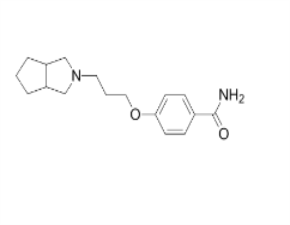
S-38093
CAS No. 862896-30-8
S-38093( —— )
Catalog No. M17625 CAS No. 862896-30-8
S-38093 is a brain-penetrant antagonist of the H3 receptor (Ki: 8.8/1.44/1.2 μM, for rat/mouse/human).
Purity : >98% (HPLC)
 COA
Datasheet
HNMR
HPLC
MSDS
Handing Instructions
COA
Datasheet
HNMR
HPLC
MSDS
Handing Instructions
| Size | Price / USD | Stock | Quantity |
| 1 mL x 10 mM in DMSO | 46 | In Stock |


|
| 2MG | 30 | In Stock |
|
| 5MG | 46 | In Stock |
|
| 10MG | 69 | In Stock |
|
| 25MG | 126 | In Stock |
|
| 50MG | 206 | In Stock |
|
| 100MG | 327 | In Stock |
|
| 200MG | 458 | In Stock |
|
| 500MG | Get Quote | In Stock |
|
| 1G | Get Quote | In Stock |
|
Biological Information
-
Product NameS-38093
-
NoteResearch use only, not for human use.
-
Brief DescriptionS-38093 is a brain-penetrant antagonist of the H3 receptor (Ki: 8.8/1.44/1.2 μM, for rat/mouse/human).
-
DescriptionS-38093 is a brain-penetrant antagonist of the H3 receptor (Ki: 8.8/1.44/1.2 μM, for rat/mouse/human).(In Vitro):In cellular models, S 38093 is able to antagonize mice H3 receptors (KB=0.65 μM) and to suppress cAMP decrease induced by an H3 agonist via human H3 receptors (KB=0.11 μM). In cells expressing a high H3 density, S 38093 behaves as a moderate inverse agonist at rat and human H3 receptors (EC50=9 and 1.7 μM, respectively).(In Vivo):S 38093 (0.3 and 3 mg/kg/d p.o., 28 days) significantly increases proliferation of progenitors in the DG of hippocampus in young adult mice. S 38093 (0.3 mg/kg/d) treatment significantly increases the number of DCX+ cells with tertiary dendrites. S 38093 (0.3, 1 and/or 3 mg/kg) significantly increases cell proliferation, survival, and maturation in the DG of hippocampus in aged mice relative to vehicle. S 38093 (3 mg/kg/d p.o., 28 days) increases cell proliferation and has a strong effect on cell survival, also increases the dendritic intersections in both genotypes (one-way ANOVA with repeated measure, p < 0.01), with a significant effect from 50 to 80 in APPSWETG mice only. In aged mice, chronic administration of S 38093 (1 and/or 3 mg/kg/day p.o., 28 days) reverses this age-dependent decrease in BDNF-IX, BDNF-IV and BDNF-I transcripts. In addition, S 38093 at three tested doses (0.3, 1 and 3 mg/kg/d) increases VEGF transcripts compared to vehicle-aged group. In mice, S 38093 significantly increases ex vivo N-tele-Methylhistamine cerebral levels from 3 mg/kg p.o. and antagonized R-α-Methylhistamine-induced dipsogenia from 10 mg/kg i.p.
-
In VitroIn cellular models, S 38093 is able to antagonize mice H3 receptors (KB=0.65 μM) and to suppress cAMP decrease induced by an H3 agonist via human H3 receptors (KB=0.11 μM). In cells expressing a high H3 density, S 38093 behaves as a moderate inverse agonist at rat and human H3 receptors (EC50=9 and 1.7 μM, respectively).
-
In VivoS 38093 (0.3 and 3?mg/kg/d p.o., 28 days) significantly increases proliferation of progenitors in the DG of hippocampus in young adult mice. S 38093 (0.3?mg/kg/d) treatment significantly increases the number of DCX+ cells with tertiary dendrites. S 38093 (0.3, 1 and/or 3?mg/kg) significantly increases cell proliferation, survival, and maturation in the DG of hippocampus in aged mice relative to vehicle. S 38093 (3?mg/kg/d p.o., 28 days) increases cell proliferation and has a strong effect on cell survival, also increases the dendritic intersections in both genotypes (one-way ANOVA with repeated measure, p?Synonyms——PathwayOthersTargetOther TargetsRecptorHuman H3 receptor| Mouse H3 receptor| Rat H3 receptorResearch AreaNeurological DiseaseIndication——
Chemical Information
-
CAS Number862896-30-8
-
Formula Weight288.38
-
Molecular FormulaC17H24N2O2
-
Purity>98% (HPLC)
-
SolubilityDMSO : 15 mg/mL. 52.01 mM;
-
SMILESNC(=O)c1ccc(OCCCN2CC3CCCC3C2)cc1
-
Chemical Name——
Shipping & Storage Information
-
Storage(-20℃)
-
ShippingWith Ice Pack
-
Stability≥ 2 years
Reference
1.Guilloux JP, et al. S 38093, a histamine H3 antagonist/inverse agonist, promotes hippocampal neurogenesis and improves context discrimination task in aged mice. Sci Rep. 2017 Feb 20;7:42946.
molnova catalog



related products
-
Rebaudioside E
Rebaudioside E is a natural product.
-
Ajugasterone C
Ajugasterone C shows significant inhibitory effect at 100 mg/kg dose on rat paw oedema development due to carrageenan-induced inflammation in Sprague Dawley rats.
-
Menthofuran
Menthofuran is a natural product.
