


 Cart
Cart
 sales@molnova.com



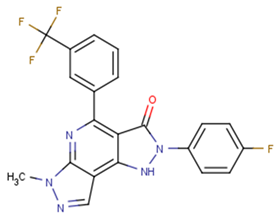
CTLA-4 inhibitor
CAS No. 635324-72-0
CTLA-4 inhibitor( MDK24720 | MDK-24720 | CTLA-4 inhibitor )
Catalog No. M17558 CAS No. 635324-72-0
CTLA-4 inhibitor is a potent CTLA-4 inhibitor.
Purity : >98% (HPLC)
 COA
Datasheet
HNMR
HPLC
MSDS
Handing Instructions
COA
Datasheet
HNMR
HPLC
MSDS
Handing Instructions
| Size | Price / USD | Stock | Quantity |
| 1 mL x 10 mM in DMSO | 202 | In Stock |


|
| 2MG | 109 | In Stock |
|
| 5MG | 183 | In Stock |
|
| 10MG | 297 | In Stock |
|
| 25MG | 549 | In Stock |
|
| 50MG | 770 | In Stock |
|
| 100MG | 1014 | In Stock |
|
| 200MG | Get Quote | In Stock |
|
| 500MG | Get Quote | In Stock |
|
| 1G | Get Quote | In Stock |
|
Biological Information
-
Product NameCTLA-4 inhibitor
-
NoteResearch use only, not for human use.
-
Brief DescriptionCTLA-4 inhibitor is a potent CTLA-4 inhibitor.
-
DescriptionMDK24720 is a CTLA-4 inhibitor. MDK24720 has CAS#635324-72-0, in which the last 5 digital was used in the code name. CTLA4 or CTLA-4 (cytotoxic T-lymphocyte-associated protein 4), also known as CD152 (cluster of differentiation 152), is a protein receptor that, functioning as an immune checkpoint, downregulates immune responses. CTLA4 is constitutively expressed in Tregs but only upregulated in conventional T cells after activation. It acts as an "off" switch when bound to CD80 or CD86 on the surface of antigen-presenting cells. Polymorphisms of the CTLA-4 gene are associated with autoimmune diseases such as autoimmune thyroid disease and multiple sclerosis, though this association is often weak. In Systemic Lupus Erythematosus (SLE), the splice variant sCTLA-4 is found to be aberrantly produced and found in the serum of patients with active SLE.
-
In VitroBivalent CTLA4 homodimers bridge bivalent B7.1 homodimers to form an unusually stable signaling complex. Blocking B7/CD28 interactions with monoclonal antibodies or soluble receptors results in immunosuppression and enhanced allograft survival, while B7/CTLA-4 blockade results in enhanced antitumor immune responses. The interaction of co-stimulatory molecules on T cells with B7 molecules on antigen presenting cells plays an important role in the activation of naive T cells. Consequently, agents that disrupt these interactions should have applications in treatment of transplant rejection as well as autoimmune diseases.
-
In Vivo——
-
SynonymsMDK24720 | MDK-24720 | CTLA-4 inhibitor
-
PathwayAngiogenesis
-
TargetIGF-1R
-
RecptorCTLA-4
-
Research Area——
-
Indication——
Chemical Information
-
CAS Number635324-72-0
-
Formula Weight427.11
-
Molecular FormulaC21H13F4N5O
-
Purity>98% (HPLC)
-
SolubilityIn Vitro:?DMSO : 62.5 mg/mL (146.25 mM)
-
SMILESc12c(nc3c(c1[nH]n(c2=O)c1ccc(cc1)F)cnn3C)c1cc(ccc1)C(F)(F)F
-
Chemical Name2-(4-Fluoro-phenyl)-6-methyl-4-(3-trifluoromethyl-phenyl)-1,6-dihydro-2H-1,2,5,6,7-pentaaza-as-indacen-3-one
Shipping & Storage Information
-
Storage(-20℃)
-
ShippingWith Ice Pack
-
Stability≥ 2 years
Reference
molnova catalog



related products
-
Tyrphostin AG 538
Tyrphostin AG 538 is a chalcone compound, an IGF-1 receptor kinase inhibitor (IC?0 : for 400 nM) that is potent, cell-permeable, reversible, and competitive.
-
Insulin efsitora alf...
Insulin efsitora alfa (LY-3209590) is a selective insulin receptor (IR) agonist and fusion protein that combines a novel single-chain insulin variant with the structural domain of human IgG Fc for the study of type 2 diabetes.
-
LMPTP INHIBITOR 1 hy...
LMPTP INHIBITOR 1 is a selective inhibitor of low molecular weight protein tyrosine phosphatase (LMPTP), with an IC50 of 0.8 μM LMPTP-A.
