


 Cart
Cart
 sales@molnova.com



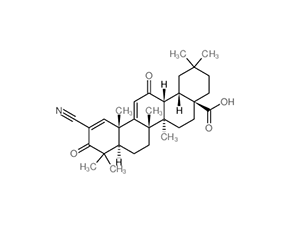
Bardoxolone
CAS No. 218600-44-3
Bardoxolone( CDDO | RTA 401 | RTA-401 | RTA401 | Bardoxolone )
Catalog No. M17438 CAS No. 218600-44-3
CDDO is a synthetic oleanane triterpenoid that blocks the cellular synthesis of inducible nitric oxide synthase and inducible COX-2 in INF-γ-activated mouse macrophages with an IC50 value of 0.4 nM.
Purity : >98% (HPLC)
 COA
Datasheet
HNMR
HPLC
MSDS
Handing Instructions
COA
Datasheet
HNMR
HPLC
MSDS
Handing Instructions
| Size | Price / USD | Stock | Quantity |
| 1 mL x 10 mM in DMSO | 70 | In Stock |


|
| 5MG | 65 | In Stock |
|
| 10MG | 88 | In Stock |
|
| 25MG | 106 | In Stock |
|
| 50MG | 125 | In Stock |
|
| 100MG | 230 | In Stock |
|
| 200MG | Get Quote | In Stock |
|
| 500MG | Get Quote | In Stock |
|
| 1G | Get Quote | In Stock |
|
Biological Information
-
Product NameBardoxolone
-
NoteResearch use only, not for human use.
-
Brief DescriptionCDDO is a synthetic oleanane triterpenoid that blocks the cellular synthesis of inducible nitric oxide synthase and inducible COX-2 in INF-γ-activated mouse macrophages with an IC50 value of 0.4 nM.
-
DescriptionCDDO is a synthetic oleanane triterpenoid that blocks the cellular synthesis of inducible nitric oxide synthase and inducible COX-2 in INF-γ-activated mouse macrophages with an IC50 value of 0.4 nM. By suppressing reactive oxygen and nitrogen species (ROS/RNS) formation, it promotes the cellular control of ROS/RNS levels that would lead to DNA damage associated with tumorigenesis. In various Y cell lines, CDDO has been shown to specifically inhibit proliferation and induce apoptosis. Mechanism studies revealed that CDDO is a ligand for peroxisome proliferator-activated receptor γ, and also that it induces genes regulated by Nrf2, including heme oxygenase-1 and eotaxin-1, which play a role in antioxidant response element signaling activity.(In Vitro):Bardoxolone methyl, a novel synthetic triterpenoid and antioxidant inflammation modulator, potently induces Nrf2 and inhibits NF-κB and Janus-activated kinase/STAT signaling. Bardoxolone methyl has been shown to induce differentiation, inhibit proliferation, and induce apoptosis in cancer cell lines.(In Vivo):Kidney sections from Bardoxolone methyl-treated monkeys demonstrates decreased megalin protein expression despite similar mRNA expression across groups. The visualized decrease in megalin protein expression is confirmed by densitometry analyses, which demonstrated that Bardoxolone methyl administration significantly decreased megalin protein expression in the monkey kidney. Bardoxolone methyl administration does not affect the protein expression of cubilin in the kidney or the mRNA expression of cubilin in the kidney. The creatinine clearance in monkeys administered Bardoxolone methyl significantly differed from that at baseline and in vehicle-treated animals on day 28. After 28 days of Bardoxolone methyl administration, urinary albumin-to-creatinine ratios (UACRs), determined from the 24-hour urine collections, are significantly increased compared with those in animals receiving vehicle. Of note, UACRs decreases 53.3% in vehicle-treated animals and increased 27.9% in Bardoxolone methyl-treated monkeys. Male C57BL/6J mice are administered oral BARD during HFD feeding (HFD/BARD), only fed a high-fat diet (HFD), or fed low-fat diet (LFD) for 21 weeks. Compared with LFD mice, HFD mice have a marked increase in the number of F4/80 crown-like structures (+95%; p<0.001), which is effectively prevented by BARD ( 50%; p<0.01). Similarly, the number of F4/80 interstitial macrophages is significantly higher in HFD mice by 98% (p<0.001) compared with LFD mice and by 32% (p<0.01) compared with HFD/BARD mice.
-
In Vitro——
-
In Vivo——
-
SynonymsCDDO | RTA 401 | RTA-401 | RTA401 | Bardoxolone
-
PathwayCell Cycle/DNA Damage
-
TargetWee1
-
RecptorNrf2
-
Research AreaInflammation/Immunology
-
Indication——
Chemical Information
-
CAS Number218600-44-3
-
Formula Weight491.7
-
Molecular FormulaC31H41NO4
-
Purity>98% (HPLC)
-
SolubilityDMSO : 100 mg/mL 203.39 mM;
-
SMILESC[C@@]12CC[C@]3(CCC(C[C@H]3[C@H]1C(=O)C=C1[C@]2(CC[C@@H]2[C@@]1(C=C(C(=O)C2(C)C)C#N)C)C)(C)C)C(=O)O
-
Chemical Name(4aS,6aR,6bS,8aR,12aS,14aR,14bS)-11-cyano-2,2,6a,6b,9,9,12a-heptamethyl-10,14-dioxo-1,3,4,5,6,6a,6b,7,8,8a,9,10,12a,14,14a,14b-hexadecahydropicene-4a(2H)-carboxylic acid
Shipping & Storage Information
-
Storage(-20℃)
-
ShippingWith Ice Pack
-
Stability≥ 2 years
Reference
1. Reisman SA, et al. J Am Soc Nephrol. 2012 Oct;23(10):1663-73.
molnova catalog



related products
-
JUN76288
JUN76288 is a potent Wee1 kinase inhibitor with an IC50 of <10 nM. It?treatment of cancer and other proliferative diseases.
-
Debio-0123
Debio-0123 (WEE1-IN-5) is a potent, orally available and highly specific WEE1 inhibitor with an IC 50 in the low nanomolar range.
-
ZN-c3
ZN-c3 is a potent and selective Wee1 inhibitor with balanced potency, ADME, and pharmacokinetic properties.
