


 Cart
Cart
 sales@molnova.com



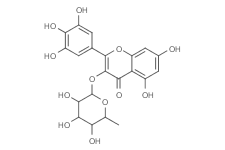
Myricetrin
CAS No. 17912-87-7
Myricetrin( Myricetrin | Myricitrine | Myricitroside )
Catalog No. M17378 CAS No. 17912-87-7
Myricitrin, a flavonoid compound isolated from the root bark of Myrica cerifera, exerts antinociceptive effects.
Purity : >98% (HPLC)
 COA
Datasheet
HNMR
HPLC
MSDS
Handing Instructions
COA
Datasheet
HNMR
HPLC
MSDS
Handing Instructions
| Size | Price / USD | Stock | Quantity |
| 1 mL x 10 mM in DMSO | 48 | In Stock |


|
| 2MG | 49 | In Stock |
|
| 5MG | 81 | In Stock |
|
| 10MG | 129 | In Stock |
|
| 25MG | 241 | In Stock |
|
| 50MG | 366 | In Stock |
|
| 100MG | Get Quote | In Stock |
|
| 200MG | Get Quote | In Stock |
|
| 500MG | Get Quote | In Stock |
|
| 1G | Get Quote | In Stock |
|
Biological Information
-
Product NameMyricetrin
-
NoteResearch use only, not for human use.
-
Brief DescriptionMyricitrin, a flavonoid compound isolated from the root bark of Myrica cerifera, exerts antinociceptive effects.
-
DescriptionMyricetrin is a flavonoid that has been found in C. menyharthii leaf extracts and has diverse biological activities.
-
In Vitro——
-
In Vivo——
-
SynonymsMyricetrin | Myricitrine | Myricitroside
-
PathwayCell Cycle/DNA Damage
-
TargetDNA/RNA Synthesis
-
RecptorPKCα| PKCε
-
Research AreaOthers-Field
-
Indication——
Chemical Information
-
CAS Number17912-87-7
-
Formula Weight464.38
-
Molecular FormulaC21H20O12
-
Purity>98% (HPLC)
-
SolubilityIn Vitro:?DMSO : 100 mg/mL (215.34 mM)
-
SMILESC[C@H]1[C@@H]([C@H]([C@H]([C@@H](O1)Oc1c(=O)c2c(cc(cc2oc1c1cc(c(c(c1)O)O)O)O)O)O)O)O
-
Chemical Name3-[(6-deoxy-α-L-mannopyranosyl)oxy]-5,7-dihydroxy-2-(3,4,5-trihydroxyphenyl)-4H-1-benzopyran-4-one
Shipping & Storage Information
-
Storage(-20℃)
-
ShippingWith Ice Pack
-
Stability≥ 2 years
Reference
1. Meotti FC, et al. J Pharmacol Exp Ther, 2006, 316(2), 789-796.
molnova catalog



related products
-
2’-Deoxy-2’-fluoro-β...
2’-Deoxy-2’-fluoro-β-D-arabinocytidine hydrochloride is a cytosine nucleoside analog with inhibitory effects on DNA methyltransferase , with potential antimetabolic and antitumor activity.
-
UNC6852
UNC6852 contains an EED ligand (IC50 = 247 nM) and a von Hippel-Lindau ligand and is a selective polycomb repressive complex 2 (PRC2) degrader based on PROTAC.
-
CKK-E12
CKK-E12 is a selective ionizable lipid that often binds to other lipids to form carrier mRNA lipid nanoparticles.CKK-E12 is used in the study of RNA-related diseases.
