


 Cart
Cart
 sales@molnova.com



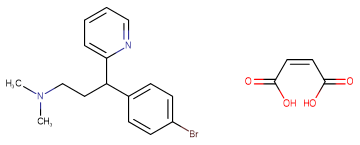
Brompheniramine hydrogen maleate
CAS No. 980-71-2
Brompheniramine hydrogen maleate( (±)-Brompheniramine )
Catalog No. M16888 CAS No. 980-71-2
Brompheniramine maleate is a histamine H1 receptors antagonist.
Purity : >98% (HPLC)
 COA
Datasheet
HNMR
HPLC
MSDS
Handing Instructions
COA
Datasheet
HNMR
HPLC
MSDS
Handing Instructions
| Size | Price / USD | Stock | Quantity |
| 1 mL x 10 mM in DMSO | 30 | In Stock |


|
| 25MG | 28 | In Stock |
|
| 50MG | 34 | In Stock |
|
| 100MG | 45 | In Stock |
|
| 200MG | 83 | In Stock |
|
| 500MG | 141 | In Stock |
|
| 1G | Get Quote | In Stock |
|
Biological Information
-
Product NameBrompheniramine hydrogen maleate
-
NoteResearch use only, not for human use.
-
Brief DescriptionBrompheniramine maleate is a histamine H1 receptors antagonist.
-
DescriptionBrompheniramine maleate is a histamine H1 receptors antagonist. (In Vitro):Brompheniramine (0.1-100 μM) blocks hERG K+ channels expressed in CHO cells in a concentration-dependent manner with an IC50 of 0.90±0.14 μM, and reduced peak tail current amplitude measured at -60 mV (cells are depolarized for 2 s to +20 mV from a holding potential of -80 mV followed by a 3s repolarization back to -60 mV).Brompheniramine (1, 10 and 100 μM) significantly shortens the APD50 and depresses the plateau phase on the action potential in guinea pig papillary muscle, as well as slightly prolongs the APD90 in guinea pig papillary muscle at 10 and 100 μM.Brompheniramine (0.1-100 μM) inhibit the amplitude of the Ca2+ channel currents in rat ventricular myocytes by 14.1±1.1, 31.1±5.8, 38.0±3.8 and 90.2±3.7% at 0.1, 1, 10 and 100 μM, respectively.Brompheniramine blocks muscarinic cholinergic receptors in human chinese hamster ovary (CHO) cells.(In Vivo):Brompheniramine (0.3-3 μM; SC, single dosage) induces cutaneous analgesia in rats.
-
In VitroBrompheniramine (0.1-100 μM) blocks hERG K+ channels expressed in CHO cells in a concentration-dependent manner with an IC50 of 0.90±0.14 μM, and reduced peak tail current amplitude measured at -60 mV (cells are depolarized for 2 s to +20 mV from a holding potential of -80 mV followed by a 3s repolarization back to -60 mV).Brompheniramine (1, 10 and 100 μM) significantly shortens the APD50 and depresses the plateau phase on the action potential in guinea pig papillary muscle, as well as slightly prolongs the APD90 in guinea pig papillary muscle at 10 and 100 μM.Brompheniramine (0.1-100 μM) inhibit the amplitude of the Ca2+ channel currents in rat ventricular myocytes by 14.1±1.1, 31.1±5.8, 38.0±3.8 and 90.2±3.7% at 0.1, 1, 10 and 100 μM, respectively.Brompheniramine blocks muscarinic cholinergic receptors in human chinese hamster ovary (CHO) cells.
-
In VivoBrompheniramine (0.3-3?μM; SC, single dosage) induces cutaneous analgesia in rats. Animal Model:Male Sprague-Dawley rats Dosage:0.3, 0.6, 1.1, 1.5 and 3.0 ?μM Administration:SC, single dosage Result:Provoked cutaneous analgesia in a dose-dependent manner, with an EC50 value of 0.66 μM, and induced prolonged analgesic duration.
-
Synonyms(±)-Brompheniramine
-
PathwayEndocrinology/Hormones
-
Target5-HT Receptor
-
RecptorHT
-
Research AreaInflammation/Immunology
-
Indication——
Chemical Information
-
CAS Number980-71-2
-
Formula Weight435.31
-
Molecular FormulaC16H19BrN2·C4H4O4
-
Purity>98% (HPLC)
-
SolubilityEthanol: 18 mg/mL (41.34 mM); Water: 46 mg/mL warmed (105.67 mM); DMSO: 87 mg/mL (199.85 mM)
-
SMILESCN(C)CCC(C1=CC=C(C=C1)Br)C2=CC=CC=N2.C(=C\C(=O)O)\C(=O)O
-
Chemical Name——
Shipping & Storage Information
-
Storage(-20℃)
-
ShippingWith Ice Pack
-
Stability≥ 2 years
Reference
1.Tardioli S, et al. J Phys Chem B. 2012 Jun 21;116(24):7033-9.
molnova catalog



related products
-
SB 258719
SB 258719 is a selective antagonist of 5-HT7 receptor with pKi of 7.5.
-
Metadoxine
It is neurotransmitter stimulants.
-
Incensole
Incensole has a protective or stimulating effect on β-cells of the rat pancreas, it also can increase the insulin secretion, which evidenced by a significant increase both in body weight and in liver glycogen.
