


 Cart
Cart
 sales@molnova.com



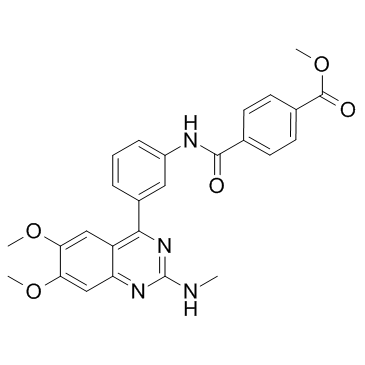
Lotamilast
CAS No. 947620-48-6
Lotamilast( RVT 501 | E6005 )
Catalog No. M16789 CAS No. 947620-48-6
Lotamilast (RVT 501, E6005) is a potent, selective PDE4 inhibitor with IC50 of 2.8 nM, suppresses the production of various cytokines from human lymphocytes and monocytes with IC50 of 0.49-3.1 nM.
Purity : >98% (HPLC)
 COA
Datasheet
HNMR
HPLC
MSDS
Handing Instructions
COA
Datasheet
HNMR
HPLC
MSDS
Handing Instructions
| Size | Price / USD | Stock | Quantity |
| 1 mL x 10 mM in DMSO | 51 | In Stock |


|
| 2MG | 31 | In Stock |
|
| 5MG | 49 | In Stock |
|
| 10MG | 75 | In Stock |
|
| 25MG | 150 | In Stock |
|
| 50MG | 222 | In Stock |
|
| 100MG | 338 | In Stock |
|
| 200MG | Get Quote | In Stock |
|
| 500MG | Get Quote | In Stock |
|
| 1G | Get Quote | In Stock |
|
Biological Information
-
Product NameLotamilast
-
NoteResearch use only, not for human use.
-
Brief DescriptionLotamilast (RVT 501, E6005) is a potent, selective PDE4 inhibitor with IC50 of 2.8 nM, suppresses the production of various cytokines from human lymphocytes and monocytes with IC50 of 0.49-3.1 nM.
-
DescriptionLotamilast (RVT 501, E6005) is a potent, selective PDE4 inhibitor with IC50 of 2.8 nM, suppresses the production of various cytokines from human lymphocytes and monocytes with IC50 of 0.49-3.1 nM; produces an immediate antipruritic effect as well as an anti-inflammatory effect with reduced expression of cytokines/adhesion molecules in mice after topical application; ameliorates the appearance of atopic dermatitis-like skin lesions in AD models.Dermatitis Phase 2 Clinical(In Vitro):Lotamilast potently and selectively inhibits human PDE4 activity with an IC50 of 2.8 nM and suppresses the production of various cytokines from human lymphocytes and monocytes with IC50 values ranging from 0.49 to 3.1 nM.(In Vivo):Lotamilast is currently in phase 2 development for patients with mild-to-moderate atopic dermatitis. In mice models, the topical application of Lotamilast produces an immediate antipruritic effect as well as an anti-inflammatory effect with reduced expression of cytokines/adhesion molecules. On the basis of these observed effects, topical RVT-501 ameliorates the appearance of atopic dermatitis-like skin lesions in two types of AD models, hapten- and mite-elicited models, exhibiting inhibitory effects comparable to that of tacrolimus. A single topical application of Lotamilast significantly inhibits spontaneous scratching during 1–2 h after application in mice with chronic dermatitis; the inhibition is partial and similar between 0.01% and 0.03%. Topical application of 0.03% Lotamilast to the rostral back significantly inhibits the increased activity of the cutaneous nerve in mice with chronic dermatitis. The cutaneous concentration of cAMP is significantly decreased in mice with chronic dermatitis, and this decrease is reversed by topical Lotamilast application.
-
In VitroLotamilast potently and selectively inhibits human PDE4 activity with an IC50 of 2.8 nM and suppresses the production of various cytokines from human lymphocytes and monocytes with IC50 values ranging from 0.49 to 3.1 nM.
-
In VivoLotamilast is currently in phase 2 development for patients with mild-to-moderate atopic dermatitis. In mice models, the topical application of Lotamilast produces an immediate antipruritic effect as well as an anti-inflammatory effect with reduced expression of cytokines/adhesion molecules. On the basis of these observed effects, topical RVT-501 ameliorates the appearance of atopic dermatitis-like skin lesions in two types of AD models, hapten- and mite-elicited models, exhibiting inhibitory effects comparable to that of tacrolimus. A single topical application of Lotamilast significantly inhibits spontaneous scratching during 1–2 h after application in mice with chronic dermatitis; the inhibition is partial and similar between 0.01% and 0.03%. Topical application of 0.03% Lotamilast to the rostral back significantly inhibits the increased activity of the cutaneous nerve in mice with chronic dermatitis. The cutaneous concentration of cAMP is significantly decreased in mice with chronic dermatitis, and this decrease is reversed by topical Lotamilast application.
-
SynonymsRVT 501 | E6005
-
PathwayAngiogenesis
-
TargetPDE
-
RecptorPDE4|PDE-4
-
Research AreaInflammation/Immunology
-
IndicationDermatitis
Chemical Information
-
CAS Number947620-48-6
-
Formula Weight472.501
-
Molecular FormulaC26H24N4O5
-
Purity>98% (HPLC)
-
Solubility< 1 mg/ml refers to the product slightly soluble or insoluble
-
SMILESO=C(OC)C1=CC=C(C(NC2=CC=CC(C3=C4C=C(OC)C(OC)=CC4=NC(NC)=N3)=C2)=O)C=C1
-
Chemical Namemethyl 4-({3-[6,7-dimethoxy-2-(methylamino)quinazolin-4-yl]phenyl}carbamoyl)benzoate
Shipping & Storage Information
-
Storage(-20℃)
-
ShippingWith Ice Pack
-
Stability≥ 2 years
Reference
1. Ishii N, et al. J Pharmacol Exp Ther. 2013 Jul;346(1):105-12.
2. Andoh T, et al. Exp Dermatol. 2014 May;23(5):359-61.
3. Kubota S, et al. Eur J Pharmacol. 2015 Dec 5;768:41-8.
4. Furue M, et al. Expert Opin Investig Drugs. 2017 Dec;26(12):1403-1408.
molnova catalog



related products
-
Lirimilast
Lirimilast (BAY 19-8004;BAY 198004) is a potent and selective PDE4 inhibitor for the treatment of COPD.
-
Vardenafil
Vardenafil (Levitra) is an oral therapy for the treatment of erectile dysfunction.
-
Rolipram
A potent, selective inhibitor of phosphodiesterases PDE4 with IC50 of 3 nM, 130 nM and 240 nM for PDE4A, PDE4B, and PDE4D, respectively.
