


 Cart
Cart
 sales@molnova.com



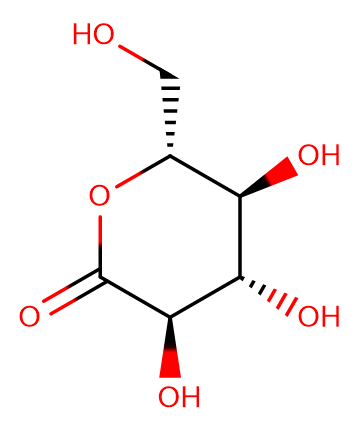
Delta-Gluconolactone
CAS No. 90-80-2
Delta-Gluconolactone( —— )
Catalog No. M16523 CAS No. 90-80-2
Gluconolactone is a naturally-occurring food additive used as a sequestrant, an acidifier, or a curing, pickling, or leavening agent.
Purity : >98% (HPLC)
 COA
Datasheet
HNMR
HPLC
MSDS
Handing Instructions
COA
Datasheet
HNMR
HPLC
MSDS
Handing Instructions
| Size | Price / USD | Stock | Quantity |
| 1 mL x 10 mM in DMSO | 28 | In Stock |


|
| 100MG | Get Quote | In Stock |
|
| 200MG | Get Quote | In Stock |
|
| 500MG | 45 | In Stock |
|
| 1G | Get Quote | In Stock |
|
Biological Information
-
Product NameDelta-Gluconolactone
-
NoteResearch use only, not for human use.
-
Brief DescriptionGluconolactone is a naturally-occurring food additive used as a sequestrant, an acidifier, or a curing, pickling, or leavening agent.
-
DescriptionGluconolactone is a naturally-occurring food additive used as a sequestrant, an acidifier, or a curing, pickling, or leavening agent. It is a cyclic ester of D-gluconic acid. Pure gluconolactone is a white odorless crystalline powder. (In Vitro):D-(+)-Glucono-1,5-lactone is a lactone (cyclic ester) of D-gluconic acid. D-(+)-Glucono-1,5-lactone is commonly found in honey, fruit juices, personal lubricants, and wine. D-(+)-Glucono-1,5-lactone is neutral, but hydrolyses in water to gluconic acid which is acidic, adding a tangy taste to foods, though it has roughly a third of the sourness of citric acid. It is metabolized to glucose; one gram of D-(+)-Glucono-1,5-lactone yields roughly the same amount of metabolicenergy as one gram of sugar. Upon addition to water, GDL is partially hydrolysed to gluconic acid, with the balance between the lactone form and the acid form established as a chemical equilibrium. The rate of hydrolysis of D-(+)-Glucono-1,5-lactone is increased by heat and high pH.
-
In VitroD-(+)-Glucono-1,5-lactone is a lactone (cyclic ester) of D-gluconic acid. D-(+)-Glucono-1,5-lactone is commonly found in honey, fruit juices, personal lubricants, and wine. D-(+)-Glucono-1,5-lactone is neutral, but hydrolyses in water to gluconic acid which is acidic, adding a tangy taste to foods, though it has roughly a third of the sourness of citric acid. It is metabolized to glucose; one gram of D-(+)-Glucono-1,5-lactone yields roughly the same amount of metabolicenergy as one gram of sugar. Upon addition to water, GDL is partially hydrolysed to gluconic acid, with the balance between the lactone form and the acid form established as a chemical equilibrium. The rate of hydrolysis of D-(+)-Glucono-1,5-lactone is increased by heat and high pH.
-
In Vivo——
-
Synonyms——
-
PathwayOthers
-
TargetOther Targets
-
RecptorLPH
-
Research Area——
-
Indication——
Chemical Information
-
CAS Number90-80-2
-
Formula Weight178.14
-
Molecular FormulaC6H10O6
-
Purity>98% (HPLC)
-
SolubilityDMSO: 10 mM
-
SMILESC([C@@H]1[C@H]([C@@H]([C@H](C(=O)O1)O)O)O)O
-
Chemical Name——
Shipping & Storage Information
-
Storage(-20℃)
-
ShippingWith Ice Pack
-
Stability≥ 2 years
Reference
1.Pocker Y, Green E. J Am Chem Soc. 1973 Jan 10;95(1):113-9.
molnova catalog



related products
-
Guaiacin
(+)-Guaiacin has significant neuroprotective, and anti-inflammatory activities, it can inhibit cyclooxygenase (COX)-1 and COX-2.
-
α1 adrenoceptor-MO-1
α1 adrenoceptor-MO-1 (S enantiomer) has affinity at alpha 1 adrenergic receptor with alphalytic activity and analgesic action. It has more active than R enantiomer.
-
Methyl piperate
The fruits of Piper nigrum L.
