


 Cart
Cart
 sales@molnova.com



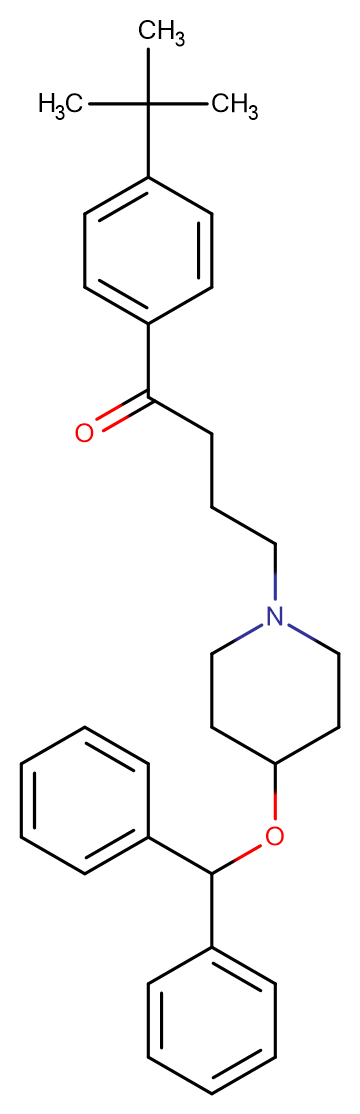
Ebastine
CAS No. 90729-43-4
Ebastine( LAS-W 090 | RP 64305 )
Catalog No. M16520 CAS No. 90729-43-4
Ebastine is a potent H1-histamine receptor antagonist, used for allergic disorders.
Purity : >98% (HPLC)
 COA
Datasheet
HNMR
HPLC
MSDS
Handing Instructions
COA
Datasheet
HNMR
HPLC
MSDS
Handing Instructions
| Size | Price / USD | Stock | Quantity |
| 1 mL x 10 mM in DMSO | 49 | In Stock |


|
| 100MG | Get Quote | In Stock |
|
| 200MG | Get Quote | In Stock |
|
| 500MG | 44 | In Stock |
|
| 1G | Get Quote | In Stock |
|
Biological Information
-
Product NameEbastine
-
NoteResearch use only, not for human use.
-
Brief DescriptionEbastine is a potent H1-histamine receptor antagonist, used for allergic disorders.
-
DescriptionEbastine is a potent H1-histamine receptor antagonist, used for allergic disorders.(In Vitro):Ebastine (10-500 ng/mL; 24-48 hours) treatment significantly increases the proliferation of HFDPC.Ebastine (10-500 ng/mL; 24-48 hours) treatment shows dose-dependent increases in Cyclin D1, Cyclin E1, and Cyclin A expression levels. And the expression levels of Cdk4, Cdk2, and Cdc2 are alos increased. Ebastine treatment elevates expression levels of phospho-AKT and phospho-p44/42 extracellular signal-regulated kinase. (In Vivo):In rats, after intravenous administration of [14C]Ebastine at 2 mg/kg, the plasma level of radioactivity decreased biphasically with α-phase half-life (t1/2 α) of 1.6 h and β-phase half-life (t1/2 β) of 3.1 h.Following oral administration of [14C]Ebastine at a dose of 2 mg/kg, the plasma level reached the maximum (Cmax) of 102 ng eq./ml at 2 h and decreased monophasically with t1/2 of 3.9 h. At 20 mg/kg, a monophasic decrease is also observed with Cmax of 1110 ng eq./ml at 4 h and with t1/2 of 4.0 h.
-
In VitroEbastine (10-500 ng/mL; 24-48 hours) treatment significantly increases the proliferation of HFDPC.Ebastine (10-500 ng/mL; 24-48 hours) treatment shows dose-dependent increases in Cyclin D1, Cyclin E1, and Cyclin A expression levels. And the expression levels of Cdk4, Cdk2, and Cdc2 are alos increased. Ebastine treatment elevates expression levels of phospho-AKT and phospho-p44/42 extracellular signal-regulated kinase. Cell Proliferation Assay Cell Line:Human follicle dermal papilla cells (HFDPC)Concentration:10 ng/mL, 50 ng/mL, 100 ng/mL, 200 ng/mL, 500 ng/mL Incubation Time:24 hours, 48 hours Result:The proliferative activity in cells was significantly enhanced.Western Blot Analysis Cell Line:Human follicle dermal papilla cells (HFDPC)Concentration:10 ng/mL, 50 ng/mL, 100 ng/mL, 200 ng/mL, 500 ng/mL.Incubation Time:24 hours Result:The expression levels of cell-cycle regulatory proteins and an antiapoptotic protein were increased in HFDPC.
-
In VivoIn rats, after intravenous administration of [14C]Ebastine at 2 mg/kg, the plasma level of radioactivity decreased biphasically with α-phase half-life (t1/2 α) of 1.6 h and β-phase half-life (t1/2 β) of 3.1 h. Following oral administration of [14C]Ebastine at a dose of 2 mg/kg, the plasma level reached the maximum (Cmax) of 102 ng eq./ml at 2 h and decreased monophasically with t1/2 of 3.9 h. At 20 mg/kg, a monophasic decrease is also observed with Cmax of 1110 ng eq./ml at 4 h and with t1/2 of 4.0 h.
-
SynonymsLAS-W 090 | RP 64305
-
PathwayGPCR/G Protein
-
TargetHistamine Receptor
-
RecptorH1 receptor
-
Research AreaInflammation/Immunology
-
Indication——
Chemical Information
-
CAS Number90729-43-4
-
Formula Weight469.66
-
Molecular FormulaC32H39NO2
-
Purity>98% (HPLC)
-
SolubilityEthanol: 11 mg/mL (23.42 mM); DMSO: 2 mg/mL (4.25 mM)
-
SMILESO=C(CCCN1CCC(OC(C2=CC=CC=C2)C3=CC=CC=C3)CC1)C4=CC=C(C(C)(C)C)C=C4
-
Chemical Name4-(4-(benzhydryloxy)piperidin-1-yl)-1-(4-(tert-butyl)phenyl)butan-1-one
Shipping & Storage Information
-
Storage(-20℃)
-
ShippingWith Ice Pack
-
Stability≥ 2 years
Reference
1.Ko CM, et al. J Pharmacol Exp Ther, 1997, 281(1), 233-244.
molnova catalog



related products
-
Hydroxyzine dihydroc...
Hydroxyzine Dihydrochloride is a histamine H1-receptor antagonist.
-
Amodiaquine hydrochl...
A 4-aminoquinoline compound with anti-inflammatory properties.
-
ReN-1869
ReN-1869 is a novel selective histamine H(1) receptor antagonist with anti-neurogenic pain and anti-inflammatory activity for the study of neurological diseases.
