


 Cart
Cart
 sales@molnova.com



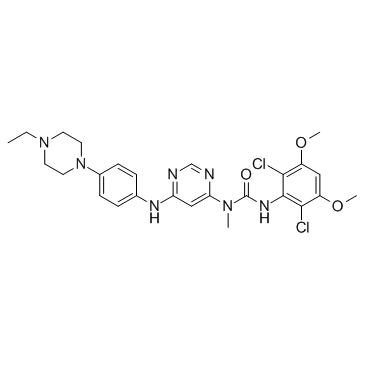
Infigratinib
CAS No. 872511-34-7
Infigratinib( NVP-BGJ398 | BGJ-398 | BGJ398 )
Catalog No. M16344 CAS No. 872511-34-7
Infigratinib (NVP-BGJ398, BGJ398) is a potent, selective pan-FGFR inhibitor.
Purity : >98% (HPLC)
 COA
Datasheet
HNMR
HPLC
MSDS
Handing Instructions
COA
Datasheet
HNMR
HPLC
MSDS
Handing Instructions
| Size | Price / USD | Stock | Quantity |
| 1 mL x 10 mM in DMSO | 41 | In Stock |


|
| 5MG | 37 | In Stock |
|
| 10MG | 52 | In Stock |
|
| 25MG | 77 | In Stock |
|
| 50MG | 90 | In Stock |
|
| 100MG | 144 | In Stock |
|
| 200MG | 268 | In Stock |
|
| 500MG | 451 | In Stock |
|
| 1G | Get Quote | In Stock |
|
Biological Information
-
Product NameInfigratinib
-
NoteResearch use only, not for human use.
-
Brief DescriptionInfigratinib (NVP-BGJ398, BGJ398) is a potent, selective pan-FGFR inhibitor.
-
DescriptionInfigratinib (NVP-BGJ398, BGJ398) is a potent, selective pan-FGFR inhibitor with IC50 of 0.9/1.0/1.4/60 nM for FGFR1/2/3/4, also shows high potenct against mutant FGFR3-K650E with IC50 of 4.9 nM; inhibits the proliferation of the FGFR1-, FGFR2-, and FGFR3-dependent BaF3 cells with IC50 of low nanomolar range; shows significant antitumor activity in RT112 bladder cancer xenografts models overexpressing wild-type FGFR3, significantly inhibits the growth of FGFR2-mutated endometrial cancer xenograft models, also ameliorates FGF23-mediated hypophosphatemic rickets in mouse models.Blood Cancer Phase 2 Clinical(In Vitro):Infigratinib (BGJ-398) inhibits FGFR1, FGFR2, and FGFR3 with IC50=~1 nM, FGFR3K650E with IC50=4.9 nM, and FGFR4 with IC50=60 nM. IC50 values for all other kinases are in the μM range (FYN, LCK, YES, and ABL, IC50=1.9, 2.5, 1.1, and 2.3 μM, respectively) except for VEGFR2, KIT, and LYN, which are inhibited at submicromolar concentrations (IC50=0.18, 0.75, and 0.3 μM, respectively).Infigratinib (BGJ-398) inhibits the proliferation of the FGFR1-, FGFR2-, and FGFR3-dependent BaF3 cells with IC50 values which are in the low nanomolar range and comparable to those observed for the inhibition of the receptors kinase activity in the enzymatic assay.For the remaining cells, all IC50 values are greater than 1.5 μM except for VEGFR2 (IC50 1449 and 938 nM), for which there is at least a 400-fold selectivity versus FGFR1, FGFR2, and FGFR3.Infigratinib (BGJ-398) (ranging between 1 nM and 10 μM) is potent at inhibiting cell growth of FGFR2-mutant endometrial cancer cells. (In Vivo):Infigratinib (BGJ-398) is administered to athymic nude mice implanted subcutaneously with RT112/luc1 tumors: either as a 5 mg/kg intravenous bolus in NMP/PEG200 (1:9, v/v) or orally by gavage as a suspension in PEG300/D5W (2:1, v/v) at a 20 mg/kg dose.The relevant pharmacokinetic (PK) parameters indicate that the oral bioavailability of Infigratinib (BGJ-398) in this study is 32%. After intravenous dosing, Infigratinib (BGJ-398) shows a rapid distribution from the vascular compartment into the peripheral tissues, translating into a high volume of distribution (26 L/kg). The plasma clearance is high at 3.3 L/h/kg (61% of liver blood flow). The ratio of tumor to plasma after oral dosing based on AUC is determined to be 10.Infigratinib (BGJ-398) (30 mg/kg) significantly inhibits the growth of FGFR2-mutated endometrial cancer xenograft models.
-
In VitroInfigratinib (BGJ-398) inhibits FGFR1, FGFR2, and FGFR3 with IC50=~1 nM, FGFR3K650E with IC50=4.9 nM, and FGFR4 with IC50=60 nM. IC50 values for all other kinases are in the μM range (FYN, LCK, YES, and ABL, IC50=1.9, 2.5, 1.1, and 2.3 μM, respectively) except for VEGFR2, KIT, and LYN, which are inhibited at submicromolar concentrations (IC50=0.18, 0.75, and 0.3 μM, respectively).Infigratinib (BGJ-398) inhibits the proliferation of the FGFR1-, FGFR2-, and FGFR3-dependent BaF3 cells with IC50 values which are in the low nanomolar range and comparable to those observed for the inhibition of the receptors kinase activity in the enzymatic assay.For the remaining cells, all IC50 values are greater than 1.5 μM except for VEGFR2 (IC50 1449 and 938 nM), for which there is at least a 400-fold selectivity versus FGFR1, FGFR2, and FGFR3.Infigratinib (BGJ-398) (ranging between 1 nM and 10 μM) is potent at inhibiting cell growth of FGFR2-mutant endometrial cancer cells.
-
In VivoInfigratinib (BGJ-398) is administered to athymic nude mice implanted subcutaneously with RT112/luc1 tumors: either as a 5 mg/kg intravenous bolus in NMP/PEG200 (1:9, v/v) or orally by gavage as a suspension in PEG300/D5W (2:1, v/v) at a 20 mg/kg dose.The relevant pharmacokinetic (PK) parameters indicate that the oral bioavailability of Infigratinib (BGJ-398) in this study is 32%. After intravenous dosing, Infigratinib (BGJ-398) shows a rapid distribution from the vascular compartment into the peripheral tissues, translating into a high volume of distribution (26 L/kg). The plasma clearance is high at 3.3 L/h/kg (61% of liver blood flow). The ratio of tumor to plasma after oral dosing based on AUC is determined to be 10. Infigratinib (BGJ-398) (30 mg/kg) significantly inhibits the growth of FGFR2-mutated endometrial cancer xenograft models.
-
SynonymsNVP-BGJ398 | BGJ-398 | BGJ398
-
PathwayAngiogenesis
-
TargetFGFR
-
RecptorFGFR1|FGFR2|FGFR3|FGFR3(K650E)|FGFR4
-
Research AreaCancer
-
IndicationBlood cancer
Chemical Information
-
CAS Number872511-34-7
-
Formula Weight560.5
-
Molecular FormulaC26H31Cl2N7O3
-
Purity>98% (HPLC)
-
SolubilityDMSO: 27 mg/mL
-
SMILESCCN1CCN(CC1)C1=CC=C(NC2=CC(=NC=N2)N(C)C(=O)NC2=C(Cl)C(OC)=CC(OC)=C2Cl)C=C1
-
Chemical NameUrea, N'-(2,6-dichloro-3,5-dimethoxyphenyl)-N-[6-[[4-(4-ethyl-1-piperazinyl)phenyl]amino]-4-pyrimidinyl]-N-methyl-
Shipping & Storage Information
-
Storage(-20℃)
-
ShippingWith Ice Pack
-
Stability≥ 2 years
Reference
1. Guagnano V, et al. J Med Chem. 2011 Oct 27;54(20):7066-83.
2. Guagnano V, et al. Cancer Discov. 2012 Dec;2(12):1118-33.
3. Konecny GE, et al. Mol Cancer Ther. 2013 May;12(5):632-42.
molnova catalog



related products
-
SKLB 610
SKLB610, a novel multi-targeted inhibitor, inhibits angiogenesis-related tyrosine kinase VEGFR2, FGFR2 and PDGFR.
-
EBE-A22
EBE-A22 is a derivative of PD 153035 which can inhibit ErbB-1-phosphorylation, whereas EBE-A22 is inactive.
-
FGFR4-IN-1
FGFR4-IN-1 is a potent FGFR4 inhibitor (IC50: 0.7 nM).
