


 Cart
Cart
 sales@molnova.com



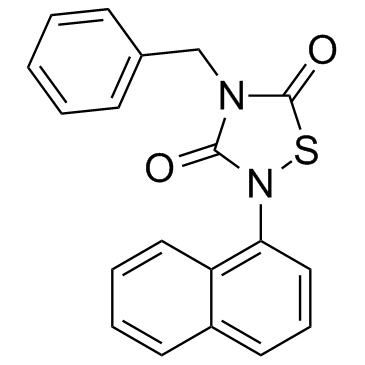
Tideglusib
CAS No. 865854-05-3
Tideglusib( NP031112 )
Catalog No. M16292 CAS No. 865854-05-3
Tideglusib is an irreversible, non ATP-competitive GSK-3β inhibitor with IC50 of 60 nM in a cell-free assay.
Purity : >98% (HPLC)
 COA
Datasheet
HNMR
HPLC
MSDS
Handing Instructions
COA
Datasheet
HNMR
HPLC
MSDS
Handing Instructions
| Size | Price / USD | Stock | Quantity |
| 1 mL x 10 mM in DMSO | 41 | In Stock |


|
| 10MG | 37 | In Stock |
|
| 25MG | 67 | In Stock |
|
| 50MG | 107 | In Stock |
|
| 100MG | 183 | In Stock |
|
| 200MG | 276 | In Stock |
|
| 500MG | 480 | In Stock |
|
| 1G | Get Quote | In Stock |
|
Biological Information
-
Product NameTideglusib
-
NoteResearch use only, not for human use.
-
Brief DescriptionTideglusib is an irreversible, non ATP-competitive GSK-3β inhibitor with IC50 of 60 nM in a cell-free assay.
-
DescriptionTideglusib is an irreversible, non ATP-competitive GSK-3β inhibitor with IC50 of 60 nM in a cell-free assay; fails to inhibit kinases with a Cys homologous to Cys-199 located in the active site. Phase 2.(In Vitro):Incubation of both astrocyte and microglial cultures with Tideglusib (NP031112) completely abrogates the induction of TNF-α and COX-2 expression after glutamate treatment. These effects of NP031112 are not caused by a loss of cell viability, because the 24 h exposure of astrocyte and microglial cells to this TDZD does not modify cell viability.(In Vivo):Injection of Tideglusib (NP031112) (50 mg/kg) into the rat hippocampus dramatically reduces kainic acid-induced inflammation, as measured by edema formation using T2-weighted magnetic resonance imaging and glial activation and has a neuroprotective effect in the damaged areas of the hippocampus.
-
In VitroIncubation of both astrocyte and microglial cultures with Tideglusib (NP031112) completely abrogates the induction of TNF-α and COX-2 expression after glutamate treatment. These effects of NP031112 are not caused by a loss of cell viability, because the 24 h exposure of astrocyte and microglial cells to this TDZD does not modify cell viability.
-
In VivoInjection of Tideglusib (NP031112) (50 mg/kg) into the rat hippocampus dramatically reduces kainic acid-induced inflammation, as measured by edema formation using T2-weighted magnetic resonance imaging and glial activation and has a neuroprotective effect in the damaged areas of the hippocampus.
-
SynonymsNP031112
-
PathwayPI3K/Akt/mTOR signaling
-
TargetGSK-3
-
RecptorGSK-3β
-
Research AreaNeurological Disease
-
Indication——
Chemical Information
-
CAS Number865854-05-3
-
Formula Weight334.39
-
Molecular FormulaC19H14N2O2S
-
Purity>98% (HPLC)
-
SolubilityDMSO: 1 mg/mL (2.99 mM)
-
SMILESO=C(N1CC2=CC=CC=C2)N(C3=C4C=CC=CC4=CC=C3)SC1=O
-
Chemical Name2-(1-naphthalenyl)-4-(phenylmethyl)-1,2,4-thiadiazolidine-3,5-dione
Shipping & Storage Information
-
Storage(-20℃)
-
ShippingWith Ice Pack
-
Stability≥ 2 years
Reference
1.Domínguez JM, et al. J Biol Chem, 2012, 287(2), 893-90
molnova catalog



related products
-
ABC 1183
ABC1183 is a potent, selective, orally active GSK3α/β and CDK9 inhibitor with IC50 of 327/657 nM and 321 nM (CDK9/cyclin T1).
-
A 1070722
A 1070722 is a potent and selective GSK-3 inhibitor, shows high affinity GSK-3α(Ki = 0.6 nM) and GSK-3β(Ki = 0.6 nM).
-
PF-04802367
A potent, highly selective GSK-3 inhibitor with IC50 of 2.1 nM for human GSK-3β in enzyme assays.
