


 Cart
Cart
 sales@molnova.com



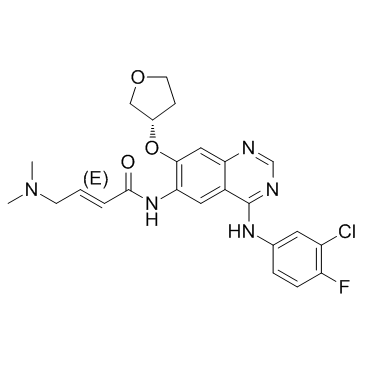
Afatinib
CAS No. 850140-72-6
Afatinib( BIBW-2992 | BIBW2992 | BIBW 2992 )
Catalog No. M16170 CAS No. 850140-72-6
An irreversible, dual EGFR/HER2 inhibitor with IC50 of 0.5/0.4/10/14 nM for wt EGFR/EGFR L858R/EGFR L858R+T790M/HER2 respectively.
Purity : >98% (HPLC)
 COA
Datasheet
HNMR
HPLC
MSDS
Handing Instructions
COA
Datasheet
HNMR
HPLC
MSDS
Handing Instructions
| Size | Price / USD | Stock | Quantity |
| 1 mL x 10 mM in DMSO | 46 | In Stock |


|
| 5MG | 29 | In Stock |
|
| 10MG | 45 | In Stock |
|
| 25MG | 74 | In Stock |
|
| 50MG | 109 | In Stock |
|
| 100MG | 137 | In Stock |
|
| 200MG | 174 | In Stock |
|
| 500MG | 294 | In Stock |
|
| 1G | Get Quote | In Stock |
|
Biological Information
-
Product NameAfatinib
-
NoteResearch use only, not for human use.
-
Brief DescriptionAn irreversible, dual EGFR/HER2 inhibitor with IC50 of 0.5/0.4/10/14 nM for wt EGFR/EGFR L858R/EGFR L858R+T790M/HER2 respectively.
-
DescriptionAn irreversible, dual EGFR/HER2 inhibitor with IC50 of 0.5/0.4/10/14 nM for wt EGFR/EGFR L858R/EGFR L858R+T790M/HER2 respectively; shows high selectivity over HGFR, c-Src, β-InsRK,VEGFR2; suppresses transformation in isogenic cell-based assays, inhibits survival of cancer cell lines and induces tumor regression in xenograft and transgenic lung cancer models.Lung Cancer Approved(In Vitro):Afatinib (100 nM) sufficiently prevents heregulin-stimulated HER3 phosphorylation.Afatinib (0-10000 nM) effectively inhibits anchorage-independent proliferation of NIH-3T3 cells ectopically expressing EGFR mutants, and inhibits cell proliferation of H1666, H3255, and NCI 1975 cells.Afatinib (48-72 h)shows growth inhibition in HKESC-1, HKESC-2, SLMT-1 and EC-1 cells.Afatinib (0-1 μM, 24-48 h) inhibits AKT and MAPK pathways, and inhibits EGFR and AKT phosphorylation in ESCC cell lines.Afatinib (0-1 μM, 16-48 h) induces G0/G1 cell cycle arrest in HKESC-2 and EC-1.Afatinib (0-1 μM, 24-48 h) effectively induces apoptotic cell death in HKESC-2 and EC-1.(In Vivo):Afatinib (0-20 mg/kg, Orally, daily for 25 days) shows dramatic tumor regression and downregulation of EGFR, HER2, HER3 and AKT phosphorylation.Afatinib (15 mg/kg, Orally, in a schedule of 5 days on plus 2 days off, for two weeks) strongly inhibits the growth of HKESC-2 tumor.
-
In VitroAfatinib (100 nM) sufficiently prevents heregulin-stimulated HER3 phosphorylation.Afatinib (0-10000 nM) effectively inhibits anchorage-independent proliferation of NIH-3T3 cells ectopically expressing EGFR mutants, and inhibits cell proliferation of H1666, H3255, and NCI 1975 cells.Afatinib (48-72 h)shows growth inhibition in HKESC-1, HKESC-2, SLMT-1 and EC-1 cells.Afatinib (0-1 μM, 24-48 h) inhibits AKT and MAPK pathways, and inhibits EGFR and AKT phosphorylation in ESCC cell lines.Afatinib (0-1 μM, 16-48 h) induces G0/G1 cell cycle arrest in HKESC-2 and EC-1.Afatinib (0-1 μM, 24-48 h) effectively induces apoptotic cell death in HKESC-2 and EC-1. Cell Proliferation AssayCell Line:NIH-3T3 cells, H1666, H3255, and NCI 1975 cellsConcentration:0, 1, 10, 100, 1000, 10000 nM Incubation Time:Result:Effectively inhibited anchorage-independent proliferation of NIH-3T3 cells ectopically expressing EGFR mutants. Showed inhibition of anchorage independent cell proliferation of various lung cancer cell lines (H1666, H3255, and NCI 1975 cells), with IC50 values of 60 nM, 0.7 nM and 99 nM, respectively.Cell Viability Assay Cell Line:HKESC-1, HKESC-2, SLMT-1 and EC-1 cell lines Concentration:Incubation Time:48 and 72 hours Result:Observed over 95% of growth inhibition. The respective IC50 concentrations at 48 hours (HKESC-1=0.078 μM, HKESC-2=0.115 μM, KYSE510=3.182 μM, SLMT-1=4.625 μM and EC-1=1.489 μM) and 72 hours (HKESC-1=0.002 μM, HKESC-2=0.002 μM, KYSE510=1.090 μM, SLMT-1=1.161 μM and EC-1=0.109 μM) were all in lower micro-molar range. Western Blot Analysis Cell Line:HKESC-2 cells and EC-1 cells Concentration:0, 0.01, and 0.1 μM (HKESC-2 cells), 0, 0.1 and 1 μM (EC-1 cells)Incubation Time:24 and 48 hoursResult:Reduced the phosphorylation of EGFR and the endogenous expression level of HER2 receptors in ESCC cells. Suppressed AKT phosphorylation in a dose and time dependent manner. Significantly reduced the phosphorylation level of the downstream effectors of the AKT-mTOR axis especially in HKESC-2 cells. Inhibited the two major downstream pathways of the ErbB/HER axis, namely, AKT and MAPK pathways in ESCC cell lines.Cell Cycle AnalysisCell Line:HKESC-2 cells and EC-1 cells Concentration:0, 0.01, and 0.1 μM (HKESC-2 cells), 0, 0.1 and 1 μM (EC-1 cells)Incubation Time:16, 24, and 48 hours Result:Induced G0/G1 cell cycle arrest in both tested ESCC cell lines in a time and dose dependent manner. In HKESC-2 cells, the percentage of cells in G0/G1 phase was increased from 38.2% to 68.1% at 0.01 μM of afatinib and to 74.7% at 0.1 μM of afatinib, from 24 hours (82.4% G0/G1 arrest at 0.01 μM and 86.2% at 0.1 μM) to 48 hours (from 74.7% to 88.2% for 0.01 μM and 91.0% for 0.1 μM). In EC-1 cells, the percentage of cells arrested in the G0/G1 phase was increased from 59.1% to 66.6% and 72.2% at 24 and 48 hours respectively.Apoptosis Analysis Cell Line:HKESC-2 cells and EC-1 cells Concentration:0, 0.01, and 0.1 μM (HKESC-2 cells), 0, 0.1 and 1 μM (EC-1 cells)Incubation Time:24 and 48 hours Result:Effectively induced cell death by triggering apoptotic mechanisms in ESCC cell lines. Showed a stronger expression level of cleaved Poly (ADP-ribose) polymerase (PARP) in these cell lines.
-
In VivoAfatinib (0-20 mg/kg, Orally, daily for 25 days) shows dramatic tumor regression and downregulation of EGFR, HER2, HER3 and AKT phosphorylation.Afatinib (15 mg/kg, Orally, in a schedule of 5 days on plus 2 days off, for two weeks) strongly inhibits the growth of HKESC-2 tumor. Animal Model:Athymic NMRI-nu/nu female mice (21–31 g, five to six-week-old, transgenic murine lung cancer model and xenograft models)Dosage:15 mg/kg, 20 mg/kgAdministration:Orally, daily for 25 days Result:Resulted in dramatic tumor regression with a cumulative treated/control tumor volume ratio (T/C ratio) of 2% in a standard xenograft model of the epidermoid carcinoma cell line A431, and downregulation of EGFR and AKT phosphorylation. Induced regression of large tumors in this HER2-driven model, effectively controlled xenograft tumor formation by the NCIH1975 cell line, expressing EGFR L858R/T790M, with a T/C value of 12% for doses of 20 mg/kg. Induced more than 50% percent tumor reduction after a 4-week treatment period. Downregulated EGFR, HER2 and HER3 phosphorylation. Animal Model:Six weeks old female athymic nude mice (nu/nu) (16-20 g)Dosage:15 mg/kg Administration:Oral gavage in a schedule of 5 days on plus 2 days off, for two weeks Result:Strongly inhibited the growth of HKESC-2 tumor. Average tumor sizes of vehicle and treatment at end point are 348 ± 24 mm3 and 108 ± 36 mm3 respectively.
-
SynonymsBIBW-2992 | BIBW2992 | BIBW 2992
-
PathwayAngiogenesis
-
TargetEGFR
-
RecptorEGFR
-
Research AreaCancer
-
IndicationLung Cancer
Chemical Information
-
CAS Number850140-72-6
-
Formula Weight485.9384
-
Molecular FormulaC24H25ClFN5O3
-
Purity>98% (HPLC)
-
Solubility10 mM in DMSO
-
SMILESCN(C)CC=CC(=O)NC1=C(C=C2C(=C1)C(=NC=N2)NC3=CC(=C(C=C3)F)Cl)OC4CCOC4
-
Chemical Name2-Butenamide, N-[4-[(3-chloro-4-fluorophenyl)amino]-7-[[(3S)-tetrahydro-3-furanyl]oxy]-6-quinazolinyl]-4-(dimethylamino)-, (2E)-
Shipping & Storage Information
-
Storage(-20℃)
-
ShippingWith Ice Pack
-
Stability≥ 2 years
Reference



-
AV-412
AV-412 is an EGFR inhibitor (EGFR, EGFR T790M, EGFR L858R, EGFR L858R/T790M and ErbB2 with IC50s of 0.75, 0.79, 0.5, 2.3, 19 nM).In cells, MP-412 inhibited autophosphorylation of EGFR and ErbB2 with IC(50) of 43 and 282 nM, respectively.?
-
HER2/neu (654-662) G...
Affibody (affibody) ligands that are specific for the extracellular domain of human epidermal growth factor receptor 2 (HER2/neu) have been selected by phage display technology from a combinatorial protein library based on the 58 amino acid residue staphylococcal protein A-derived Z domain.
-
Falnidamol
Falnidamol (BIBX 1382) is an orally active, selective EGFR tyrosine kinase inhibitor with an IC50 of 3 nM. It displays >1000-fold lower potency against ErbB2 (IC50=3.4 μM) and other related tyrosine kinases (IC50>10 μM).
