


 Cart
Cart
 sales@molnova.com



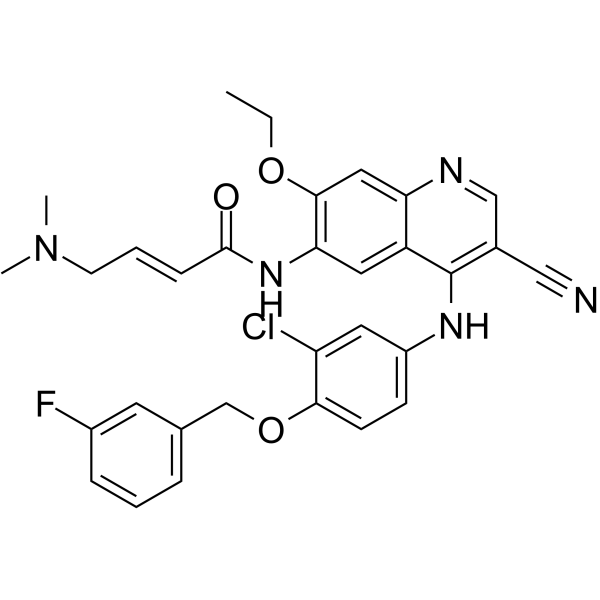
HKI-357
CAS No. 848133-17-5
HKI-357( —— )
Catalog No. M26249 CAS No. 848133-17-5
HKI-357 is an irreversible dual inhibitor of EGFR and ERBB2 (IC50s: 34 nM and 33 nM). HKI-357 suppresses EGFR autophosphorylation (at Y1068), and AKT and MAPK phosphorylation.
Purity : >98% (HPLC)
 COA
Datasheet
HNMR
HPLC
MSDS
Handing Instructions
COA
Datasheet
HNMR
HPLC
MSDS
Handing Instructions
| Size | Price / USD | Stock | Quantity |
| 1 mL x 10 mM in DMSO | 154 | In Stock |


|
| 2MG | 75 | In Stock |
|
| 5MG | 121 | In Stock |
|
| 10MG | 188 | In Stock |
|
| 25MG | 372 | In Stock |
|
| 50MG | 528 | In Stock |
|
| 100MG | 770 | In Stock |
|
| 200MG | 1014 | In Stock |
|
| 500MG | Get Quote | In Stock |
|
| 1G | Get Quote | In Stock |
|
Biological Information
-
Product NameHKI-357
-
NoteResearch use only, not for human use.
-
Brief DescriptionHKI-357 is an irreversible dual inhibitor of EGFR and ERBB2 (IC50s: 34 nM and 33 nM). HKI-357 suppresses EGFR autophosphorylation (at Y1068), and AKT and MAPK phosphorylation.
-
DescriptionHKI-357 is an irreversible dual inhibitor of EGFR and ERBB2 (IC50s: 34 nM and 33 nM). HKI-357 suppresses EGFR autophosphorylation (at Y1068), and AKT and MAPK phosphorylation.(In Vitro):HKI-357 also is effective in suppressing EGFR autophosphorylation (measured at residue Y1068), and AKT and MAPK phosphorylation in parental NCI-H1650 cells harboring the delE746-A750 EGFR mutation. HKI-357 (0.01-10 μM) is effective in suppressing ligand-induced EGFR autophosphorylation and its downstream signaling, as determined by AKT and MAPK phosphorylation in NCI-H1975 cells.
-
In VitroHKI-357 (0.01-10 μM) is effective in suppressing ligand-induced EGFR autophosphorylation and its downstream signaling, as determined by AKT and MAPK phosphorylation in NCI-H1975 cells.HKI-357 also is effective in suppressing EGFR autophosphorylation (measured at residue Y1068), and AKT and MAPK phosphorylation in parental NCI-H1650 cells harboring the delE746-A750 EGFR mutation. Western Blot Analysis Cell Line:NCI-H1975 bronchoalveolar cell line Concentration:0.01, 0.01, 0.1, 1 and 10 μM Incubation Time:Result:Suppressed ligand-induced EGFR autophosphorylation and its downstream signaling AKT and MAPK phosphorylation.
-
In Vivo——
-
Synonyms——
-
PathwayAngiogenesis
-
TargetEGFR
-
RecptorPEGs
-
Research Area——
-
Indication——
Chemical Information
-
CAS Number848133-17-5
-
Formula Weight574.05
-
Molecular FormulaC31H29ClFN5O3
-
Purity>98% (HPLC)
-
SolubilityIn Vitro:?DMSO : 100 mg/mL (174.20 mM)
-
SMILESCCOc1cc2ncc(C#N)c(Nc3ccc(OCc4cccc(F)c4)c(Cl)c3)c2cc1NC(=O)\C=C\CN(C)C
-
Chemical Name——
Shipping & Storage Information
-
Storage(-20℃)
-
ShippingWith Ice Pack
-
Stability≥ 2 years
Reference
1.An S, et al. Small-molecule PROTACs: An emerging and promising approach for the development of targeted therapy drugs. EBioMedicine. 2018 Oct;36:553-562
molnova catalog



related products
-
Naquotinib
Naquotinib (ASP-8273) is a potent, irreversible, mutant-selective inhibitor of EGFR.
-
Sodium Nitroprusside...
Sodium Nitroprusside Dihydrate is a potent vasodilator working through releasing NO spontaneously in blood.
-
Avitinib maleate
Avitinib maleate (AC-0010MA, AC0010 maleate) is an?orally available, irreversible, and mutant-selective EGFR inhibitor with IC50 of 0.18 nM against EGFR L858R/T790M.
