


 Cart
Cart
 sales@molnova.com



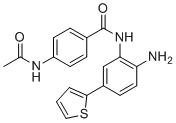
Merck60
CAS No. 849234-64-6
Merck60( BRD 6929 | Compound-60 )
Catalog No. M16166 CAS No. 849234-64-6
Merck60 (BRD 6929, Compound-60) is a potent, selective and brain-penetrant inhibitor of HDAC1 and HDAC2 with IC50 of 1 nM and 8 nM respectively.
Purity : >98% (HPLC)
 COA
Datasheet
HNMR
HPLC
MSDS
Handing Instructions
COA
Datasheet
HNMR
HPLC
MSDS
Handing Instructions
| Size | Price / USD | Stock | Quantity |
| 1 mL x 10 mM in DMSO | 45 | In Stock |


|
| 5MG | 41 | In Stock |
|
| 10MG | 79 | In Stock |
|
| 25MG | 169 | In Stock |
|
| 50MG | 299 | In Stock |
|
| 100MG | 432 | In Stock |
|
| 200MG | 607 | In Stock |
|
| 500MG | Get Quote | In Stock |
|
| 1G | Get Quote | In Stock |
|
Biological Information
-
Product NameMerck60
-
NoteResearch use only, not for human use.
-
Brief DescriptionMerck60 (BRD 6929, Compound-60) is a potent, selective and brain-penetrant inhibitor of HDAC1 and HDAC2 with IC50 of 1 nM and 8 nM respectively.
-
DescriptionMerck60 (BRD 6929, Compound-60) is a potent, selective and brain-penetrant inhibitor of HDAC1 and HDAC2 with IC50 of 1 nM and 8 nM respectively; displays 50-400 fold selectivity over class I HDAC3 (IC50 = 458 nM) and no appreciable inhibition of HDAC8 or of the class II HDACs (IC50>30 uM); alters gene expression in brain circuits involved in mood regulation, improves mood-related behaviors in mice.
-
In VitroIn vitro?IC50 for HDAC1-9 by BRD-6929 using recombinant human HDAC enzymes and HDAC class-specific substrates. BRD-6929 and substrate are incubated for 180 min (HDAC1-3)?to control for HDAC1-3 inhibition, BRD-6929 is against HDAC1, HDAC2, HDAC3 and HDAC4-9 with IC50s of 0.001 μM, 0.008 μM, 0.458 μM and >30 μM, respectively.In vitro?binding affinity (Ki) and kinetics (half-life ‘T1/2′?in minutes) for HDAC 1, 2 and 3 incubated with BRD-6929 (10 μM), the Ki values are <0.2 nM, 1.5nM, and 270 nM for HDAC 1, 2 and 3, respectively. The T1/2 values are >2400 mins, >4800 mins, and 1200 mins for HDAC 1, 2 and 3, respectively. BRD-6929 (1 and 10 uM) does not cause an increase or decrease in overall cell number in brain region specific primary cultures. Additionally, BRD-6929 (10 uM) causes an increase in H4K12 acetylation in brain region specific primary cultures (striatum).BRD-6929 (1-10 uM; 6 hours) causes a significant increase in H2B acetylation in primary neuronal cell cultures. BRD-6929 (1-20 uM; 24 hours) induces a dose-dependent acetylation of H4K12ac with an EC50 of 7.2 μM in cultured neurons.BRD-6929 potentiates the efficacy of gnidimacrin (a PKC Agonist) against latent HIV-1.
-
In VivoBRD-6929 (intraperitoneal?injection; 45 mg/kg; single dose) exhibits a Cmax, T1/2 and AUC values of 17.7 μM, 7.2 hours, and 25.6 μM/L*hr, respectively in plasma. It shows a Cmax, T1/2 and AUC values of 0.83 μM, 6.4 hours, and 3.9 μM/L*hr, respectively in brain.BRD-6929 (intraperitoneal?injection; 45 mg/kg; 10 days) acts as a deacetylase inhibitor in mouse brain. It significantly increases acetylation in each brain region by 1.5- to 2.0-fold compared to vehicle. The western blotting reveals that BRD-6929 significantly increases acetylation of histone H2B (tetra-acetylated), H3K9 and H4K12 in cortex, ventral striatum and hippocampus after the 10th daily treatment in adult male C57BL/6J mice.
-
SynonymsBRD 6929 | Compound-60
-
PathwayCell Cycle/DNA Damage
-
TargetHDAC
-
RecptorHDAC
-
Research Area——
-
Indication——
Chemical Information
-
CAS Number849234-64-6
-
Formula Weight351.424
-
Molecular FormulaC19H17N3O2S
-
Purity>98% (HPLC)
-
SolubilityIn Vitro:?DMSO : 5 mg/mL (14.23 mM助)
-
SMILES——
-
Chemical Name4-acetamido-N-(2-amino-5-(thiophen-2-yl)phenyl)benzamide
Shipping & Storage Information
-
Storage(-20℃)
-
ShippingWith Ice Pack
-
Stability≥ 2 years
Reference
1. Schroeder FA, et al. PLoS One. 2013 Aug 14;8(8):e71323.
2. Methot JL, et al. Bioorg Med Chem Lett. 2008 Feb 1;18(3):973-8.
3. Stubbs MC, et al. Clin Cancer Res. 2015 May 15;21(10):2348-58.
molnova catalog



related products
-
AES-135
AES-135 is a potent HDAC inhibitor, inhibits HDAC3, HDAC6, HDAC11 (IC50s: 654, 190, and 636 nM) with anti-tumor activity.
-
4-(1H-Pyrazol-4-yl)-...
Detail unknown.
-
HNHA
HNHA is an inhibitor of HDAC.
