


 Cart
Cart
 sales@molnova.com



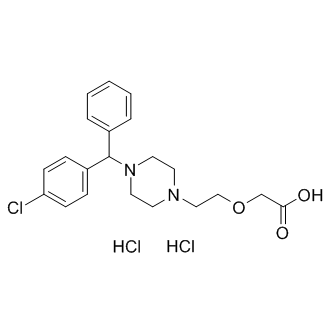
Cetirizine dihydrochloride
CAS No. 83881-52-1
Cetirizine dihydrochloride( P-071 )
Catalog No. M16110 CAS No. 83881-52-1
A second-generation antihistamine that acts as a selective H1 receptor antagonist.
Purity : >98% (HPLC)
 COA
Datasheet
HNMR
HPLC
MSDS
Handing Instructions
COA
Datasheet
HNMR
HPLC
MSDS
Handing Instructions
| Size | Price / USD | Stock | Quantity |
| 50MG | 32 | In Stock |


|
| 100MG | 45 | In Stock |
|
| 200MG | 65 | In Stock |
|
| 500MG | Get Quote | In Stock |
|
| 1G | Get Quote | In Stock |
|
Biological Information
-
Product NameCetirizine dihydrochloride
-
NoteResearch use only, not for human use.
-
Brief DescriptionA second-generation antihistamine that acts as a selective H1 receptor antagonist.
-
DescriptionA second-generation antihistamine that acts as a selective H1 receptor antagonist; used in the treatment of allergies.Allergy Approved(In Vitro):Cetirizine (>5 μM) at higher concentrations can reduce the release of GM-CSF and IL-8 from A549 cells stimulated with IL-1β. Cetirizine exerts anti-inflammatory effects beyond histamine H1-receptor antagonist.(In Vivo):Cetirizine (20 mg/kg, mice, orally) exerts its anti-inflammatory effects by inhibiting MIF as well as IL-8 production in mice immunized and challenged with ragweed pollen.
-
In VitroCetirizine (>5 μM) at higher concentrations can reduce the release of GM-CSF and IL-8 from A549 cells stimulated with IL-1β. Cetirizine exerts anti-inflammatory effects beyond histamine H1-receptor antagonist. Cell Viability AssayCell Line:Human airway epithelial cell line A549.Concentration:0-10 μM.Incubation Time:24 h.Result:The survival of A549 cells incubated with various concentrations of cetirizine (0.1, 1, 2.5, 5, and 10 μM) for 24 hours were all higher than 90% when comparing with the control group by MTT test.Cetirizine, 5 and 10 μM, suppressed GM-CSF release by 70.71 and 61.55%, respectively.Preincubation with cetirizine, 10 μM, suppressed the IL-8 secretion by 75.04%.
-
In VivoCetirizine (20 mg/kg, mice, orally) exerts its anti-inflammatory effects by inhibiting MIF as well as IL-8 production in mice immunized and challenged with ragweed pollen. Animal Model:Male 8-week-old BALB/c mice (25-30 g) immunized and challenged with ragweed pollen.Dosage:2 or 20 mg/kg.Administration:Orally, diluted in sterile water on days 18, 19, and 20.
-
SynonymsP-071
-
PathwayGPCR/G Protein
-
TargetHistamine Receptor
-
RecptorH1receptor
-
Research AreaInflammation/Immunology
-
IndicationAllergy
Chemical Information
-
CAS Number83881-52-1
-
Formula Weight461.8097
-
Molecular FormulaC21H27Cl3N2O3
-
Purity>98% (HPLC)
-
Solubility10 mM in DMSO
-
SMILESCl.OC(=O)COCCN1CCN(CC1)C(C1=CC=CC=C1)C1=CC=C(Cl)C=C1
-
Chemical NameAcetic acid, 2-[2-[4-[(4-chlorophenyl)phenylmethyl]-1-piperazinyl]ethoxy]-, hydrochloride (1:2)
Shipping & Storage Information
-
Storage(-20℃)
-
ShippingWith Ice Pack
-
Stability≥ 2 years
Reference
molnova catalog



related products
-
Diphenylpyraline hyd...
Diphenylpyraline Hcl is a first-generation antihistamine with anticholinergic effects, acts as a dopamine reuptake inhibitor.
-
Diphenhydramine
Diphenhydramine, a first-generation antihistamine possessing antiemetic, antitussive, anticholinergic, and sedative properties, is mainly used in the treatment of allergies.
-
Esculetin
Esculetin is slightly soluble (in water) and a very weakly acidic compound (based on its pKa). Esculetin can be found in a number of food items such as dandelion, highbush blueberry, wild leek, and opium poppy.
