


 Cart
 sales@molnova.com




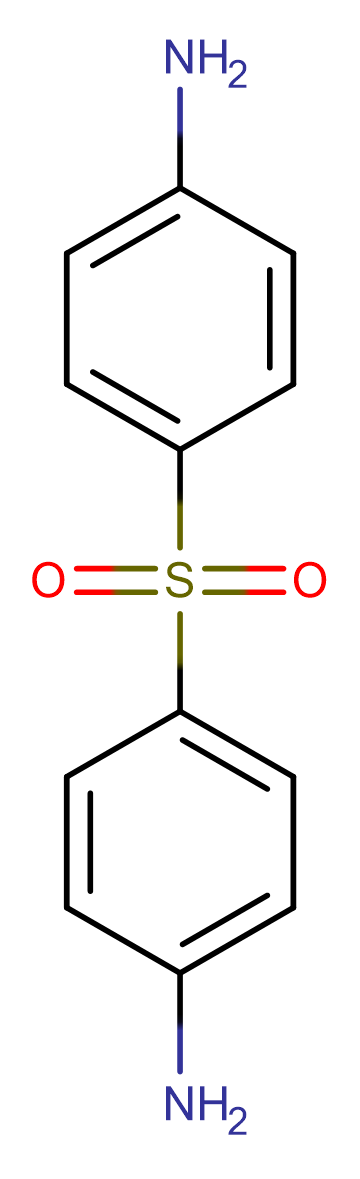
Sulphadione
CAS No. 80-08-0
Sulphadione( 4,4'-Diaminodiphenyl sulfone | NSC 6091 )
Catalog No. M15997 CAS No. 80-08-0
Dapsone is a sulfone active against a wide range of bacteria but mainly employed for its actions against mycobacterium leprae.
Purity : >98% (HPLC)
 COA
Datasheet
HNMR
HPLC
MSDS
Handing Instructions
| Size | Price / USD | Stock | Quantity |
| 1 mL x 10 mM in DMSO | 28 | In Stock |


|
| 100MG | Get Quote | In Stock |
|
| 200MG | Get Quote | In Stock |
|
| 500MG | Get Quote | In Stock |
|
| 1G | 29 | In Stock |
|
Biological Information
-
Product NameSulphadione
-
NoteResearch use only, not for human use.
-
Brief DescriptionDapsone is a sulfone active against a wide range of bacteria but mainly employed for its actions against mycobacterium leprae.
-
DescriptionDapsone is a sulfone active against a wide range of bacteria but mainly employed for its actions against mycobacterium leprae.(In Vitro):Dapsone are added to cell lysates (100 μg of protein) and DHPS activity assay is tested. Dapsone exhibits an IC50 of 3.0 μg/ml for E. coli C600 in DHPS activity assay, but the growth of E. coli C600 is not inhibited at 256 μg/ml Dapsone. For the recombinant strain carrying M. leprae folP1 (pML101), Dapsone shows an IC50 of 0.06 μg/ml and a MIC of 1 μg/ml.(In Vivo):In L. major-infected BALB/c MiceDapsone (topical treatment; 50 mg/kg; twice daily; 30 days) leads to sizes lesions around 186 mm2 compared to 125 mm2 for control mice. Furthermore, the amount of DAP quantified in the lesions treated with DAP cream is 9.6±8.5 μg of DAP/mg of skin. However, the number of parasites found in the spleen is significantly lower in mice treated with the cream than in non-treated mice.
-
In VitroDapsone are added to cell lysates (100 μg of protein) and DHPS activity assay is tested. Dapsone exhibits an IC50 of 3.0 μg/ml for E. coli?C600 in DHPS activity assay, but the growth of E. coli C600 is not inhibited at 256 μg/ml Dapsone. For the recombinant strain carrying?M. leprae folP1?(pML101), Dapsone shows an IC50?of 0.06 μg/ml and a MIC of 1 μg/ml.
-
In VivoIn L. major-infected BALB/c Mice Dapsone (topical treatment; 50 mg/kg; twice daily; 30 days) leads to sizes lesions around 186 mm2?compared to 125 mm2?for control mice. Furthermore, the amount of DAP quantified in the lesions treated with DAP cream is 9.6±8.5 μg of DAP/mg of skin. However, the number of parasites found in the spleen is significantly lower in mice treated with the cream than in non-treated mice.
-
Synonyms4,4'-Diaminodiphenyl sulfone | NSC 6091
-
PathwayOthers
-
TargetOther Targets
-
RecptorOthers
-
Research AreaInfection
-
Indication——
Chemical Information
-
CAS Number80-08-0
-
Formula Weight248.3
-
Molecular FormulaC12H12N2O2S
-
Purity>98% (HPLC)
-
SolubilityWater: 380 mg/L (at 37 °C)
-
SMILESC1=CC(=CC=C1N)S(=O)(=O)C2=CC=C(C=C2)N
-
Chemical Name4-(4-aminophenyl)sulfonylaniline
Shipping & Storage Information
-
Storage(-20℃)
-
ShippingWith Ice Pack
-
Stability≥ 2 years
Reference
1.Gengenbacher M, et al. FEMS Microbiol Lett. 2008 Oct;287(1):128-35.
molnova catalog


related products
-
2-Iodobenzoic acid
2-Iodobenzoic acid is the impact-sensitive intermediate in the synthesis of the Dess-Martin periodinane.
-
N-Acetyl-L-aspartic ...
N-Acetylaspartic acid is a derivative of aspartic acid. It is the second most concentrated molecule in the brain after the amino acid glutamate. It is synthesized in neurons from the amino acid aspartate and acetyl coenzyme A (acetyl CoA).
-
Rhododendrol
Rhododendrol is a melanin synthesis and acts by preventing high-fat diet-induced elevation in body weight and increasing lipolysis in white adipocytes in male mice.
