


 Cart
Cart
 sales@molnova.com



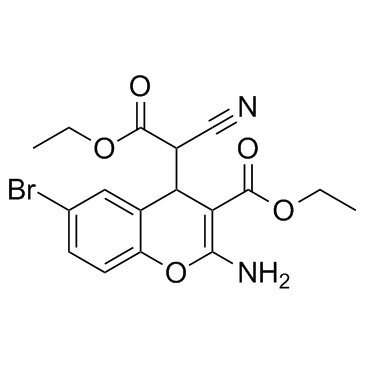
HA14-1
CAS No. 65673-63-4
HA14-1( HA-14-1 | HA 14-1 )
Catalog No. M15498 CAS No. 65673-63-4
HA14-1 a small molecule, nonpeptidic Bcl-2 antagonist that binds Bcl-2 surface pocket with binding IC50 of 9 uM.
Purity : >98% (HPLC)
 COA
Datasheet
HNMR
HPLC
MSDS
Handing Instructions
COA
Datasheet
HNMR
HPLC
MSDS
Handing Instructions
| Size | Price / USD | Stock | Quantity |
| 1 mL x 10 mM in DMSO | 29 | In Stock |


|
| 10MG | 37 | In Stock |
|
| 25MG | 59 | In Stock |
|
| 50MG | 83 | In Stock |
|
| 100MG | 119 | In Stock |
|
| 200MG | Get Quote | In Stock |
|
| 500MG | Get Quote | In Stock |
|
| 1G | Get Quote | In Stock |
|
Biological Information
-
Product NameHA14-1
-
NoteResearch use only, not for human use.
-
Brief DescriptionHA14-1 a small molecule, nonpeptidic Bcl-2 antagonist that binds Bcl-2 surface pocket with binding IC50 of 9 uM.
-
DescriptionHA14-1 a small molecule, nonpeptidic Bcl-2 antagonist that binds Bcl-2 surface pocket with binding IC50 of 9 uM, induces apoptosis of tumor cells; effectively induces apoptosis of HL-60 cells overexpressing Bcl-2 protein associated with the decrease in mitochondrial membrane potential and activation of caspase-9 followed by caspase-3; strongly induces the death of NIH 3T3 (Apaf-1(+/+)) cells.
-
In VitroHA14-1 is a nonpeptidic ligand of a Bcl-2 surface pocket. HA14-1 induces the activation of Apaf-1 and caspases, possibly by binding to Bcl-2 protein and inhibiting its function. The interaction of HA14-1 with the Bcl-2 surface pocket appeared to be specific for the chemical structure of HA14-1 as a series of synthetic analogs derived from HA14-1 containing various modifications are found to have widely different Bcl-2 binding activities. To examine the effect of HA14-1 on cell viability, HL-60 cells are treated with various concentrations of HA14-1 for 4 h. HA14-1 induces the death of HL-60 cells in a dose-dependent manner. At 50 μM, HA14-1 causes the lost of viability in more than 90% of the cells. HA14-1 is a Bcl-2/Bcl-xL antagonist.
-
In VivoSwiss nude mice are challenged with BeGBM cells (104 injected s.c.). HA14-1 (400 nmol) in 100 μL free RPMI 1640-50% DMSO, or the carrier alone, is given at the site of injection once weekly from day 2 following cell injection. HA14-1 treatment does not have any significant effect on the growth of glioblastoma tumors in immunodeficient mice as monitored twice weekly by measuring the volume of the expanding tumors. Moreover, no gross organ toxicity or weight loss can be detected in mice receiving such treatment. To analyze whether HA14-1 treatment might enhance the efficiency of another antitumoral treatment, Swiss nude mice challenged with human glioblastoma multiforme cells are also given i.p. low doses of Etoposide (2.5 mg/kg in 200 μL of 0.9% NaCl 5 days a week from day 2 following cell injection) together with HA14-1 or mock treatment. Whereas Etoposide treatment is insufficient by itself to restrain the growth of glioblastoma cells, its combination with HA14-1 leads to a significant restrain on tumor growth as judged by the ability of the combined treatment to increase the doubling time of the tumor volume.
-
SynonymsHA-14-1 | HA 14-1
-
PathwayAngiogenesis
-
TargetBcl-2
-
RecptorBcl-2
-
Research AreaCancer
-
Indication——
Chemical Information
-
CAS Number65673-63-4
-
Formula Weight409.2313
-
Molecular FormulaC17H17BrN2O5
-
Purity>98% (HPLC)
-
Solubility10 mM in DMSO
-
SMILESO=C(C1=C(N)OC2=C(C=C(Br)C=C2)[C@H]1[C@H](C#N)C(OCC)=O)OCC
-
Chemical Name4H-1-Benzopyran-4-acetic acid, 2-amino-6-bromo-.alpha.-cyano-3-(ethoxycarbonyl)-, ethyl ester, (.alpha.R,4R)-rel-
Shipping & Storage Information
-
Storage(-20℃)
-
ShippingWith Ice Pack
-
Stability≥ 2 years
Reference
1. Wang JL, et al. Proc Natl Acad Sci U S A. 2000 Jun 20;97(13):7124-9.
2. Milella M, et al. Blood. 2002 May 1;99(9):3461-4.
3. Chen J, et al. Mol Cancer Ther. 2002 Oct;1(12):961-7.
4. Lickliter JD, et al. Leukemia. 2003 Nov;17(11):2074-80.
molnova catalog



related products
-
Thevetiaflavone
Thevetiaflavone could up-regulate the expression of Bcl 2 and down-regulate that of Bax and caspase 3.
-
Sabutoclax
Sabutoclax (BI-97C1) is a potent, pan Bcl-2 family proteins inhibitor.
-
BCL6-IN-3
BCL6-IN-3 is a potent BCL6 inhibitor with GI50 of 70 nM in SU-DHL4 cells. BCL6-in-3 regulates cell activation, differentiation, DNA damage and apoptosis, and has antitumor activity.
