


 Cart
 sales@molnova.com




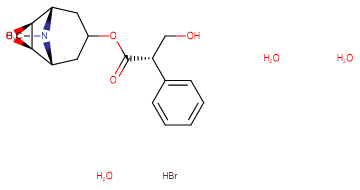
Scopolamine HBr trihydrate
CAS No. 6533-68-2
Scopolamine HBr trihydrate( —— )
Catalog No. M15485 CAS No. 6533-68-2
An alkaloid from SOLANACEAE, especially DATURA and SCOPOLIA.
Purity : >98% (HPLC)
 COA
Datasheet
HNMR
HPLC
MSDS
Handing Instructions
| Size | Price / USD | Stock | Quantity |
| 5MG | 37 | In Stock |


|
| 10MG | 49 | In Stock |
|
| 25MG | 74 | In Stock |
|
| 50MG | 120 | In Stock |
|
| 100MG | Get Quote | In Stock |
|
| 200MG | Get Quote | In Stock |
|
| 500MG | Get Quote | In Stock |
|
| 1G | Get Quote | In Stock |
|
Biological Information
-
Product NameScopolamine HBr trihydrate
-
NoteResearch use only, not for human use.
-
Brief DescriptionAn alkaloid from SOLANACEAE, especially DATURA and SCOPOLIA.
-
DescriptionAn alkaloid from solanaceae, especially datura and scopolia. Scopolamine and its quaternary derivatives act as antimuscarinics like atropine, but may have more central nervous system effects. Among the many uses are as an anesthetic premedication, in urinary incontinence, in motion sickness, as an antispasmodic, and as a mydriatic and cycloplegic.
-
In Vitro——
-
In Vivo——
-
Synonyms——
-
PathwayEndocrinology/Hormones
-
TargetAChR
-
RecptormAChR
-
Research Area——
-
Indication——
Chemical Information
-
CAS Number6533-68-2
-
Formula Weight438.31
-
Molecular FormulaC17H28BrNO7
-
Purity>98% (HPLC)
-
SolubilityDMSO: 10 mM
-
SMILESCN1[C@@H]2CC(C[C@H]1[C@H]3[C@@H]2O3)OC(=O)[C@H](CO)C4=CC=CC=C4.O.O.O.Br
-
Chemical Name——
Shipping & Storage Information
-
Storage(-20℃)
-
ShippingWith Ice Pack
-
Stability≥ 2 years
Reference
1.Murasaki O, et al. J Pharmacol Exp Ther. 2003 Dec;307(3):995-1000.
molnova catalog



related products
-
Zeaxanthin
Lutein and Zeaxanthin in neural tissue may have biological effects that include antioxidation, anti-inflammation, and structural actions.
-
Catestatin
Non-competitive nicotinic cholinergic antagonist; selectively inhibits nicotinic-stimulated catecholamine secretion from chromaffin cells and noradrenergic neurons (IC50 ~ 200 nM). Blocks nicotinic-induced cationic signaling (IC50 ~ 200 - 250 nM) and inhibits nicotinic-agonist induced desensitization of catecholamine release. Also stimulates mast cell release of histamine via a separate mechanism.
-
Dibucaine
Dibucaine is a local anesthetic of the amide type now generally used for surface anesthesia.
