


 Cart
Cart
 sales@molnova.com



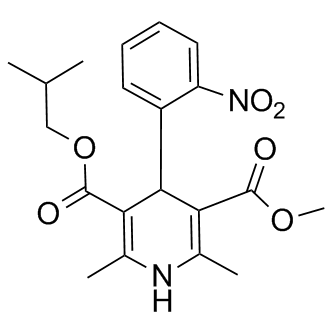
Nisoldipine
CAS No. 63675-72-9
Nisoldipine( BAY-k 5552 )
Catalog No. M15415 CAS No. 63675-72-9
A dihydropyridine type calcium channel blocker that is used as an antihypertensive.
Purity : >98% (HPLC)
 COA
Datasheet
HNMR
HPLC
MSDS
Handing Instructions
COA
Datasheet
HNMR
HPLC
MSDS
Handing Instructions
| Size | Price / USD | Stock | Quantity |
| 1 mL x 10 mM in DMSO | 37 | In Stock |


|
| 100MG | Get Quote | In Stock |
|
| 200MG | 32 | In Stock |
|
| 500MG | 41 | In Stock |
|
| 1G | 65 | In Stock |
|
Biological Information
-
Product NameNisoldipine
-
NoteResearch use only, not for human use.
-
Brief DescriptionA dihydropyridine type calcium channel blocker that is used as an antihypertensive.
-
DescriptionA dihydropyridine type calcium channel blocker that is used as an antihypertensive.Hypertension Approved.
-
In Vitro——
-
In Vivo——
-
SynonymsBAY-k 5552
-
PathwayGPCR/G Protein
-
TargetCalcium Channel
-
RecptorL-typeCav1.2
-
Research AreaCardiovascular Disease
-
IndicationHypertension
Chemical Information
-
CAS Number63675-72-9
-
Formula Weight388.4144
-
Molecular FormulaC20H24N2O6
-
Purity>98% (HPLC)
-
Solubility10 mM in DMSO
-
SMILESCC1=C(C(C(=C(N1)C)C(=O)OCC(C)C)C2=CC=CC=C2[N+](=O)[O-])C(=O)OC
-
Chemical Name3,5-Pyridinedicarboxylic acid, 1,4-dihydro-2,6-dimethyl-4-(2-nitrophenyl)-, 3-methyl 5-(2-methylpropyl) ester
Shipping & Storage Information
-
Storage(-20℃)
-
ShippingWith Ice Pack
-
Stability≥ 2 years
Reference



-
Upacicalcet
Upacicalcet (AJT-240) is an intraventricular calcium mimetic, a SHPT available for human hemodialysis, that inhibits excessive parathyroid hormone (PTH) secretion by directly acting on parathyroid cell membrane calcium-sensitive receptors, thereby lowering blood levels of PTH.
-
Yangambin
Yangambin is a selective antagonist of the cardiovascular effects of platelet activating factor (PAF); it has hypotensive effect, which is probably due to a peripheral vasodilatation that involves, at least, the inhibition the Ca2+ influx through voltage-gated Ca2+ channels. Yangambin has central nervous system activity, it presents a depressant activity in the open field, forced swimming and pentobarbital sleeping time tests.
-
Gallopamil
Gallopamil inhibits acid secretion in a concentration-dependent manner with an IC50 of 10.9 μM.
