


 Cart
Cart
 sales@molnova.com



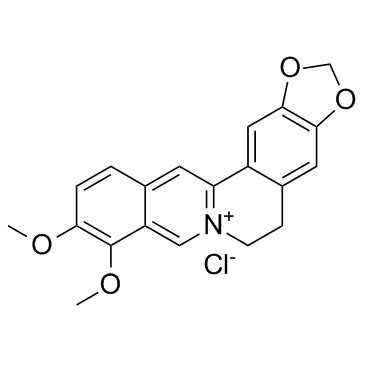
Berberine hydrochloride
CAS No. 633-65-8
Berberine hydrochloride( BBR | Umbellatine )
Catalog No. M15393 CAS No. 633-65-8
An alkaloid from Hydrastis canadensis L., Berberidaceae. It is also found in many other plants.
Purity : >98% (HPLC)
 COA
Datasheet
HNMR
HPLC
MSDS
Handing Instructions
COA
Datasheet
HNMR
HPLC
MSDS
Handing Instructions
| Size | Price / USD | Stock | Quantity |
| 1 mL x 10 mM in DMSO | 29 | In Stock |


|
| 10MG | 37 | In Stock |
|
| 25MG | 44 | In Stock |
|
| 50MG | 51 | In Stock |
|
| 100MG | Get Quote | In Stock |
|
| 200MG | Get Quote | In Stock |
|
| 500MG | Get Quote | In Stock |
|
| 1G | Get Quote | In Stock |
|
Biological Information
-
Product NameBerberine hydrochloride
-
NoteResearch use only, not for human use.
-
Brief DescriptionAn alkaloid from Hydrastis canadensis L., Berberidaceae. It is also found in many other plants.
-
DescriptionAn alkaloid from Hydrastis canadensis L., Berberidaceae. It is also found in many other plants. It is relatively toxic parenterally, but has been used orally for various parasitic and fungal infections and as antidiarrheal.
-
In VitroCell Proliferation Assay Cell Line:Four colorectal carcinoma cell lines LoVo, HCT116, SW480, and HT-29 Concentration:1.25, 2.5, 5, 10, 20, 40, 80, and 160 μM Incubation Time:72 hours Result:Inhibited the proliferation of four cell lines. The IC50 ranged from 40.8±4.1 μM (LoVo) to 98.6±2.9 μM (HCT116).Cell Proliferation Assay Cell Line:Colorectal carcinoma cell lines LoVo Concentration:1.25, 2.5, 5, 10, 20, 40, 80, and 160 μM Incubation Time:24, 48, 72 hours Result:Induced a time- and dose-dependent inhibition of cell growth. By 72 h, 160.0 μM induced 71.1±1.9 % growth inhibitions in LoVo cells.Cell Cycle Analysis Cell Line:LoVo cells Concentration:0, 10, 20, 40, or 80 μM Incubation Time:24 hours Result:Exposure to 40.0 μM induced G2/M-phase cell cycle arrest, an increase in the G2/M-phase population and a progressive decline in the G1 population.Western Blot AnalysisCell Line:LoVo cellsConcentration:10, 20, 40, or 80 μM Incubation Time:24 hours Result:Suppressed cyclin B1, cdc2 and cdc25c protein expression.
-
In VivoAnimal Model:5-week-old BALB/c nu/nu mice with human colorectal adenocarcinoma LoVo xenografts Dosage:10, 30, or 50 mg/kg/day Administration:Gastrointestinal gavage; for 10 consecutive days Result:Showed inhibitory rates of 33.1 % and 45.3 % at doses of 30 and 50 mg/kg/day.
-
SynonymsBBR | Umbellatine
-
PathwayOthers
-
TargetOther Targets
-
RecptorOthers
-
Research AreaCancer
-
Indication——
Chemical Information
-
CAS Number633-65-8
-
Formula Weight371.8
-
Molecular FormulaC20H18ClNO4
-
Purity>98% (HPLC)
-
SolubilityDMSO: 74 mg/mL (199.02 mM)
-
SMILES[Cl-].COC1=C(OC)C2=C[N+]3=C(C=C2C=C1)C1=CC2=C(OCO2)C=C1CC3
-
Chemical Name——
Shipping & Storage Information
-
Storage(-20℃)
-
ShippingWith Ice Pack
-
Stability≥ 2 years
Reference
1.Zhang Y, et al. J Pharmacol Exp Ther. 2014 Jun; 349(3):417-26.
molnova catalog



related products
-
Cyanidin-3-O-arabino...
Cyanidin-3-O-arabinoside chloride has antioxidant activity. It reduces the peroxynitrite-induced suppression of mitochondrial respiration, DNA damage, PARS activation and vascular dysfunction in HUVECs.
-
Flaviviruses-IN-3
Flaviviruses-IN-3 (compound 87) is a potent inhibitor of flaviviruses, capable of reducing West Nile virus (WNV) protease activity by 54%.
-
19-Oxocinobufotalin
19-Oxocinobufotalin 3-adipoylarginine ester shows significant inhibition effect against human hepatocellular carcinoma cell line SMMC-7721 in vitro.
