


 Cart
Cart
 sales@molnova.com



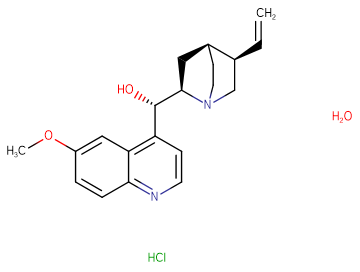
Quinidine hydrochloride
CAS No. 6151-40-2
Quinidine hydrochloride( —— )
Catalog No. M15320 CAS No. 6151-40-2
An optical isomer of quinine, extracted from the bark of the Cinchona tree and similar plant species.
Purity : >98% (HPLC)
 COA
Datasheet
HNMR
HPLC
MSDS
Handing Instructions
COA
Datasheet
HNMR
HPLC
MSDS
Handing Instructions
| Size | Price / USD | Stock | Quantity |
| 1 mL x 10 mM in DMSO | 48 | In Stock |


|
| 50MG | 31 | In Stock |
|
| 100MG | 44 | In Stock |
|
| 200MG | Get Quote | In Stock |
|
| 500MG | 104 | In Stock |
|
| 1G | Get Quote | In Stock |
|
Biological Information
-
Product NameQuinidine hydrochloride
-
NoteResearch use only, not for human use.
-
Brief DescriptionAn optical isomer of quinine, extracted from the bark of the Cinchona tree and similar plant species.
-
DescriptionAn optical isomer of quinine, extracted from the bark of the Cinchona tree and similar plant species. This alkaloid dampens the excitability of cardiac and skeletal muscles by blocking sodium and potassium currents across cellular membranes. It prolongs cellular action potential, and decreases automaticity. Quinidine also blocks muscarinic and alpha-adrenergic neurotransmission. (In Vitro):Quinidine hydrochloride monohydrate blocks WT mSlo3 (KCa5.1) channels with an IC50 of 19.9±1.41 μM and Hill slope of 1.15±0.15 (n=7). Again, the potency of inhibition by Quinidine hydrochloride monohydrate is higher for F304Y mSlo3 (IC50 of 2.42±0.60 μM, n=9, P<0.005; Hill slope of 0.98±0.12), but lower with R196Q mSlo3 (IC50 of 38.4±6.77 μM, n=5, P<0.001; Hill slope of 1.05±0.16). The inhibition of F304Y mSlo3 by Quinidine hydrochloride monohydrate is observed to have some time dependence.(In Vivo):Direct application of Quinidine hydrochloride monohydrate on the sciatic nerve produces a dose-related decrease in amplitude at ascending somato-sensory evoked potential (SSEP) and descending compound muscle action potentials (CMAP) when comparing baseline with other time points, or when comparing the experimental left limb to the right contra-lateral glucose-treated limb. The latencies of SSEPs and CMAP potentials after Quinidine hydrochloride monohydrate applications are increased compare to baseline and the contralateral side.
-
In VitroQuinidine hydrochloride monohydrate blocks WT mSlo3 (KCa5.1) channels with an IC50 of 19.9±1.41?μM and Hill slope of 1.15±0.15 (n=7). Again, the potency of inhibition by Quinidine hydrochloride monohydrate is higher for F304Y mSlo3 (IC50 of 2.42±0.60?μM, n=9, P<0.005; Hill slope of 0.98±0.12), but lower with R196Q mSlo3 (IC50 of 38.4±6.77?μM, n=5, P<0.001; Hill slope of 1.05±0.16). The inhibition of F304Y mSlo3 by Quinidine hydrochloride monohydrate is observed to have some time dependence.
-
In VivoDirect application of Quinidine hydrochloride monohydrate on the sciatic nerve produces a dose-related decrease in amplitude at ascending somato-sensory evoked potential (SSEP) and descending compound muscle action potentials (CMAP) when comparing baseline with other time points, or when comparing the experimental left limb to the right contra-lateral glucose-treated limb. The latencies of SSEPs and CMAP potentials after Quinidine hydrochloride monohydrate applications are increased compare to baseline and the contralateral side.
-
Synonyms——
-
PathwayCell Cycle/DNA Damage
-
TargetPotassium Channel
-
RecptorPotassium Channel| Sodium Channel
-
Research Area——
-
Indication——
Chemical Information
-
CAS Number6151-40-2
-
Formula Weight378.89
-
Molecular FormulaC20H27ClN2O3
-
Purity>98% (HPLC)
-
SolubilityDMSO: 10 mM
-
SMILESCOC1=CC2=C(C=CN=C2C=C1)[C@@H]([C@H]3C[C@@H]4CCN3C[C@@H]4C=C)O.O.Cl
-
Chemical Name——
Shipping & Storage Information
-
Storage(-20℃)
-
ShippingWith Ice Pack
-
Stability≥ 2 years
Reference
1.Stokoe KS, et al. J Physiol. 2007 Jan 1;578(Pt 1):69-84.
molnova catalog



related products
-
Bisaramil hydrochlor...
Bisaramil hydrochloride (Bisaramil) is a novel diazabicyclononane antiarrhythmic compound that inhibits the generation of free radicals.
-
RL648_81
RL648_81 is a selective activator of KCNQ2/3 channels (EC50 = 190 nM). RL648_81 can be used in studies about neuronal hyperexcitability neurologic disorders.
-
RY785
RY785 is a potent and selective inhibitor of voltage-gated potassium channel such as KV2.2 (IC50 = 50 nM). RY785 may be used in pain relief studies.
