


 Cart
Cart
 sales@molnova.com



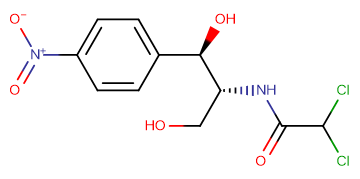
Chloramphenicol
CAS No. 56-75-7
Chloramphenicol( —— )
Catalog No. M15065 CAS No. 56-75-7
Chloramphenicol is a broad-spectrum antibiotic.
Purity : >98% (HPLC)
 COA
Datasheet
HNMR
HPLC
MSDS
Handing Instructions
COA
Datasheet
HNMR
HPLC
MSDS
Handing Instructions
| Size | Price / USD | Stock | Quantity |
| 500MG | 37 | In Stock |


|
| 1G | 43 | In Stock |
|
Biological Information
-
Product NameChloramphenicol
-
NoteResearch use only, not for human use.
-
Brief DescriptionChloramphenicol is a broad-spectrum antibiotic.
-
DescriptionChloramphenicol is a broad-spectrum antibiotic. (In Vitro):Chloramphenicol (1-100 μg/mL, 18-24 h) inhibits the HIF-1α pathway in NSCLC cells in a concentration-dependent manner.Chloramphenicol (100 μg/mL, 0-24 h) induces autophagy in NSCLC cells, substantially increases the levels of autophagic biomarkers (beclin-1, Atg12-Atg5 conjugates, and LC3-II).Chloramphenicol induces abnormal differentiation and inhibits apoptosis in activated T cells.Chloramphenicol can inhibit both bacterial and mitochondrial protein synthesis, causing mitochondrial stress and decreased ATP biosynthesis.chloramphenicol (1-100 μg/mL) can induce matrix metalloproteinase (MMP)-13 expression and increase MMP-13 protein.chloramphenicol (1-100 μg/mL) can activate c-Jun N-terminal kinases (JNK) and phosphatidylinositol 3-kinase (PI-3K)/Akt signaling, leading to c-Jun protein phosphorylation.Chloramphenicol acts primarily on the 50S subunit of bacterial 70S rihosomes and inhibits peptide bond formation by suppressing peptidyl transferase activity.(In Vivo):Chloramphenicol (0-3500 mg/kg, Gavage, daily, for 5 days) decreases erythrocytes and erythrocyte precursors and reduces marrow erythroid cells were at day 1 post-dosing, and returns to normal by 14 days post-dosing.
-
In VitroChloramphenicol (1-100 μg/mL, 18-24 h) inhibits the HIF-1α pathway in NSCLC cells in a concentration-dependent manner.Chloramphenicol (100 μg/mL, 0-24 h) induces autophagy in NSCLC cells, substantially increases the levels of autophagic biomarkers (beclin-1, Atg12-Atg5 conjugates, and LC3-II).Chloramphenicol induces abnormal differentiation and inhibits apoptosis in activated T cells.Chloramphenicol can inhibit both bacterial and mitochondrial protein synthesis, causing mitochondrial stress and decreased ATP biosynthesis.chloramphenicol (1-100 μg/mL) can induce matrix metalloproteinase (MMP)-13 expression and increase MMP-13 protein. chloramphenicol (1-100 μg/mL) can activate c-Jun N-terminal kinases (JNK) and phosphatidylinositol 3-kinase (PI-3K)/Akt signaling, leading to c-Jun protein phosphorylation.Chloramphenicol acts primarily on the 50S subunit of bacterial 70S rihosomes and inhibits peptide bond formation by suppressing peptidyl transferase activity. Cell Viability Assay Cell Line:A549 and H1299 cells Concentration:0, 1, 10, 100 μg/mL Incubation Time:3 h and 24 h Result:In the 3-h-treated group, the viability of A549 and H1299 cells at 100 μg/mL concentration was 97.0 ± 3.9% and 98.1 ± 5.0%, respectively. The viability of A549 cells was 102.9 ± 1.3% and 99.2 ± 0.9%, whereas the viability of H1299 cells was 103.3 ± 1.9% and 93.8 ± 4.5%, under hypoxia and treatment with CoCl2, respectively.Western Blot Analysis Cell Line:A549 and H1299 cells Concentration:0, 1, 10, 50, 100 μg/mL Incubation Time:18-24 h Result:Inhibited HIF-1α protein accumulation in NSCLC cells in a concentration-dependent manner, while the expression levels of ARNT remained unaltered. Had no effect on CoCl2 (250 μM, 3 h treatment)-mediated HIF-1α protein accumulation and SENP-1 protein reduction.Western Blot Analysis Cell Line:A549 and H1299 cells Concentration:100 μg/mL Incubation Time:0, 6, 12, 24 h Result:Induced autophagy in NSCLC cells in a time-dependent manner. Upregulats the expression of beclin-1 and increased the levels of Atg12-Atg5 conjugates in both NSCLC cell lines, both in a time dependent and concentration-dependent manner. Augmented LC3-II and downregulated p62/STSQM1 in A549 cells. Induced an augmentation of p62/STSQM1, and a decrease in LC3-II levels in H1299 cells.
-
In VivoChloramphenicol (0-3500 mg/kg, Gavage, daily, for 5 days) decreases erythrocytes and erythrocyte precursors and reduces marrow erythroid cells were at day 1 post-dosing, and returns to normal by 14 days post-dosing. Animal Model:Female B6C3F1 mice (12-14 weeks old) Dosage:0, 2500 and 3500 mg/kg Administration:Gavage, daily, for 5 days Result:Cessation of erythropoiesis was evident at day 1 post-dosing. A recovery was seen at day 7 post-dosing at the 2500 mg/kg dose level and at between 7 and 14 days at the 3500 mg/kg dose level. Myelotoxicity was most pronounced in the erythroid series at each dose level. Depressed femoral marrow BFU-E and CFU-E at day 1 post-dosing. All the blood and marrow parameters in the present study returned to normal by 14 days post-dosing.
-
Synonyms——
-
PathwayMicrobiology/Virology
-
Targetribosome
-
Recptor50S ribosome
-
Research AreaInfection
-
Indication——
Chemical Information
-
CAS Number56-75-7
-
Formula Weight323.13
-
Molecular FormulaC11H12Cl2N2O5
-
Purity>98% (HPLC)
-
SolubilityEthanol: 65 mg/mL (201.15 mM); DMSO: 65 mg/mL (201.15 mM)
-
SMILESC1=CC(=CC=C1[C@H]([C@@H](CO)NC(=O)C(Cl)Cl)O)[N+](=O)[O-]
-
Chemical Name——
Shipping & Storage Information
-
Storage(-20℃)
-
ShippingWith Ice Pack
-
Stability≥ 2 years
Reference
1.Murray IA, et al. J Mol Biol. 1995 Dec 15;254(5):993-1005.
molnova catalog



related products
-
Tobramycin
Tobramycin is an aminoglycoside, broad-spectrum antibiotic produced by Streptomyces tenebrarius.
-
Methacycline hydroch...
Methacycline hydrochloride is a tetracycline antibiotic, and also an inhibitor of epithelial–mesenchymal transition (EMT) with IC50 of roughly 5 μM, used to treat various infections.
-
Lefamulin acetate
Lefamulin acetate (BC-3781 acetate) is the first semi-synthetic pleuromutilin for systemic treatment of bacterial infections in humans.
