


 Cart
Cart
 sales@molnova.com



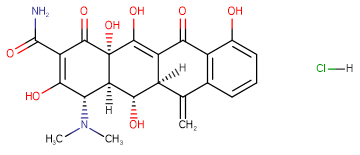
Methacycline hydrochloride
CAS No. 3963-95-9
Methacycline hydrochloride( 6-methylene Oxytetracycline | Rondomycin )
Catalog No. M14365 CAS No. 3963-95-9
Methacycline hydrochloride is a tetracycline antibiotic, and also an inhibitor of epithelial–mesenchymal transition (EMT) with IC50 of roughly 5 μM, used to treat various infections.
Purity : >98% (HPLC)
 COA
Datasheet
HNMR
HPLC
MSDS
Handing Instructions
COA
Datasheet
HNMR
HPLC
MSDS
Handing Instructions
| Size | Price / USD | Stock | Quantity |
| 100MG | 47 | In Stock |


|
| 200MG | 73 | In Stock |
|
| 500MG | Get Quote | In Stock |
|
| 1G | Get Quote | In Stock |
|
Biological Information
-
Product NameMethacycline hydrochloride
-
NoteResearch use only, not for human use.
-
Brief DescriptionMethacycline hydrochloride is a tetracycline antibiotic, and also an inhibitor of epithelial–mesenchymal transition (EMT) with IC50 of roughly 5 μM, used to treat various infections.
-
DescriptionMethacycline hydrochloride is a tetracycline antibiotic, and also an inhibitor of epithelial–mesenchymal transition (EMT) with IC50 of roughly 5 μM, used to treat various infections.(In Vitro):Methacycline hydrochloride is an inhibitor of A549 EMT with an IC50 of roughly 5 μM.In vitro, Methacycline hydrochloride (10, 20 μM; for 48 hours) inhibits TGF-β1-induced α-smooth muscle actin, Snail1, and collagen I of primary alveolar epithelial cells. Methacycline hydrochloride inhibits TGF-β1–induced non-Smad pathways, including c-Jun N-terminal kinase, p38, and Akt activation, but not Smad or β-catenin transcriptional activity. Methacycline has no effect on baseline c-Jun N-terminal kinase, p38, or Akt activities or lung fibroblast responses to TGF-β1. (In Vivo):In vivo, Methacycline hydrochloride (100 mg/kg/day; ip; beginning 10 days after intratracheal Bleomycin) improves survival at Day 17. Bleomycin-induced canonical EMT markers, Snail1, Twist1, collagen I, as well as fibronectin protein and mRNA, ARE attenuated by Methacycline hydrochloride (Day 17).
-
In Vitro——
-
In Vivo——
-
Synonyms6-methylene Oxytetracycline | Rondomycin
-
PathwayMicrobiology/Virology
-
Targetribosome
-
Recptor16S ribosome| 30S ribosome
-
Research AreaInfection
-
Indication——
Chemical Information
-
CAS Number3963-95-9
-
Formula Weight478.88
-
Molecular FormulaC22H23ClN2O8
-
Purity>98% (HPLC)
-
SolubilityWater: 5 mg/mL (10.44 mM); DMSO: 3 mg/mL (6.26 mM)
-
SMILESO=C(C(C1=O)=C(O)[C@@H](N(C)C)[C@]2([H])[C@@H](O)[C@]3([H])C(C4=C(C(C3=C(O)[C@@]21O)=O)C(O)=CC=C4)=C)N.[H]Cl
-
Chemical Name2-Naphthacenecarboxamide, 4-(dimethylamino)-1,4,4a,5,5a,6,11,12a-octahydro-3,5,10,12,12a-pentahydroxy-6-methylene-1,11-dioxo-, monohydrochloride, (4S,4aR,5S,5aR,12aS)-
Shipping & Storage Information
-
Storage(-20℃)
-
ShippingWith Ice Pack
-
Stability≥ 2 years
Reference
1.Xi Y, et al. Am J Respir Cell Mol Biol,?014, 50(1), 51-60.
molnova catalog



related products
-
Doxycycline
Doxycycline is a synthetic tetracycline derivative with similar antimicrobial activity.
-
Chlortetracycline hy...
Chlortetracycline hydrochloride is the first identified tetracycline antibiotic.
-
Tigecycline
Tigecycline is bacteriostatic and is a protein synthesis inhibitor by binding to the 30S ribosomal subunit of bacteria and thereby blocking entry of Aminoacyl-tRNA into the A site of the ribosome during prokaryotic translation.
