


 Cart
Cart
 sales@molnova.com



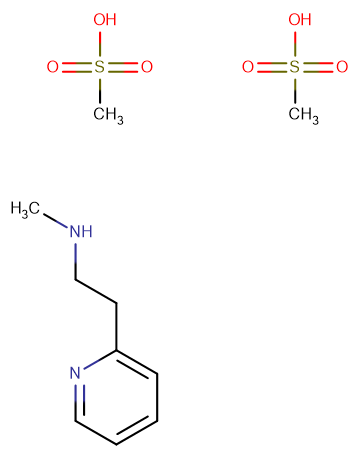
Betahistine mesylate
CAS No. 54856-23-4
Betahistine mesylate( —— )
Catalog No. M14976 CAS No. 54856-23-4
Betahistine is an antivertigo drug first used for treating vertigo assosicated with Ménière’s disease.
Purity : >98% (HPLC)
 COA
Datasheet
HNMR
HPLC
MSDS
Handing Instructions
COA
Datasheet
HNMR
HPLC
MSDS
Handing Instructions
| Size | Price / USD | Stock | Quantity |
| 1 mL x 10 mM in DMSO | 37 | In Stock |


|
| 50MG | 28 | In Stock |
|
| 100MG | 37 | In Stock |
|
| 200MG | Get Quote | In Stock |
|
| 500MG | 86 | In Stock |
|
| 1G | 124 | In Stock |
|
Biological Information
-
Product NameBetahistine mesylate
-
NoteResearch use only, not for human use.
-
Brief DescriptionBetahistine is an antivertigo drug first used for treating vertigo assosicated with Ménière’s disease.
-
DescriptionBetahistine is an antivertigo drug first used for treating vertigo assosicated with Ménière’s disease. It is also commonly used for patients with balance disorders.(In Vitro):Betahistine mesylate (0-10 μM) inhibits [125I]iodoproxyfan binding to membranes of CHO (rH3(445)R) and CHO (hH3(445)R) cells with IC50 values of 1.9 μM and 3.3 μM, respectively. Lead to Ki values of 1.4 μM and 2.5 μM, respectively.Betahistine mesylate (0-10 μM) has a regulating function on cAMP formation in CHO (rH3(445)R), CHO (rH3(413)R), and CHO (hH3(445)R) cells. At low concentrations, Betahistine mesylate behaves an apparent inverse agonist, and progressively enhances cAMP formation with EC50 values of 0.1 nM, 0.05 nM and 0.3 nM, respectively. In contrast, at concentrations higher than 10 nM, Betahistine mesylate inhibits cAMP formation with an EC50 value of 0.1 μM in CHO (rH3(445)R) and full agonist activity. (In Vivo):Betahistine mesylate (intraperitoneal or oral administration; 0.1-30 mg/kg; single dose) with acute administration has increased tele-methylhistamine (t-MeHA) levels with an ED50 of 0.4 mg/kg, indicating the inverse agonism. Besides, after acute oral administration, it increases t-MeHA levels with an ED50 of 2 mg/kg in male Swissmice.Betahistine mesylate (oral adminstration; 1 and 5 mg/kg; daily for 3 weeks) attenuates the severity of arthritis and reduces the levels of pro-inflammatory cytokines in the paw tissues of CIA mice.
-
In VitroBetahistine mesylate (0-10 μM) inhibits [125I]iodoproxyfan binding to membranes of CHO (rH3(445)R) and CHO (hH3(445)R) cells with IC50 values of 1.9 μM and 3.3 μM, respectively. Lead to Ki values of 1.4 μM and 2.5 μM, respectively.Betahistine mesylate (0-10 μM) has a regulating function on cAMP formation in CHO (rH3(445)R), CHO (rH3(413)R), and CHO (hH3(445)R) cells. At low concentrations, Betahistine mesylate behaves an apparent inverse agonist, and progressively enhances cAMP formation with EC50 values of 0.1 nM, 0.05 nM and 0.3 nM, respectively. In contrast, at concentrations higher than 10 nM, Betahistine mesylate inhibits cAMP formation with an EC50 value of 0.1 μM in CHO (rH3(445)R) and full agonist activity.
-
In VivoBetahistine mesylate (intraperitoneal or oral administration; 0.1-30 mg/kg; single dose) with acute administration has increased tele-methylhistamine (t-MeHA) levels with an ED50 of 0.4 mg/kg, indicating the inverse agonism. Besides, after acute oral administration, it increases t-MeHA levels with an ED50 of 2 mg/kg in male Swissmice.Betahistine mesylate (oral adminstration; 1 and 5 mg/kg; daily for 3 weeks) attenuates the severity of arthritis and reduces the levels of pro-inflammatory cytokines in the paw tissues of CIA mice. Animal Model:Collagen-induced arthritis (CIA) DBA/1 male mouse model Dosage:1 mg/kg; 5mg/kg Administration:Oral adminstration; day 21 to day 42 after a 21-day CIA induction Result:Ameliorated mouse CIA by decreasing joint destruction.
-
Synonyms——
-
PathwayGPCR/G Protein
-
TargetHistamine Receptor
-
RecptorH1 receptor| H3 receptor
-
Research Area——
-
Indication——
Chemical Information
-
CAS Number54856-23-4
-
Formula Weight328.4
-
Molecular FormulaC8H12N2·2(CH4O3S)
-
Purity>98% (HPLC)
-
SolubilitySoluble in DMSO
-
SMILESCS(O)(=O)=O.CS(O)(=O)=O.CNCCC1=CC=CC=N1
-
Chemical Name——
Shipping & Storage Information
-
Storage(-20℃)
-
ShippingWith Ice Pack
-
Stability≥ 2 years
Reference
1.Lacour M, Sterkers O. CNS Drugs. 2001; 15(11): 853-70.
molnova catalog



related products
-
Tesmilifene fumarate
Tesmilifene fumarate (DPPE fumarate) is an H1C receptor antagonist。
-
Tripelennamine hydro...
A first-generation antihistamine that acts primarily as H1 receptor antagonist.
-
Diphenhydramine hydr...
Diphenhydramine HCl (Benadryl), a histamine H1 antagonist used as an antiemetic, antitussive.
