


 Cart
Cart
 sales@molnova.com



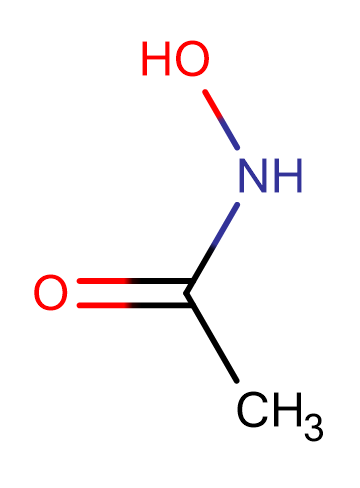
Acetohydroxamic acid
CAS No. 546-88-3
Acetohydroxamic acid( AHA | NSC 5073 | NSC 176136 | NSC 408425 )
Catalog No. M14966 CAS No. 546-88-3
Acetohydroxamic Acid, a synthetic drug derived from hydroxylamine and ethyl acetate, is similar in structure to urea.
Purity : >98% (HPLC)
 COA
Datasheet
HNMR
HPLC
MSDS
Handing Instructions
COA
Datasheet
HNMR
HPLC
MSDS
Handing Instructions
| Size | Price / USD | Stock | Quantity |
| 1 mL x 10 mM in DMSO | 28 | In Stock |


|
| 100MG | 27 | In Stock |
|
| 200MG | Get Quote | In Stock |
|
| 500MG | 50 | In Stock |
|
| 1G | 73 | In Stock |
|
Biological Information
-
Product NameAcetohydroxamic acid
-
NoteResearch use only, not for human use.
-
Brief DescriptionAcetohydroxamic Acid, a synthetic drug derived from hydroxylamine and ethyl acetate, is similar in structure to urea.
-
DescriptionAcetohydroxamic Acid, a synthetic drug derived from hydroxylamine and ethyl acetate, is similar in structure to urea. In the urine, it acts as an antagonist of the bacterial enzyme urease. Acetohydroxamic Acid has no direct antimicrobial action and does not acidify urine directly. It is used, in addition to antibiotics or medical procedures, to treat chronic urea-splitting urinary infections.
-
In Vitro——
-
In Vivo——
-
SynonymsAHA | NSC 5073 | NSC 176136 | NSC 408425
-
PathwayMetabolic Enzyme/Protease
-
TargetMMP
-
RecptorMMP
-
Research AreaInfection
-
Indication——
Chemical Information
-
CAS Number546-88-3
-
Formula Weight75.07
-
Molecular FormulaC2H5NO2
-
Purity>98% (HPLC)
-
SolubilitySoluble in Water
-
SMILESCC(NO)=O
-
Chemical NameAcetamide, N-hydroxy- (9CI)
Shipping & Storage Information
-
Storage(-20℃)
-
ShippingWith Ice Pack
-
Stability≥ 2 years
Reference
1.Palinska KA, et al. Microbiology. 2000 Dec;146 Pt 12:3099-107.
molnova catalog



related products
-
MMP-9-IN-7
Acetamide, N-[2-[(5-chloro-2 methoxyphenyl)amino]-4'-methyl[4,5'-bithiazol]-2'-yl]-inhibits pro-matrix metalloproteinase activation and can be used to prevent, treat or ameliorate MMP9 and/or MMP13-mediated syndromes.
-
DB04760
DB04760 is a highly selective, non-zinc-chelating inhibitor of MMP-13 (IC50: 8 nM). DB04760 obviously decreases paclitaxel neurotoxicity and has anticancer activity.
-
NSC 405020
NSC 405020 is a noncatalytic inhibitor of MT1-MMP, directly interacts with PEX domain of MT1-MMP, affects PEX homodimerization but not catalytic activity of MT1-MMP.
