


 Cart
Cart
 sales@molnova.com



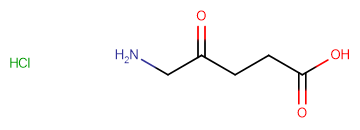
ALA hydrochloride
CAS No. 5451-09-2
ALA hydrochloride( 5-ALA | δ-Aminolevulinic Acid )
Catalog No. M14958 CAS No. 5451-09-2
5-Aminolevulinic acid hydrochloride is an intermediate in heme biosynthesis in the body and the universal precursor of tetrapyrroles.
Purity : >98% (HPLC)
 COA
Datasheet
HNMR
HPLC
MSDS
Handing Instructions
COA
Datasheet
HNMR
HPLC
MSDS
Handing Instructions
| Size | Price / USD | Stock | Quantity |
| 1 mL x 10 mM in DMSO | 46 | In Stock |


|
| 50MG | 30 | In Stock |
|
| 100MG | 41 | In Stock |
|
| 200MG | 43 | In Stock |
|
| 500MG | Get Quote | In Stock |
|
| 1G | 60 | In Stock |
|
Biological Information
-
Product NameALA hydrochloride
-
NoteResearch use only, not for human use.
-
Brief Description5-Aminolevulinic acid hydrochloride is an intermediate in heme biosynthesis in the body and the universal precursor of tetrapyrroles.
-
Description5-Aminolevulinic acid hydrochloride is an intermediate in heme biosynthesis in the body and the universal precursor of tetrapyrroles.(In Vitro):5-Aminolevulinic acid hydrochloride (ALA) is a non-fluorescent prodrug that leads to intracellular accumulation of fluorescent porphyrins in malignant gliomas-a finding that is under investigation for intraoperative identification and resection of these tumours. Median follow-up was 35.4 months (95% CI 1.0-56.7). Contrast-enhancing tumour was resected completely in 90 (65%) of 139 patients assigned 5-aminolevulinic acid compared with 47 (36%) of 131 assigned white light (difference between groups 29% [95% CI 17-40], p<0.0001). Patients allocated 5-aminolevulinic acid had higher 6-month progression free survival than did those allocated white light (41.0% [32.8-49.2] vs 21.1% [14.0-28.2]; difference between groups 19.9% [9.1-30.7], p=0.0003, Z test) . 5-ALA alone proved to be insufficient in attaining gross total resection without the danger of incurring postoperative neurological deterioration. Furthermore, in the case of functional grade III gliomas, iMRI in combination with functional neuronavigation was significantly superior to the 5-ALA resection technique.
-
In Vitro5-Aminolevulinic acid hydrochloride (ALA) is a non-fluorescent prodrug that leads to intracellular accumulation of fluorescent porphyrins in malignant gliomas-a finding that is under investigation for intraoperative identification and resection of these tumours. Median follow-up was 35.4 months (95% CI 1.0-56.7). Contrast-enhancing tumour was resected completely in 90 (65%) of 139 patients assigned 5-aminolevulinic acid compared with 47 (36%) of 131 assigned white light (difference between groups 29% [95% CI 17-40], p<0.0001). Patients allocated 5-aminolevulinic acid had higher 6-month progression free survival than did those allocated white light (41.0% [32.8-49.2] vs 21.1% [14.0-28.2]; difference between groups 19.9% [9.1-30.7], p=0.0003, Z test) . 5-ALA alone proved to be insufficient in attaining gross total resection without the danger of incurring postoperative neurological deterioration. Furthermore, in the case of functional grade III gliomas, iMRI in combination with functional neuronavigation was significantly superior to the 5-ALA resection technique.
-
In Vivo——
-
Synonyms5-ALA | δ-Aminolevulinic Acid
-
PathwayImmunology/Inflammation
-
TargetAmino Acids and Derivatives
-
RecptorAminolevulinic acid dehydratase
-
Research AreaMetabolic Disease
-
Indication——
Chemical Information
-
CAS Number5451-09-2
-
Formula Weight167.59
-
Molecular FormulaC5H10ClNO3
-
Purity>98% (HPLC)
-
SolubilityEthanol: 6 mg/mL (35.8 mM); Water: 34 mg/mL (202.87 mM); DMSO: 34 mg/mL (202.87 mM)
-
SMILESCl.NCC(=O)CCC(O)=O
-
Chemical Name——
Shipping & Storage Information
-
Storage(-20℃)
-
ShippingWith Ice Pack
-
Stability≥ 2 years
Reference
1.Vajpayee P, et al. Chemosphere. 2000 Oct;41(7):1075-82.
molnova catalog



related products
-
γ-Glu-Gly
γ-Glu-Gly (gamma-Glutamylglycine), a γ-glutamyl dipeptide, is a human lipid metabolite with a structure resembling that of GABA (γ-aminobutyric acid). It functions as an antagonist of excitatory amino acids.
-
Pepstatin
Pepstatin is a potent inhibitor of aspartyl proteases; inhibits the aspartic proteases cathepsin D, pepsin, and renin.
-
L-Cysteine methyl es...
Mecysteine hydrochloride is an antitussive, and an expectorant agent, used to relieve breathing difficulties caused by mucus.
