


 Cart
Cart
 sales@molnova.com



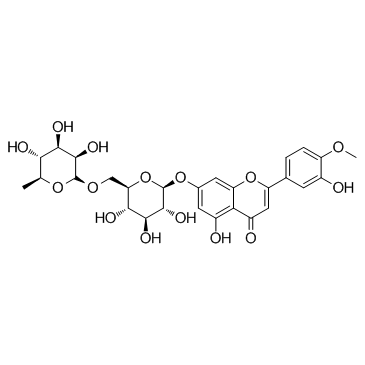
Diosmin
CAS No. 520-27-4
Diosmin( 3’,5,7-Trihydroxy-4’-methoxyflavone 7-rutinoside )
Catalog No. M14824 CAS No. 520-27-4
Diosmin is a semisynthetic phlebotropic agent and a member of the flavonoid family.
Purity : >98% (HPLC)
 COA
Datasheet
HNMR
HPLC
MSDS
Handing Instructions
COA
Datasheet
HNMR
HPLC
MSDS
Handing Instructions
| Size | Price / USD | Stock | Quantity |
| 25MG | 31 | In Stock |


|
| 50MG | 42 | In Stock |
|
| 100MG | 67 | In Stock |
|
| 200MG | Get Quote | In Stock |
|
| 500MG | 157 | In Stock |
|
| 1G | Get Quote | In Stock |
|
Biological Information
-
Product NameDiosmin
-
NoteResearch use only, not for human use.
-
Brief DescriptionDiosmin is a semisynthetic phlebotropic agent and a member of the flavonoid family.
-
DescriptionDiosmin is a semisynthetic phlebotropic agent and a member of the flavonoid family. Extracted from hesperidin;Store the product in sealed, cool and dry condition.(In Vitro):Treatment with Diosmin causes a dose dependent increase in the amount of adducts formed (up to a 7-fold increase in adducts at 5 μM Diosmin). At 5 μM, Diosmin increases the cytotoxicity of 7,12-dimethylbenz(a)anthracene, shifting the IC50 from an estimated 1.2 μM to 400 nM. Diosmin is not cytotoxic in itself at the concentrations tested. Diosmin causes an increase in CYPIAI activity in MCF-7 cells in a time- and dose-dependent fashion. Diosmin causes a dose-dependent increase in CYPIAI mRNA after 24 h of incubation, causes a long-lasting increase in CYPIAI mRNA accumu lation that reaches its peak after 48 h of incubation. (In Vivo):Diosmin significantly decreases the malondialdehyde (MDA) levels and increases the activities of total-superoxide dismutase (T-SOD), glutathione peroxidase (GSH-Px), and catalase (CAT) in the retina of rats compare with the ischemia group (P<0.05), and suppresses the ischemia/reperfusion (I/R)-induced reduction in the a- and b-wave amplitudes of the electroretinograms (ERGs) (P<0.05). The thickness of the entire retina, inner nuclear layer, inner plexiform layer, and outer retinal layer and the number of cells in the ganglion cell layer are significantly less after I/R injury (P<0.05), and Diosmin remarkably ameliorates these changes on retinal morphology. Diosmin also attenuates the I/R-induced loss of retinal ganglion cells (RGCs) of the rat retina (P<0.05).
-
In VitroTreatment with Diosmin causes a dose dependent increase in the amount of adducts formed (up to a 7-fold increase in adducts at 5 μM Diosmin). At 5 μM, Diosmin increases the cytotoxicity of 7,12-dimethylbenz(a)anthracene, shifting the IC50 from an estimated 1.2 μMto 400 nM. Diosmin is not cytotoxic in itself at the concentrations tested. Diosmin causes an increase in CYPIAI activity in MCF-7 cells in a time- and dose-dependent fashion. Diosmin causes a dose-dependent increase in CYPIAI mRNA after 24 h of incubation, causes a long-lasting increase in CYPIAI mRNA accumulation that reaches its peak after 48 h of incubation.
-
In VivoDiosmin significantly decreases the malondialdehyde (MDA) levels and increases the activities of total-superoxide dismutase (T-SOD), glutathione peroxidase (GSH-Px), and catalase (CAT)in the retina of rats compare with the ischemia group (P<0.05), and suppresses the ischemia/reperfusion (I/R)-induced reduction in the a- and b-wave amplitudes of the electroretinograms (ERGs) (P<0.05). The thickness of the entire retina, inner nuclear layer, inner plexiform layer, and outer retinal layer and the number of cells in the ganglion cell layer are significantly less after I/R injury (P<0.05), and Diosmin remarkably ameliorates these changes on retinal morphology. Diosmin also attenuates the I/R-induced loss of retinal ganglion cells (RGCs) of the rat retina (P<0.05).
-
Synonyms3’,5,7-Trihydroxy-4’-methoxyflavone 7-rutinoside
-
PathwayNeuroscience
-
TargetNorepinephrine
-
RecptorNorepinephrine (NE)
-
Research AreaOther Indications
-
Indication——
Chemical Information
-
CAS Number520-27-4
-
Formula Weight608.54
-
Molecular FormulaC28H32O15
-
Purity>98% (HPLC)
-
SolubilityDMSO: 6 mg/mL (9.85 mM)
-
SMILESOC1=C(C(C=C(C2=CC=C(OC)C(O)=C2)O3)=O)C3=CC(O[C@H]4[C@H](O)[C@@H](O)[C@H](O)[C@@H](CO[C@H]5[C@H](O)[C@H](O)[C@@H](O)[C@H](C)O5)O4)=C1
-
Chemical Name5-hydroxy-2-(3-hydroxy-4-methoxyphenyl)-7-(((2S,3R,4S,5S,6R)-3,4,5-trihydroxy-6-((((2R,3R,4R,5R,6S)-3,4,5-trihydroxy-6-methyltetrahydro-2H-pyran-2-yl)oxy)methyl)tetrahydro-2H-pyran-2-yl)oxy)-4H-chromen-4-one
Shipping & Storage Information
-
Storage(-20℃)
-
ShippingWith Ice Pack
-
Stability≥ 2 years
Reference
1.Veverková L, et al. Rozhl Chir. 2005 Aug;84(8):410-2, 414-6.
molnova catalog



related products
-
Amfepramone hydrochl...
A appetite depressant considered to produce less central nervous system disturbance than most drugs in this therapeutic category.
-
(S)-Viloxazine Hydro...
(S)-Viloxazine Hydrochloride, the S-isomer of Viloxazine. Viloxazine is a selective norepinephrine reuptake inhibitor (NRI) that can be used as an antidepressant.
-
Milnacipran hydrochl...
Milnacipran hydrochloride is a serotonin-norepinephrine reuptake inhibitor (SNRI) used in the clinical treatment of fibromyalgia.
