


 Cart
Cart
 sales@molnova.com



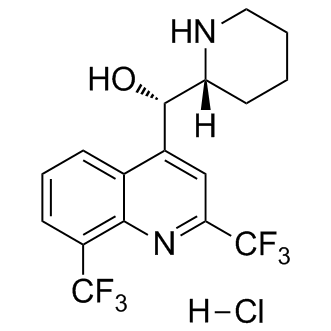
Mefloquine hydrochloride
CAS No. 51773-92-3
Mefloquine hydrochloride( Mefloquin hydrochloride )
Catalog No. M14802 CAS No. 51773-92-3
A quinoline antimalarial drug that is structurally related to the antiarrhythmic agent quinidine; inhibits autophagy and has been recognized as a potential target for cancer therapy.
Purity : >98% (HPLC)
 COA
Datasheet
HNMR
HPLC
MSDS
Handing Instructions
COA
Datasheet
HNMR
HPLC
MSDS
Handing Instructions
| Size | Price / USD | Stock | Quantity |
| 1 mL x 10 mM in DMSO | 48 | In Stock |


|
| 25MG | 29 | In Stock |
|
| 50MG | 39 | In Stock |
|
| 100MG | 50 | In Stock |
|
| 200MG | 67 | In Stock |
|
| 500MG | 91 | In Stock |
|
| 1G | Get Quote | In Stock |
|
Biological Information
-
Product NameMefloquine hydrochloride
-
NoteResearch use only, not for human use.
-
Brief DescriptionA quinoline antimalarial drug that is structurally related to the antiarrhythmic agent quinidine; inhibits autophagy and has been recognized as a potential target for cancer therapy.
-
DescriptionA quinoline antimalarial drug that is structurally related to the antiarrhythmic agent quinidine; inhibits autophagy and has been recognized as a potential target for cancer therapy.Bacterial Infection Approved(In Vitro):Mefloquine hydrochloride selectively inhibits prostate cancer (PCa) cell growth with an IC50 of ~10 μM. Mefloquine hydrochloride also induces hyperpolarization of the mitochondrial membrane potential (MMP), as well as ROS generation.Mefloquine hydrochloride (10 μM)-mediated ROS simultaneously downregulated Akt phosphorylation and activated ERK, JNK and AMPK signaling in PC3 cells.Mefloquine shows higher anti-SARS-CoV-2 activity than Hydroxychloroquine in VeroE6/TMPRSS2 and Calu-3 cells, with IC50 of 1.28 μM, IC90 of 2.31 μM, and IC99 of 4.39 μM in VeroE6/TMPRSS2 cells. Mefloquine inhibits viral entry after viral attachment to the target cell.(In Vivo):Mefloquine hydrochloride (5 mg/kg; i.p.; daily; 14 days) reverses the lower vertebral cancellous bone volume and bone formation; and has modest effects on cortical bone volume, thickness, and moment of inertia in old mice.
-
In VitroMefloquine hydrochloride selectively inhibits prostate cancer (PCa) cell growth with an IC50 of ~10 μM. Mefloquine hydrochloride also induces hyperpolarization of the mitochondrial membrane potential (MMP), as well as ROS generation.Mefloquine hydrochloride (10 μM)-mediated ROS simultaneously downregulated Akt phosphorylation and activated ERK, JNK and AMPK signaling in PC3 cells.Mefloquine shows higher anti-SARS-CoV-2 activity than Hydroxychloroquine in VeroE6/TMPRSS2 and Calu-3 cells, with IC50 of 1.28 μM, IC90 of 2.31 μM, and IC99 of 4.39 μM in VeroE6/TMPRSS2 cells. Mefloquine inhibits viral entry after viral attachment to the target cell.
-
In VivoMefloquine hydrochloride (5 mg/kg; i.p.; daily; 14 days) reverses the lower vertebral cancellous bone volume and bone formation; and has modest effects on cortical bone volume, thickness, and moment of inertia in old mice. Animal Model:Young 3.5-month-old and old 21-month-old female C57BL/6 mice Dosage:5 mg/kg Administration:Intraperitoneal injection; daily; 14 days Result:Reversed the lower vertebral cancellous bone volume and bone formation in old mice.
-
SynonymsMefloquin hydrochloride
-
PathwayAutophagy
-
TargetAutophagy
-
Recptorhemozoin
-
Research AreaInfection
-
IndicationBacterial Infection
Chemical Information
-
CAS Number51773-92-3
-
Formula Weight414.7731
-
Molecular FormulaC17H17ClF6N2O
-
Purity>98% (HPLC)
-
Solubility10 mM in DMSO
-
SMILESC1CCN[C@H](C1)[C@H](C2=CC(=NC3=C2C=CC=C3C(F)(F)F)C(F)(F)F)O.Cl
-
Chemical Name4-Quinolinemethanol, α-(2R)-2-piperidinyl-2,8-bis(trifluoromethyl)-, hydrochloride (1:1), (αS)-rel-
Shipping & Storage Information
-
Storage(-20℃)
-
ShippingWith Ice Pack
-
Stability≥ 2 years
Reference
1. Sharma N, et al. Cancer Lett. 2012 Dec 30;326(2):143-54.
2. Shin JH, et al. Neurosci Lett. 2012 May 2;515(2):162-7.
3. Shin JH, et al. Neurosci Lett. 2012 May 2;515(2):162-7.
molnova catalog



related products
-
Graveoline
Graveoline is an apoptosis and autophagy inducer in skin melanoma cancer cells.
-
Sulfamethoxazole
Sulfamethoxazole is a sulfonamide bacteriostatic antibiotic.
-
Py-BODIPY-NHS ester
Py-BODIPY-NHS ester is a small molecular dye with strong UV absorption that can be used to label living cells and immobilise cells.
