


 Cart
Cart
 sales@molnova.com



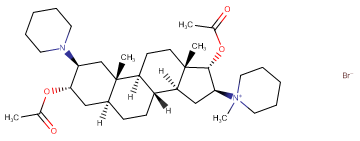
Vecuronium bromide
CAS No. 50700-72-6
Vecuronium bromide( NC 45 )
Catalog No. M14731 CAS No. 50700-72-6
Vecuronium (bromide) is a muscle relaxant in the category of non-depolarizing blocking agents.
Purity : >98% (HPLC)
 COA
Datasheet
HNMR
HPLC
MSDS
Handing Instructions
COA
Datasheet
HNMR
HPLC
MSDS
Handing Instructions
| Size | Price / USD | Stock | Quantity |
| 1 mL x 10 mM in DMSO | 46 | In Stock |


|
| 10MG | 29 | In Stock |
|
| 25MG | 43 | In Stock |
|
| 50MG | 63 | In Stock |
|
| 100MG | 91 | In Stock |
|
| 200MG | Get Quote | In Stock |
|
| 500MG | 202 | In Stock |
|
| 1G | Get Quote | In Stock |
|
Biological Information
-
Product NameVecuronium bromide
-
NoteResearch use only, not for human use.
-
Brief DescriptionVecuronium (bromide) is a muscle relaxant in the category of non-depolarizing blocking agents.
-
DescriptionVecuronium (bromide) is a muscle relaxant in the category of non-depolarizing blocking agents.(In Vitro):Vecuronium bromide (0-100 μM, 15 min) inhibits [3H] norepinephrine (NE) uptake to 65% at 100 μM in adrenal medullary cells.Vecuronium bromide (0-15 μM,72 hours) inhibits cancer cell proliferation and migration in a concentration-dependent manner.Vecuronium bromide (0-15 μM,72 hours) can significantly reduce cell viability by combining with cisplatin.(In Vivo):Vecuronium bromide (Intravenous injection, 0-5 μM, every 30 min, 2 hours) attenuates the response of carotid sinus nerve activity (CSNA) to hypoxia in a dose-dependent manner and inhibits the neural response of the carotid body to acetylcholine (ACh) in Wister rats.
-
In VitroVecuronium bromide (0-100 μM, 15 min) inhibits [3H] norepinephrine (NE) uptake to 65% at 100 μM in adrenal medullary cells.Vecuronium bromide (0-15 μM,72 hours) inhibits cancer cell proliferation and migration in a concentration-dependent manner.Vecuronium bromide (0-15 μM,72 hours) can significantly reduce cell viability by combining with cisplatin.Cell Proliferation Assay Cell Line:Lung cancer cell line (A549)Concentration:0-15 μM Incubation Time:72 hours Result:Inhibited cell proliferation at concentrations ranging from 5.0 μM to 15 μM.Cell Cytotoxicity Assay Cell Line:Lung cancer cell line (A549)Concentration:0-15 μM Incubation Time:72 hours Result:Resulted in a decrease in cell viability from 10 μM to 15 Μm by combining with cisplatin.
-
In VivoVecuronium bromide (Intravenous injection, 0-5 μM, every 30 min, 2 hours) attenuates the response of carotid sinus nerve activity (CSNA) to hypoxia in a dose-dependent manner and inhibits the neural response of the carotid body to acetylcholine (ACh) in Wister rats. Animal Model:Wister rats weighing 250-350 gDosage:0-5 μM Administration:Intravenous injection; every 30 min; 2 hours Result:Significantly diminished CSNA response to hypoxia at the concentration of 5 μM and reduced carotid sinus nerve response to ACh at 0.5 μM.
-
SynonymsNC 45
-
PathwayEndocrinology/Hormones
-
TargetAChR
-
RecptornAChR
-
Research AreaNeurological Disease
-
Indication——
Chemical Information
-
CAS Number50700-72-6
-
Formula Weight637.73
-
Molecular FormulaC34H57BrN2O4
-
Purity>98% (HPLC)
-
SolubilityEthanol: 100 mg/mL (156.8 mM); Water: 4 mg/mL (6.27 mM); DMSO: 100 mg/mL (156.8 mM)
-
SMILESCC(O[C@@H]1[C@@H](N2CCCCC2)C[C@]3(C)[C@@]4([H])CC[C@]5(C)[C@H](OC(C)=O)[C@@H]([N+]6(C)CCCCC6)C[C@@]5([H])[C@]4([H])CC[C@@]3([H])C1)=O.[Br-]
-
Chemical Name1-((2S,3S,5S,8R,9S,10S,13S,14S,16S,17S)-3,17-diacetoxy-10,13-dimethyl-2-(piperidin-1-yl)hexadecahydro-1H-cyclopenta[a]phenanthren-16-yl)-1-methylpiperidin-1-ium bromide
Shipping & Storage Information
-
Storage(-20℃)
-
ShippingWith Ice Pack
-
Stability≥ 2 years
Reference
1.Jonsson Fagerlund M, et al. Anesthesiology. 2009 Jun;110(6):1244-52.
molnova catalog



related products
-
Carbaryl
A carbamate insecticide and parasiticide. It is a potent anticholinesterase agent belonging to the carbamate group of reversible cholinesterase inhibitors.
-
Neoeriocitrin
Neoeriocitrin is a natural product isolated from Drynaria Rhizome, shows activity on proliferation and osteogenic differentiation in MC3T3-E1.?
-
3-Epioleanolic acid
3-Epioleanolic acid and oleanonic acid possess varying degrees of agonist activity on uterine smooth muscle with minor changes in the molecular structure affecting its intrinsic activity on uterine muscle.
