


 Cart
Cart
 sales@molnova.com



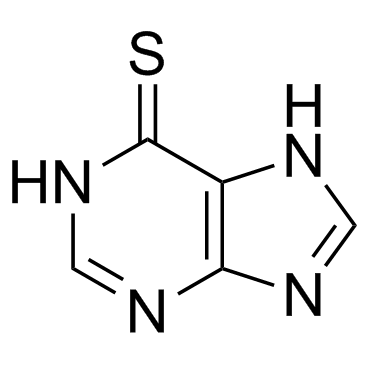
Mercaptopurine (6-MP)
CAS No. 50-44-2
Mercaptopurine (6-MP)( 6-MP )
Catalog No. M14718 CAS No. 50-44-2
Mercaptopurine (6-mercaptopurine; 6-MP) is an immunosuppressive drug.
Purity : >98% (HPLC)
 COA
Datasheet
HNMR
HPLC
MSDS
Handing Instructions
COA
Datasheet
HNMR
HPLC
MSDS
Handing Instructions
| Size | Price / USD | Stock | Quantity |
| 1 mL x 10 mM in DMSO | 48 | In Stock |


|
| 25MG | 29 | In Stock |
|
| 50MG | 43 | In Stock |
|
| 100MG | 61 | In Stock |
|
| 200MG | Get Quote | In Stock |
|
| 500MG | 77 | In Stock |
|
| 1G | 111 | In Stock |
|
Biological Information
-
Product NameMercaptopurine (6-MP)
-
NoteResearch use only, not for human use.
-
Brief DescriptionMercaptopurine (6-mercaptopurine; 6-MP) is an immunosuppressive drug.
-
DescriptionMercaptopurine (6-mercaptopurine; 6-MP) is an immunosuppressive drug; is a thiopurine.(In Vitro):6-Mercaptopurine hydrate (6-MP) induces NR4A3 transcriptional activity 1.6- to 11-fold (P<0.01) in a dose-responsive manner. It is found that 6-Mercaptopurine hydrate leads to a dose-dependent increase in NR4A3 protein levels. 6-MP treatment increases cell surface GLUT4 in both basal cells 1.8- to 3.6-fold (P<0.01) and insulin-stimulated cells 2.9- to 4.4-fold (P<0.01) over that in controls. It is also found that 6-Mercaptopurine hydrate increases phospho-AS160 significantly in a dose-responsive manner under both basal and insulin-stimulated conditions.(In Vivo):In the fetal telencephalons of the 6-Mercaptopurine hydrate (6-MP)-treated group, the S phase cell population increases at 36 and 48 h and returns to the control level at 72 h after treatment. The G2/M phase cell population begins to increase at 24 h, peaks at 36 h, decreases at 48 h, and finally returnes to the control level at 72 h. On the other hand, the sub-G1 phase cell population (apoptotic cells) begins to increase at 36 h, peaks at 48 h, and then decreases at 72 h.
-
In Vitro6-Mercaptopurine hydrate (6-MP) induces NR4A3 transcriptional activity 1.6- to 11-fold (P<0.01) in a dose-responsive manner. It is found that 6-Mercaptopurine hydrate leads to a dose-dependent increase in NR4A3 protein levels. 6-MP treatment increases cell surface GLUT4 in both basal cells 1.8- to 3.6-fold (P<0.01) and insulin-stimulated cells 2.9- to 4.4-fold (P<0.01) over that in controls. It is also found that 6-Mercaptopurine hydrate increases phospho-AS160 significantly in a dose-responsive manner under both basal and insulin-stimulated conditions.
-
In VivoIn the fetal telencephalons of the 6-Mercaptopurine hydrate (6-MP)-treated group, the S phase cell population increases at 36 and 48 h and returns to the control level at 72 h after treatment. The G2/M phase cell population begins to increase at 24 h, peaks at 36 h, decreases at 48 h, and finally returnes to the control level at 72 h. On the other hand, the sub-G1 phase cell population (apoptotic cells) begins to increase at 36 h, peaks at 48 h, and then decreases at 72 h.
-
Synonyms6-MP
-
PathwayMetabolic Enzyme/Protease
-
TargetDehydrogenase
-
RecptorIMPDH| HPRT
-
Research AreaOther Indications
-
Indication——
Chemical Information
-
CAS Number50-44-2
-
Formula Weight152.18
-
Molecular FormulaC5H4N4S
-
Purity>98% (HPLC)
-
SolubilityDMSO: 30 mg/mL (197.13 mM)
-
SMILESS=C1NC=NC2=C1NC=N2
-
Chemical Name1H-purine-6(7H)-thione.
Shipping & Storage Information
-
Storage(-20℃)
-
ShippingWith Ice Pack
-
Stability≥ 2 years
Reference
1.Dubinsky MC, et al. Clin Gastroenterol Hepatol. 2004 Sep;2(9):731-43.
molnova catalog



related products
-
AGI-14100
AGI-14100 is a novel and orally available mIDH1 inhibitor.AGI-14100 is used for the treatment of primary human myeloid leukemia.
-
DHODH-IN-15
DHODH-IN-15 is the hydroxyfuran analogue of A771726.
-
IDH889
IDH889 is a brain penetrant, an allosteric and mutant specific IDH1 inhibitor. IDH889 has effective selectivity for IDH1 R132* mutations (IC50s: 0.02 μM, 0.072 μM, and 1.38 μM for IDH1R132H, IDH1R132C, and IDH1wt).
