


 Cart
Cart
 sales@molnova.com



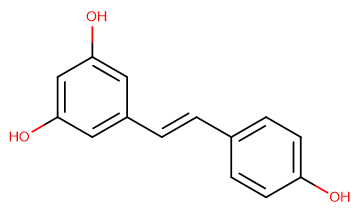
Resveratrol
CAS No. 501-36-0
Resveratrol( (E)-Resveratrol )
Catalog No. M14685 CAS No. 501-36-0
Resveratrol is a phytoalexin produced naturally by several plants with anti-Y, anti-inflammatory, blood-sugar-lowering and other beneficial cardiovascular effects.
Purity : >98% (HPLC)
 COA
Datasheet
HNMR
HPLC
MSDS
Handing Instructions
COA
Datasheet
HNMR
HPLC
MSDS
Handing Instructions
| Size | Price / USD | Stock | Quantity |
| 1 mL x 10 mM in DMSO | 48 | In Stock |


|
| 100MG | 33 | In Stock |
|
| 200MG | 47 | In Stock |
|
| 500MG | 71 | In Stock |
|
| 1G | Get Quote | In Stock |
|
Biological Information
-
Product NameResveratrol
-
NoteResearch use only, not for human use.
-
Brief DescriptionResveratrol is a phytoalexin produced naturally by several plants with anti-Y, anti-inflammatory, blood-sugar-lowering and other beneficial cardiovascular effects.
-
DescriptionResveratrol is a phytoalexin produced naturally by several plants with anti-Y, anti-inflammatory, blood-sugar-lowering and other beneficial cardiovascular effects.(In Vitro):Resveratrol (trans-Resveratrol; SRT501) is one of the numerous polyphenolic compounds found in several vegetal sources In the vast majority of cases, Resveratrol displays inhibitory/activatory effects in the micromolar range, which is potentially attainable pharmacologically, although targets with affinities in the nanomolar range have also been reported.MCF-7 cells are plated in DME-F12 medium supplemented with 5% FBS in the presence of increasing concentrations of Resveratrol. Control cells are treated with the same volume of vehicle only (0.1% ethanol). Resveratrol inhibits the growth of MCF-7 cells in a dose-dependent fashion. Addition of 10 μM Resveratrol results in an 82% inhibition of MCF-7 cell growth after 6 days while at 1 μM, only a 10% inhibition is observed. The cells treated with 10 μM Resveratrol have a doubling time of 60 hr whereas control cells doubled every 30 hr. Trypan blue exclusion assay shows that at concentrations of 10 μM or lower, Resveratrol does not affect cell viability (90% viable cells) whereas at 100 μM, only 50% of the cells are viable after 6 days of Resveratrol treatment. Moreover, MCF-7 cells do not undergo apoptosis after incubation with Resveratrol at concentration of 10 μM as determined by ApoAlert Annexin V Apoptosis kit.Resveratrol increases the production of nitric oxide (NO) in endothelial cells by upregulating the expression of endothelial NO synthase (eNOS), stimulating eNOS enzymatic activity, and preventing eNOS uncoupling. (In Vivo):The average tumor volume is reduced by treatment with Resveratrol (trans-Resveratrol; SRT501) at a dose of 50 mg/kg body weight (195.5±124.8 mm3; P<0.05) or 100 mg/kg body weight (81.7±70.5 mm3; P<0.001) compare with the vehicle-treated animals (315±94 mm3). There is a good correlation between the tumor volume and the tumor mass.
-
In Vitro——
-
In Vivo——
-
Synonyms(E)-Resveratrol
-
PathwayChromatin/Epigenetic
-
TargetCOX
-
RecptorCOX-1| COX-2| DNA polymerase α| IKKβ| LOX| Quinone reductase 2| SIRT1| SIRT2
-
Research AreaOther Indications
-
Indication——
Chemical Information
-
CAS Number501-36-0
-
Formula Weight228.24
-
Molecular FormulaC14H12O3
-
Purity>98% (HPLC)
-
SolubilityDMSO: 45 mg/mL warmed (197.16 mM)
-
SMILESOC1=CC(/C=C/C2=CC=C(O)C=C2)=CC(O)=C1
-
Chemical Name(E)-5-(4-hydroxystyryl)benzene-1,3-diol
Shipping & Storage Information
-
Storage(-20℃)
-
ShippingWith Ice Pack
-
Stability≥ 2 years
Reference
1.Pirola L, et al. IUBMB Life, 2008, 60(5), 323-332.
molnova catalog



related products
-
Tolfenamic Acid
Tolfenamic acid (TA) is one of the class of non-steroidal anti-inflammatory drugs (NSAIDs).
-
Cimicoxib
Cimicoxib is a potent and selective inhibitor of COX-2 with anti-inflammatory and analgesic activity.
-
COX-2-IN-1
COX-2-IN-1 is a potent and selective COX-2 inhibitor (IC50: 3.9 μM).
