


 Cart
Cart
 sales@molnova.com



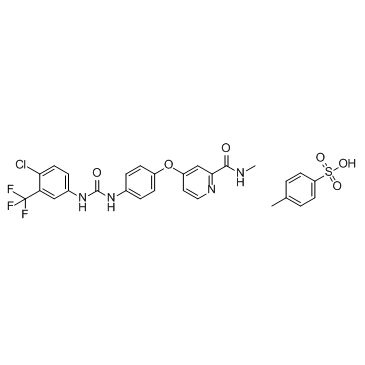
Sorafenib tosylate
CAS No. 475207-59-1
Sorafenib tosylate( Bay 43-9006 | Bay 43-9006 )
Catalog No. M14580 CAS No. 475207-59-1
A potent, orally available Raf inhibitor with IC50 of 6, 22, and 38 nM for Raf-1, wt Braf, and BRaf V599E, respectively.
Purity : >98% (HPLC)
 COA
Datasheet
HNMR
HPLC
MSDS
Handing Instructions
COA
Datasheet
HNMR
HPLC
MSDS
Handing Instructions
| Size | Price / USD | Stock | Quantity |
| 1 mL x 10 mM in DMSO | 54 | In Stock |


|
| 50MG | 34 | In Stock |
|
| 100MG | 49 | In Stock |
|
| 200MG | 57 | In Stock |
|
| 500MG | 62 | In Stock |
|
| 1G | 89 | In Stock |
|
Biological Information
-
Product NameSorafenib tosylate
-
NoteResearch use only, not for human use.
-
Brief DescriptionA potent, orally available Raf inhibitor with IC50 of 6, 22, and 38 nM for Raf-1, wt Braf, and BRaf V599E, respectively.
-
DescriptionA potent, orally available Raf inhibitor with IC50 of 6, 22, and 38 nM for Raf-1, wt Braf, and BRaf V599E, respectively; Also demonstrates potent inhibition of certain proangiogenic RTKs, including VEGFR-2, PDGFR-β, VEGFR-3, Flt-3, c-Kit (IC50<100 nM); Exhibits broad spectrum oral antitumor activity and targets the RAF/MEK/ERK pathway and receptor tyrosine kinases involved in tumor progression and angiogenesis.Kidney Cancer Approved(In Vitro):Sorafenib Tosylate also inhibits BRAFwt (IC50=22 nM), BRAFV599E (IC50=38 nM), VEGFR-2 (IC50=90 nM), VEGFR-3 (IC50=20 nM), PDGFR-β (IC50=57 nM), c-KIT (IC50=68 nM), and Flt3 (IC50=58 nM) in biochemical assays. Sorafenib-induced phosphorylation of c-Met, p70S6K and 4EBP1 is significantly reduced when 10-0505 cells are co-treated with anti-human anti-HGF antibody, suggesting that treatment with Sorafenib Tosylate leads to increased HGF secretion and activation of c-Met and mTOR targets. (In Vivo):Sorafenib Tosylate (10, 30, 50 and 100 mg/kg, orally) treatment inhibits the tumor growth of 06-0606 and 10-0505 xenografts in a dose-dependent manner (P<0.01). The growth rate of 06-0606 and 10-0505 xenografts is also significantly reduced by Sorafenib. The weights of 06-0606 tumors in mice that are treated with Sorafenib 50 mg/kg and 100 mg/kg are approximately 13% and 5% of the controls, respectively. 50 mg dose of Sorafenib significantly inhibits tumor growth in mice with lines 5-1318, 26-1004 and 10-0505 (P<0.01). For 50 mg dose, the T/C ratio, where T and C are the median weight (mg) of Sorafenib- and vehicle-treated tumors at the end of the treatment, respectively, for 06-0606, 26-1004, 5-1318, and 10-0505 xenografts is 0.13, 0.10, 0.12 and 0.49, respectively. The survival rate is 73.3 % in Diethyl nitrosamine (DENA) group and 83.3 % in Sorafenib group compared to 100 % in the normal control group. DENA group shows a significant increase in liver index (1.51-fold increase, p<0.05) compared to normal control group, while treatment with Sorafenib shows significant decrease (p<0.05) in liver index when compared to DENA group. The liver index in Sorafenib group significantly decreases to lower than its value in the normal control.
-
In VitroSorafenib Tosylate also inhibits BRAFwt (IC50=22 nM), BRAFV599E (IC50=38 nM), VEGFR-2 (IC50=90 nM), VEGFR-3 (IC50=20 nM), PDGFR-β (IC50=57 nM), c-KIT (IC50=68 nM), and Flt3 (IC50=58 nM) in biochemical assays. Sorafenib Tosylate-induced phosphorylation of c-Met, p70S6K and 4EBP1 is significantly reduced when 10-0505 cells are co-treated with anti-human anti-HGF antibody, suggesting that treatment with Sorafenib Tosylate leads to increased HGF secretion and activation of c-Met and mTOR targets.
-
In VivoSorafenib Tosylate (10, 30, 50 and 100 mg/kg, orally) treatment inhibits the tumor growth of 06-0606 and 10-0505 xenografts in a dose-dependent manner (P<0.01). The growth rate of 06-0606 and 10-0505 xenografts is also significantly reduced by Sorafenib. The weights of 06-0606 tumors in mice that are treated with Sorafenib 50 mg/kg and 100 mg/kg are approximately 13% and 5% of the controls, respectively. 50 mg dose of Sorafenib significantly inhibits tumor growth in mice with lines 5-1318, 26-1004 and 10-0505 (P<0.01). For 50 mg dose, the T/C ratio, where T and C are the median weight (mg) of Sorafenib- and vehicle-treated tumors at the end of the treatment, respectively, for 06-0606, 26-1004, 5-1318, and 10-0505 xenografts is 0.13, 0.10, 0.12 and 0.49, respectively. The survival rate is 73.3 % in Diethyl nitrosamine (DENA) group and 83.3 % in Sorafenib group compared to 100 % in the normal control group. DENA group shows a significant increase in liver index (1.51-fold increase, p<0.05) compared to normal control group, while treatment with Sorafenib shows significant decrease (p<0.05) in liver index when compared to DENA group. The liver index in Sorafenib group significantly decreases to lower than its value in the normal control.
-
SynonymsBay 43-9006 | Bay 43-9006
-
PathwayMAPK/ERK Signaling
-
TargetRaf
-
RecptorB-Raf|B-Raf(V599E)|c-Kit|FGFR1|FLT3|mPDGFRβ|PDGFRβ|Raf-1|VEGFR2|VEGFR2/Flk1
-
Research AreaCancer
-
IndicationKidney Cancer
Chemical Information
-
CAS Number475207-59-1
-
Formula Weight637.0266
-
Molecular FormulaC28H24ClF3N4O6S
-
Purity>98% (HPLC)
-
SolubilityDMSO: ≥ 31 mg/mL
-
SMILESCC1=CC=C(C=C1)S(O)(=O)=O.CNC(=O)C1=NC=CC(OC2=CC=C(NC(=O)NC3=CC(=C(Cl)C=C3)C(F)(F)F)C=C2)=C1
-
Chemical Name2-Pyridinecarboxamide, 4-[4-[[[[4-chloro-3-(trifluoromethyl)phenyl]amino]carbonyl]amino]phenoxy]-N-methyl-, 4-methylbenzenesulfonate (1:1)
Shipping & Storage Information
-
Storage(-20℃)
-
ShippingWith Ice Pack
-
Stability≥ 2 years
Reference
1. Wilhelm SM, et al. Cancer Res. 2004 Oct 1;64(19):7099-109.
2. Carlomagno F, et al. J Natl Cancer Inst. 2006 Mar 1;98(5):326-34.
4. Lyons JF, et al. Endocr Relat Cancer. 2001 Sep;8(3):219-25.
molnova catalog



related products
-
B-Raf IN 2
B-Raf IN 2, compound Ia, is a highly effective and specific inhibitor of BRAF. It exhibits significant potential for cancer research.
-
GDC-0879
A potent and selective B-Raf kinase inhibitor with IC50 of 0.13 nM against purified B-Raf V600E and a cellular pERK IC50 of 63 nM in the MALME-3M cell line.
-
GW 5074
A potent, selective c-Raf inhibitor with IC50 of 9 nM.
