


 Cart
Cart
 sales@molnova.com



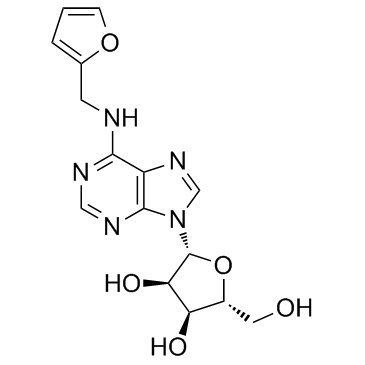
Kinetin riboside
CAS No. 4338-47-0
Kinetin riboside( N6-Furfuryladenosine | FAdo )
Catalog No. M14476 CAS No. 4338-47-0
A cytokinin analog that displays potent antiproliferative activity against various human cancer cell lines.
Purity : >98% (HPLC)
 COA
Datasheet
HNMR
HPLC
MSDS
Handing Instructions
COA
Datasheet
HNMR
HPLC
MSDS
Handing Instructions
| Size | Price / USD | Stock | Quantity |
| 1 mL x 10 mM in DMSO | 46 | In Stock |


|
| 25MG | 29 | In Stock |
|
| 100MG | Get Quote | In Stock |
|
| 200MG | Get Quote | In Stock |
|
| 500MG | Get Quote | In Stock |
|
| 1G | Get Quote | In Stock |
|
Biological Information
-
Product NameKinetin riboside
-
NoteResearch use only, not for human use.
-
Brief DescriptionA cytokinin analog that displays potent antiproliferative activity against various human cancer cell lines.
-
DescriptionA cytokinin analog that displays potent antiproliferative activity against various human cancer cell lines; inhibits MiPaCa-2 cell proliferation with IC50 of 0.27 uM; induceds marked suppression of CCND2 transcription and rapidly suppresses cyclin D1 and D2 protein expression in primary myeloma cells and tumor lines, causing cell cycle arrest, tumor cell-selective apoptosis, and inhibition of myeloma growth in xenografted mice; also can activate PINK1 in cells independent of mitochondrial depolarization.
-
In VitroKinetin riboside displays antiproliferative and apoptogenic activity against various human cancer cell lines. Kinetin riboside is able to inhibit the proliferation in HCT-15 human colon cancer cells in a dose-dependent manner (IC50=2.5 μM). Kinetin riboside induces apoptosis in HeLa and mouse melanoma B16F-10 cells. Kinetin riboside disrupts the mitochondrial membrane potential and induces the release of cytochrome c and activation of caspase-3. Bad are up-regulated while Bcl-2 is down-regulated under kinetin riboside exposure.
-
In VivoKinetin riboside significantly suppresses tumor growth. The most effective anti-melanoma response is elicited at 40 mg/kg.
-
SynonymsN6-Furfuryladenosine | FAdo
-
PathwayApoptosis
-
TargetApoptosis
-
RecptorApoptosis
-
Research Area——
-
Indication——
Chemical Information
-
CAS Number4338-47-0
-
Formula Weight347.32598
-
Molecular FormulaC15H17N5O5
-
Purity>98% (HPLC)
-
SolubilityDMSO: ≥ 29 mg/mL
-
SMILESO[C@H]1[C@H](N2C=NC3=C(NCC4=CC=CO4)N=CN=C23)O[C@H](CO)[C@H]1O
-
Chemical NameAdenosine, N-(2-furanylmethyl)-
Shipping & Storage Information
-
Storage(-20℃)
-
ShippingWith Ice Pack
-
Stability≥ 2 years
Reference
1. Osgerby L, et al. J Med Chem. 2017 Apr 27;60(8):3518-3524.
2. Tiedemann RE, et al. J Clin Invest. 2008 May;118(5):1750-64.
3. Hertz NT, et al. Cell. 2013 Aug 15;154(4):737-47.
4. Choi BH, et al. J Biol Chem. 2010 Mar 26;285(13):9770-9.
molnova catalog



related products
-
Tubulin polymerizati...
Tubulin polymerization-IN-43 is an inhibitor of tubulin polymerisation.
-
DB2313
DB2313 is a potent transcription factor PU.1 inhibitor, IC50=14 nM. DB2313 disrupts the interaction of PU.1 with target gene promoters. DB2313 induces apoptosis of acute myeloid leukemia (AML) cells, and has anticancer effects
-
Pitstop 2
Pitstop 2 is a inhibitor of clathrin, and inhibits clathrin-mediated endocytosis (CME) by associating with the terminal domain of clathrin. It has the potential for anti-cancer research.
