


 Cart
Cart
 sales@molnova.com



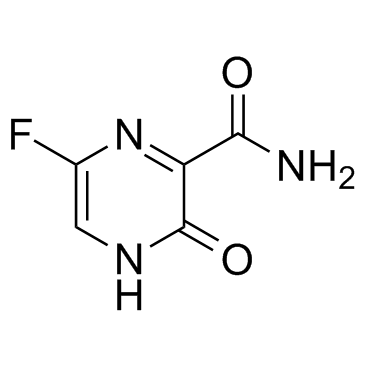
Favipiravir
CAS No. 259793-96-9
Favipiravir( T 705 )
Catalog No. M13785 CAS No. 259793-96-9
Favipiravir (T705) is a pyrazinecarboxamide derivative that is active against influenza viruses, West Nile virus, yellow fever virus, foot-and-mouth disease virus as well as other flaviviruses, arenaviruses, bunyaviruses and alphaviruses.
Purity : >98% (HPLC)
 COA
Datasheet
HNMR
HPLC
MSDS
Handing Instructions
COA
Datasheet
HNMR
HPLC
MSDS
Handing Instructions
| Size | Price / USD | Stock | Quantity |
| 1 mL x 10 mM in DMSO | 43 | In Stock |


|
| 5MG | 39 | In Stock |
|
| 10MG | 54 | In Stock |
|
| 50MG | 76 | In Stock |
|
| 100MG | 115 | In Stock |
|
| 200MG | Get Quote | In Stock |
|
| 500MG | 293 | In Stock |
|
| 1G | Get Quote | In Stock |
|
Biological Information
-
Product NameFavipiravir
-
NoteResearch use only, not for human use.
-
Brief DescriptionFavipiravir (T705) is a pyrazinecarboxamide derivative that is active against influenza viruses, West Nile virus, yellow fever virus, foot-and-mouth disease virus as well as other flaviviruses, arenaviruses, bunyaviruses and alphaviruses.
-
DescriptionFavipiravir (T705) is a pyrazinecarboxamide derivative that is active against influenza viruses, West Nile virus, yellow fever virus, foot-and-mouth disease virus as well as other flaviviruses, arenaviruses, bunyaviruses and alphaviruses; shows potent inhibitory activity against influenza A, B, and C viruses, with IC50s of 0.013 to 0.48 ug/ml.Influenza Approved(In Vitro):Favipiravir (T 705) is an antiviral drug that selectively inhibits the RNA-dependent RNA polymerase of influenza virus. Favipiravir (T 705) is a novel antiviral compound that selectively and potently inhibits the RNA-dependent RNA polymerase (RdRP) of influenza and many other RNA viruses. Favipiravir-RTP does not inhibit the human DNA polymerase α, β or γ with IC50>1 mM. The IC50 for the human RNA polymerase II is 905 μM; Favipiravir is therefore 2,650 times more selective for the influenza virus RdRP, consistent with the lack of inhibition of host-cell DNA and RNA synthesis. Favipiravir (T 705) acts as a pro-drug, its cytotoxicity is expected to be cell-line dependent. Favipiravir inhibits in a dose-dependent manner MNV-induced CPE (EC50: 250±11 μM) and MNV RNA synthesis in cell culture (EC50:124±42 μM). Despite this rather modest antiviral activity, Favipiravir (T 705) is able to completely inhibit norovirus replication at a concentration of 100 μg/mL, which is a concentration that has little or no adverse effect on the host cell (cell viability >80%).(In Vivo):Favipiravir (T 705) (30 mg/kg/day, orally) improves survival compare to placebo. Favipiravir (T 705) also provides significant protection against the A/Duck/MN/1525/81(H5N1) virus at a dose of 33 mg/kg/day or more, regardless of the number of daily doses. When given 4 times a day, all mice survive.
-
In VitroFavipiravir (T 705) is an antiviral drug that selectively inhibits the RNA-dependent RNA polymerase of influenza virus. Favipiravir (T 705) is a novel antiviral compound that selectively and potently inhibits the RNA-dependent RNA polymerase (RdRP) of influenza and many other RNA viruses. Favipiravir-RTP does not inhibit the human DNA polymerase α, β or γ with IC50>1 mM. The IC50 for the human RNA polymerase II is 905 μM; Favipiravir is therefore 2,650 times more selective for the influenza virus RdRP, consistent with the lack of inhibition of host-cell DNA and RNA synthesis. Favipiravir (T 705) acts as a pro-drug, its cytotoxicity is expected to be cell-line dependent. Favipiravir inhibits in a dose-dependent manner MNV-induced CPE (EC50: 250±11 μM) and MNV RNA synthesis in cell culture (EC50:124±42 μM). Despite this rather modest antiviral activity, Favipiravir (T 705) is able to completely inhibit norovirus replication at a concentration of 100 μg/mL, which is a concentration that has little or no adverse effect on the host cell (cell viability >80%).
-
In VivoFavipiravir (T 705) (30 mg/kg/day, orally) improves survival compare to placebo. Favipiravir (T 705) also provides significant protection against the A/Duck/MN/1525/81(H5N1) virus at a dose of 33 mg/kg/day or more, regardless of the number of daily doses. When given 4 times a day, all mice survive.
-
SynonymsT 705
-
PathwayMicrobiology/Virology
-
TargetInfluenza Virus
-
RecptorRNA-dependentRNApolymerase
-
Research AreaInfection
-
IndicationInfluenza
Chemical Information
-
CAS Number259793-96-9
-
Formula Weight157.1
-
Molecular FormulaC5H4FN3O2
-
Purity>98% (HPLC)
-
SolubilityDMSO: 29 mg/mL (184.6 mM); Ethanol: 12 mg/mL (76.4 mM); Water: 5 mg/mL (31.82 mM), warmed ( < 1 mg/ml refers to the product slightly soluble or insoluble )
-
SMILESO=C(C1=NC(F)=CN=C1O)N
-
Chemical Name6-fluoro-3-hydroxy-2-pyrazinecarboxamide
Shipping & Storage Information
-
Storage(-20℃)
-
ShippingWith Ice Pack
-
Stability≥ 2 years
Reference
1. Furuta Y, et al. Antimicrob Agents Chemother. 2002 Apr;46(4):977-81.
2. Furuta Y, et al. Antimicrob Agents Chemother. 2005 Mar;49(3):981-6.
3. Furuta Y, et al. Antiviral Res. 2009 Jun;82(3):95-102.
molnova catalog



related products
-
Nucleozin
A small-molecule influenza A nucleoprotein (NP) inhibitor that triggers the aggregation of NP and inhibits its nuclear accumulation.
-
Influenza HA 126-138
Influenza HA (126-138) is a influenza virus hemagglutinin (HA) peptide comprising amino acids 126-138, induces thymic and peripheral T-cell apoptosis.
-
N-(1-benzyl-4-piperi...
N-(1-benzyl-4-piperidyl)adamantane-1-carboxamide inhibiting the entry of Ebola virus in host cells by binding to the surface glycoprotein?the compound inhibited the Ebola virus with EC50 of 3.9 μM.
