


 Cart
Cart
 sales@molnova.com



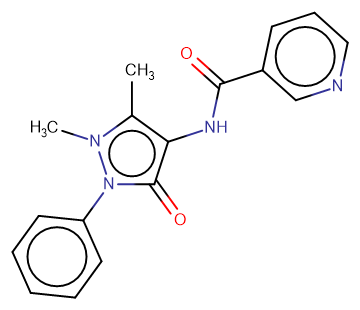
Nifenazone
CAS No. 2139-47-1
Nifenazone( N-Antipyrinylnicotinamide, Niapyrin, Nicazane, Nicodon, Nicodone, Nicofesone )
Catalog No. M13417 CAS No. 2139-47-1
Nifenazone is a drug that has been used as an analgesic for a number of rheumatic conditions.
Purity : >98% (HPLC)
 COA
Datasheet
HNMR
HPLC
MSDS
Handing Instructions
COA
Datasheet
HNMR
HPLC
MSDS
Handing Instructions
| Size | Price / USD | Stock | Quantity |
| 1 mL x 10 mM in DMSO | 28 | In Stock |


|
| 100MG | 27 | In Stock |
|
| 200MG | 36 | In Stock |
|
| 500MG | 60 | In Stock |
|
| 1G | 87 | In Stock |
|
Biological Information
-
Product NameNifenazone
-
NoteResearch use only, not for human use.
-
Brief DescriptionNifenazone is a drug that has been used as an analgesic for a number of rheumatic conditions.
-
DescriptionNifenazone is a drug that has been used as an analgesic for a number of rheumatic conditions.
-
In Vitro——
-
In Vivo——
-
SynonymsN-Antipyrinylnicotinamide, Niapyrin, Nicazane, Nicodon, Nicodone, Nicofesone
-
PathwayChromatin/Epigenetic
-
TargetCOX
-
RecptorCOX
-
Research Area——
-
Indication——
Chemical Information
-
CAS Number2139-47-1
-
Formula Weight308.34
-
Molecular FormulaC17H16N4O2
-
Purity>98% (HPLC)
-
SolubilitySoluble in DMSO
-
SMILESCc1c(c(=O)n(n1C)c2ccccc2)NC(=O)c3cccnc3
-
Chemical NameNicotinamide, N-(2,3-dimethyl-5-oxo-1-phenyl-3-pyrazolin-4-yl)-
Shipping & Storage Information
-
Storage(-20℃)
-
ShippingWith Ice Pack
-
Stability≥ 2 years
Reference
1.Bani-Yaseen AD, Al-Balawi M. Phys Chem Chem Phys. 2014 Aug 7;16(29):15519-26.
molnova catalog



related products
-
Salicoside
Salicin is a phenol β-glycosid produced from willow bark that shows anti-inflammatory effects.
-
Benoxaprofen
Benoxaprofen is a non-steroidal anti-inflammatory drug.
-
Fenoprofen calcium (...
An anti-inflammatory analgesic and antipyretic highly bound to plasma proteins. It is pharmacologically similar to ASPIRIN, but causes less gastrointestinal bleeding.
