


 Cart
Cart
 sales@molnova.com



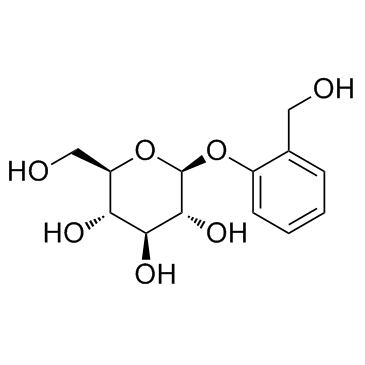
Salicoside
CAS No. 138-52-3
Salicoside( NSC 5751 | D-(-)-Salicin )
Catalog No. M11602 CAS No. 138-52-3
Salicin is a phenol β-glycosid produced from willow bark that shows anti-inflammatory effects.
Purity : >98% (HPLC)
 COA
Datasheet
HNMR
HPLC
MSDS
Handing Instructions
COA
Datasheet
HNMR
HPLC
MSDS
Handing Instructions
| Size | Price / USD | Stock | Quantity |
| 1 mL x 10 mM in DMSO | 28 | In Stock |


|
| 50MG | 37 | In Stock |
|
| 100MG | Get Quote | In Stock |
|
| 200MG | Get Quote | In Stock |
|
| 500MG | Get Quote | In Stock |
|
| 1G | Get Quote | In Stock |
|
Biological Information
-
Product NameSalicoside
-
NoteResearch use only, not for human use.
-
Brief DescriptionSalicin is a phenol β-glycosid produced from willow bark that shows anti-inflammatory effects.
-
DescriptionSalicin is a phenol β-glycosid produced from willow bark that shows anti-inflammatory effects.(In Vitro):Significant down regulation of PGE2, the enzymatic product of COX2, to 76% in lysate and 70% in supernatant is observed with Salicin 10 μM treatment in COLO cells when compare to the COLO control. This is accompanied with a minimal COX1 inhibition to 91% of the CCD control on the genetic level. Treatment with Salicin 1 μM decreases colon cancer cell proliferation rates from 144% to 113% at 24 hours and 187% to 130% at 48 hours, with 10 μM decreasing proliferation rates to 108% at 24 hours and 119% at 48 hours. The concentrations of TNF-α, IL-1β and IL-6 of LPS-induced cells pretreated with 0.07, 0.14 and 0.28 μM Salicin are significant reduced compare with LPS group.(In Vivo):Salicin (D(-)-Salicin) (35, 70, 140 μM) markedly inhibits the LPS-induced pathological changes. MPO activity in LPS-induced lung tissue is significantly increased compare with control group. However, Salicin (35, 70, 140 μM) markedly inhibits this change. Pretreatment with Salicin inhibits LPS-induced activation of JNK, ERK, p38/MAPK and p65 in a dose-dependent manner.
-
In VitroSignificant down regulation of PGE2, the enzymatic product of COX2, to 76% in lysate and 70% in supernatant is observed with Salicin 10 μM treatment in COLO cells when compare to the COLO control. This is accompanied with a minimal COX1 inhibition to 91% of the CCD control on the genetic level. Treatment with Salicin 1 μM decreases colon cancer cell proliferation rates from 144% to 113% at 24 hours and 187% to 130% at 48 hours, with 10 μM decreasing proliferation rates to 108% at 24 hours and 119% at 48 hours. The concentrations of TNF-α, IL-1β and IL-6 of LPS-induced cells pretreated with 0.07, 0.14 and 0.28 μM Salicin are significant reduced compare with LPS group.
-
In VivoSalicin (D(-)-Salicin) (35, 70, 140 μM) markedly inhibits the LPS-induced pathological changes. MPO activity in LPS-induced lung tissue is significantly increased compare with control group. However,Salicin (35, 70, 140 μM) markedly inhibits this change. Pretreatment withSalicin inhibits LPS-induced activation of JNK, ERK, p38/MAPK and p65 in a dose-dependent manner.
-
SynonymsNSC 5751 | D-(-)-Salicin
-
PathwayChromatin/Epigenetic
-
TargetCOX
-
RecptorCOX
-
Research AreaOther Indications
-
Indication——
Chemical Information
-
CAS Number138-52-3
-
Formula Weight286.28
-
Molecular FormulaC13H18O7
-
Purity>98% (HPLC)
-
SolubilityWater: 24 mg/mL (83.83 mM); DMSO: 57 mg/mL (199.1 mM)
-
SMILESO[C@H]([C@H]([C@@H]([C@@H](CO)O1)O)O)[C@@H]1OC2=CC=CC=C2CO
-
Chemical Namealpha-Hydroxy-o-tolyl beta-D-glucopyranoside
Shipping & Storage Information
-
Storage(-20℃)
-
ShippingWith Ice Pack
-
Stability≥ 2 years
Reference
1.Wei W, et al. J Asian Nat Prod Res. 2015 Apr 23:1-6.
molnova catalog



related products
-
Inulicin
Inulicin, an active compound isolated from Inula Britannica L, inhibits VEGF-mediated activation of Src and FAK.
-
Nitroflurbiprofen
Nitroflurbiprofen is a NO-releasing COX inhibitor and modulates the increased intrahepatic vascular tone in portal hypertensive cirrhotic rats.
-
4-Methylamino antipy...
4-Methylamino antipyrine is an active metabolite of Metamizole. Metamizole is a pyrazolone non-steroidal anti-inflammatory drug (NSAID) and inhibits COX.
