


 Cart
Cart
 sales@molnova.com



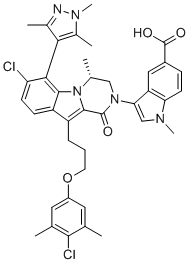
VU661013
CAS No. 2131184-57-9
VU661013( VU 661013 | VU-661013 )
Catalog No. M13394 CAS No. 2131184-57-9
VU661013 (VU-661013) is a novel potent, selective MCL-1 inhibitor with Ki of 97 pM (human MCL-1) in TR-FRET assay.
Purity : >98% (HPLC)
 COA
Datasheet
HNMR
HPLC
MSDS
Handing Instructions
COA
Datasheet
HNMR
HPLC
MSDS
Handing Instructions
| Size | Price / USD | Stock | Quantity |
| 1 mL x 10 mM in DMSO | 167 | In Stock |


|
| 5MG | 155 | In Stock |
|
| 10MG | 225 | In Stock |
|
| 25MG | 363 | In Stock |
|
| 50MG | 479 | In Stock |
|
| 100MG | Get Quote | In Stock |
|
| 200MG | Get Quote | In Stock |
|
| 500MG | Get Quote | In Stock |
|
| 1G | Get Quote | In Stock |
|
Biological Information
-
Product NameVU661013
-
NoteResearch use only, not for human use.
-
Brief DescriptionVU661013 (VU-661013) is a novel potent, selective MCL-1 inhibitor with Ki of 97 pM (human MCL-1) in TR-FRET assay.
-
DescriptionVU661013 (VU-661013) is a novel potent, selective MCL-1 inhibitor with Ki of 97 pM (human MCL-1) in TR-FRET assay, shows no significant inhibition on BCL-xL (Ki>40 uM) or BCL-2 (Ki=0.73 uM); de-stabilizes BIM/MCL-1 association, leads to apoptosis in AML, and is active in venetoclax-resistant cells and patient derived xenografts.
-
In VitroVU661013 exhibits a Ki of 97±30 pM to human MCL-1 in a TR-FRET assay by displacing a fluorescently labeled peptide derived from the pro-apoptotic protein BAK. However, VU661013 does not significantly inhibit BCL-xL (Ki>40 μM) or BCL-2 (Ki=0.73 μM).
-
In VivoVU661013, a novel, potent, selective MCL-1 inhibitor that de-stabilizes BIM/MCL-1 association, leads to apoptosis in AML, and is active in Venetoclax-resistant cells and patient derived xenografts. After establishing disseminated leukemia, NSGS mice are dosed intraperitoneally with 10, 25 or 75 mg/kg of VU661013 daily for 21 days. Weekly chimerism analyses are conducted and the percentage of MV-4-11 cells are quantified in murine peripheral blood using anti-human CD45 (hCD45) and anti-hCD33 monoclonal antibodies. Twenty-eight days post-transplant, vehicle-treated mice have developed large leukemia burdens and thus, mice are sacrificed, and their organs are harvested for analysis. Vehicle mice treated died of xenografted AML, but have no evidence of VU661013-related toxicity in non target organs. VU661013 treatment of disseminated human AML results in a dose-dependent decrease in tumor burden, nearly eliminating the hCD45+ MV-4-11 cells at the 75 mg/kg dose in the blood (mean, 13.0±2.2% in vehicle vs 7.4±7.2% in 25mg/kg vs 0.17±0.12% in 75 mg/kg treated mice), bone marrow (mean, 40.7±13.9% in vehicle vs 33.46±4.0 % in 25 mg/kg vs 0.384±0.345 in 75 mg/kg treated mice), and spleen (mean, 46.22±13.3% in vehicle vs 13.31±10.0% in 25 mg/kg vs 1.588±1.51% in 75 mg/kg treated mice). Treatment with VU661013 reduces disease-associated splenomegaly (mean, vehicle vs. 75mg/kg, 0.17±0.02 vs 0.09±0.01g), and amendeding spleen to body weight ratio (vehicle vs 75mg/kg, 0.99 vs 0.50). In a second MV-4-11 xenograft study, mice are followed until death, and survival is evaluated by Kaplan-Meier analysis. In this study, NSGS mice are treated daily (starting 7 days after transplant) with vehicle only, 15 mg/kg or 75 mg/kg of VU661013. Analysis reveals an increase in survival in mice treated with the 75mg/kg dose (vehicle treated mice=31 days, vs 15 mg/kg=32 days, vs 75 mg/kg treated mice=43 Days).
-
SynonymsVU 661013 | VU-661013
-
PathwayAngiogenesis
-
TargetBcl-2
-
RecptorBcl-2
-
Research Area——
-
Indication——
Chemical Information
-
CAS Number2131184-57-9
-
Formula Weight712.672
-
Molecular FormulaC39H39Cl2N5O4
-
Purity>98% (HPLC)
-
SolubilityDMSO : ≥ 125 mg/mL 175.40 m; MH2O : < 0.1 mg/mL
-
SMILESClC1=C(C2=C(C)N(C)N=C2C)C3=C(C(CCCOC4=CC(C)=C(Cl)C(C)=C4)=C5N3[C@H](C)CN(C6=CN(C)C7=C6C=C(C(O)=O)C=C7)C5=O)C=C1
-
Chemical Name(R)-3-(7-chloro-10-(3-(4-chloro-3,5-dimethylphenoxy)propyl)-4-methyl-1-oxo-6-(1,3,5-trimethyl-1H-pyrazol-4-yl)-3,4-dihydropyrazino[1,2-a]indol-2(1H)-yl)-1-methyl-1H-indole-5-carboxylic acid
Shipping & Storage Information
-
Storage(-20℃)
-
ShippingWith Ice Pack
-
Stability≥ 2 years
Reference
1. Ramsey HE, et al. Cancer Discov. 2018 Sep 5. pii: CD-18-0140.
2. Zhao B, et al. Biochemistry. 2018 Aug 14;57(32):4952-4958.
molnova catalog



related products
-
Wilfortrine
Wilfortrine is a bioactive sesquiterpene alkaloid. Wilfortrine exhibits immunosuppresive effects. Wilfortrine also can inhibit leukaemia cell growth in mice and shows anti-HIV activity.
-
Pyridoclax
Pyridoclax (MR29072) is a highly potent Mcl-1 inhibitor with Kd of 25 nM, disrupts Mcl-1/Bim interaction.
-
BDA-366
A potent, selective Bcl2 BH4 domain antagonist with Ki of 3.3 nM; shows no affinity for other Bcl2 family members, including Bcl-XL, Mcl-1, or Bfl-1/A1.
