


 Cart
Cart
 sales@molnova.com



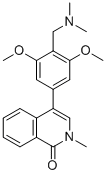
BI 7271
CAS No. 1883429-34-2
BI 7271( BI 7271 )
Catalog No. M12929 CAS No. 1883429-34-2
BI 7271 is a highly selective bromodomains of BRD9 and BRD7 inhibitor with IC50<50 nM for BRD9.
Purity : >98% (HPLC)
 COA
Datasheet
HNMR
HPLC
MSDS
Handing Instructions
COA
Datasheet
HNMR
HPLC
MSDS
Handing Instructions
| Size | Price / USD | Stock | Quantity |
| 100MG | Get Quote | Get Quote |


|
| 200MG | Get Quote | Get Quote |
|
| 500MG | Get Quote | Get Quote |
|
| 1G | Get Quote | Get Quote |
|
Biological Information
-
Product NameBI 7271
-
NoteResearch use only, not for human use.
-
Brief DescriptionBI 7271 is a highly selective bromodomains of BRD9 and BRD7 inhibitor with IC50<50 nM for BRD9.
-
DescriptionBI 7271 is a highly selective bromodomains of BRD9 and BRD7 inhibitor with IC50<50 nM for BRD9; displays >1,000 fold selectivity over the bromodomains of BRD4; suppresses the proliferation of AML cells.
-
In Vitro——
-
In Vivo——
-
SynonymsBI 7271
-
PathwayChromatin/Epigenetic
-
TargetBromodomain
-
RecptorBromodomain
-
Research Area——
-
Indication——
Chemical Information
-
CAS Number1883429-34-2
-
Formula Weight352.434
-
Molecular FormulaC21H24N2O3
-
Purity>98% (HPLC)
-
Solubility——
-
SMILES——
-
Chemical Name4-[4-[(dimethylamino)methyl]-3,5-dimethoxyphenyl]-2-methylisoquinolin-1-one
Shipping & Storage Information
-
Storage(-20℃)
-
ShippingWith Ice Pack
-
Stability≥ 2 years
Reference
1. Hohmann AF, et al. Nat Chem Biol. 2016 Sep;12(9):672-9.
2. Pérez-Salvia M, et al. Epigenetics. 2017 May 4;12(5):323-339.
molnova catalog



related products
-
PF-CBP1
A potent, highly selective CBP/p300 bromodomains inhibitor with IC50 of 125 nM and 363 nM, respectively.
-
SJ830599
SJ830599 is a modest selective BRD2-BD2 inhibitor with IC50 of 0.61 uM, 3.3-fold selectivity over BRD2-BD1.
-
BI 894999
BI 894999 is a novel potent, selective BET inhibitor with IC50 of 5 and 41 nM for BRD4-BD1 and BRD4-BD2 bromodomains, respectively.
