


 Cart
Cart
 sales@molnova.com



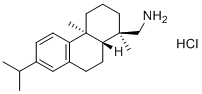
Leelamine hydrochloride
CAS No. 16496-99-4
Leelamine hydrochloride( Dehydroabietylamine )
Catalog No. M12521 CAS No. 16496-99-4
Leelamine hydrochloride (Dehydroabietylamine) is a novel inhibitor of androgen receptor (AR).
Purity : >98% (HPLC)
 COA
Datasheet
HNMR
HPLC
MSDS
Handing Instructions
COA
Datasheet
HNMR
HPLC
MSDS
Handing Instructions
| Size | Price / USD | Stock | Quantity |
| 100MG | Get Quote | Get Quote |


|
| 200MG | Get Quote | Get Quote |
|
| 500MG | Get Quote | Get Quote |
|
| 1G | Get Quote | Get Quote |
|
Biological Information
-
Product NameLeelamine hydrochloride
-
NoteResearch use only, not for human use.
-
Brief DescriptionLeelamine hydrochloride (Dehydroabietylamine) is a novel inhibitor of androgen receptor (AR).
-
DescriptionLeelamine hydrochloride (Dehydroabietylamine) is a novel inhibitor of androgen receptor (AR), inhibits castration-resistant prostate cancer cells; causes apoptosis and suppresses 22Rv1 xenograft growth in vivo; Leelamine mediates cancer cell death through inhibition of intracellular cholesterol transport.
-
In Vitro——
-
In Vivo——
-
SynonymsDehydroabietylamine
-
PathwayEndocrinology/Hormones
-
TargetAndrogen Receptor (AR)
-
RecptorAndrogen Receptor (AR)
-
Research Area——
-
Indication——
Chemical Information
-
CAS Number16496-99-4
-
Formula Weight321.933
-
Molecular FormulaC20H32ClN
-
Purity>98% (HPLC)
-
SolubilityIn Vitro:?DMSO : 25 mg/mL (77.66 mM)
-
SMILESCC(C)C1=CC2=C(C=C1)C3(CCCC(C3CC2)(C)CN)C.Cl
-
Chemical Name1R,2,3,4,4aS,9,10,10aR-octahydro-1,4a-dimethyl-7-(1-methylethyl)-1-phenanthrenemethanamine, monohydrochloride
Shipping & Storage Information
-
Storage(-20℃)
-
ShippingWith Ice Pack
-
Stability≥ 2 years
Reference
1. Singh KB, et al. Mol Cancer Ther. 2018 Jul 20. pii: molcanther.0117.2018.
2. Gowda R, et al. Oncotarget. 2017 Apr 25;8(17):28260-28277.
3. Sehrawat A, et al. Mol Carcinog. 2017 Feb;56(2):337-348.
4. Kuzu OF, et al. Mol Cancer Ther. 2014 Jul;13(7):1690-703.
molnova catalog



related products
-
Dehydroepiandrostero...
Dehydroepiandrosterone acetate is a major C19 steroid produced by the adrenal cortex.
-
Testosterone propion...
Testosterone Propionate is an efficient androgenic hormone for the treatment of low testosterone.
-
Ailanthone
Ailanthone is an effective inhibitor of both full-length androgen receptor (AR) (IC50: 69?nM) and constitutively active truncated AR splice variants (IC50: 309?nM).
