


 Cart
Cart
 sales@molnova.com



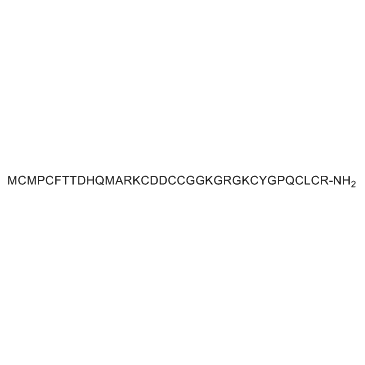
Chlorotoxin
CAS No. 163515-35-3
Chlorotoxin( TM-601 )
Catalog No. M12463 CAS No. 163515-35-3
Chlorotoxin is a 36-amino acid peptide found in the venom of the deathstalker scorpion (Leiurus quinquestriatus).
Purity : >98% (HPLC)
 COA
Datasheet
HNMR
HPLC
MSDS
Handing Instructions
COA
Datasheet
HNMR
HPLC
MSDS
Handing Instructions
| Size | Price / USD | Stock | Quantity |
| 100MG | Get Quote | Get Quote |


|
| 200MG | Get Quote | Get Quote |
|
| 500MG | Get Quote | Get Quote |
|
| 1G | Get Quote | Get Quote |
|
Biological Information
-
Product NameChlorotoxin
-
NoteResearch use only, not for human use.
-
Brief DescriptionChlorotoxin is a 36-amino acid peptide found in the venom of the deathstalker scorpion (Leiurus quinquestriatus).
-
DescriptionChlorotoxin is a 36-amino acid peptide found in the venom of the deathstalker scorpion (Leiurus quinquestriatus); blocks small-conductance chloride channels.Brain Cancer Phase 2 Clinical.
-
In VitroChlorotoxin (Chlorotoxin) preferentially binds to tumor cells and has been harnessed to develop an imaging agent to help visualize tumors during surgical resection. In addition, chlorotoxin has potential as a vehicle to deliver anti-cancer drugs specifically to cancer cells. Chlorotoxin is shown to bind glioma cells, but is unable to bind normal rat astrocytes and Te671, a human rhabdomyosarcoma cell line. Chlorotoxin inhibits the migration of U251MG (glioma) cells, with an IC50 of 600 nM. Chlorotoxin binds to glioma cells is specific and involves high affinity (Kd=4.2 nM) and low affinity (Kd=660 nM) binding sites.Small conductance chloride channels are shown to be potently blocked by Chlorotoxin. Chlorotoxin has been used as a general pharmacological tool to investigate the function of chloride channels.
-
In VivoChlorotoxin shows insecticidal activity on insects and other invertebrates. After the administration of I-Chlorotoxin to tumor-bearing mice, the peptides accumulated within the tumor.Chlorotoxin selectively accumulates in the brain of tumor-bearing mice with calculated brain: muscle ratios of 36.4% of injected dose/g (ID/g), as compared to 12.4%ID/g in control animals.
-
SynonymsTM-601
-
PathwayMembrane Transporter/Ion Channel
-
TargetChloride Channel
-
RecptorChloride Channel
-
Research AreaCancer
-
IndicationBrain Cancer
Chemical Information
-
CAS Number163515-35-3
-
Formula Weight3995.71
-
Molecular FormulaC158H249N53O47S11
-
Purity>98% (HPLC)
-
SolubilityDMSO
-
SMILESCC(C)CC(C(=O)NC(CS)C(=O)NC(CCCNC(=N)N)C(=O)O)NC(=O)C(CS)NC(=O)C(CCC(=O)N)NC(=O)C1CCCN1C(=O)CNC(=O)C(CC2=CC=C(C=C2)O)NC(=O)C(CS)NC(=O)C(CCCCN)NC(=O)CNC(=O)C(CCCNC(=N)N)NC(=O)CNC(=O)C(CCCCN)NC(=O)CNC(=O)CNC(=O)C(CS)NC(=O)C(CS)NC(=O)C(CC(=O)O)NC(=O)C(CC(=O)O)NC(=O)C(CS)NC(=O)C(CCCCN)NC(=O)C(CCCNC(=N)N)NC(=O)C(C)NC(=O)C(CCSC)NC(=O)C(CCC(=O)N)NC(=O)C(CC3=CNC=N3)NC(=O)C(CC(=O)O)NC(=O)C(C(C)O)NC(=O)C(C(C)O)NC(=O)C(CC4=CC=CC=C4)NC(=O)C(CS)NC(=O)C5CCCN5C(=O)C(CCSC)NC(=O)C(CS)NC(=O)C(CCSC)N
-
Chemical NameL-Argininamide, L-methionyl-L-cysteinyl-L-methionyl-L-prolyl-L-cysteinyl-L-phenylalanyl-L-threonyl-L-threonyl-L-α-aspartyl-L-histidyl-L-glutaminyl-L-methionyl-L-alanyl-L-arginyl-L-lysyl-L-cysteinyl-L-α-aspartyl-L-α-aspartyl-L-cysteinyl-L-cysteinylglycylgl
Shipping & Storage Information
-
Storage(-20℃)
-
ShippingWith Ice Pack
-
Stability≥ 2 years
Reference
1. DeBin JA, et al. Toxicon. 1991;29(11):1403-8.
2. Tamborini M, et al. ACS Nano. 2016 Feb 23;10(2):2509-20.
molnova catalog



related products
-
OADS
OADS is a specific, reversible, small-molecule inhibitor directs against CLC (Chloride Channel) antiporter with Ki of 29 uM.
-
Brucine sulfate hept...
Brucine is an alkaloid that acts as an antagonist at glycine receptors and paralyzes inhibitory neurons.
-
IAA-94
IAA-94 is an indanyloxyacetic acid (IAA) inhibitor of epithelial chloride channels that binds channels in bovine kidney cortex microsomes with Ki of 1 uM.
