


 Cart
Cart
 sales@molnova.com



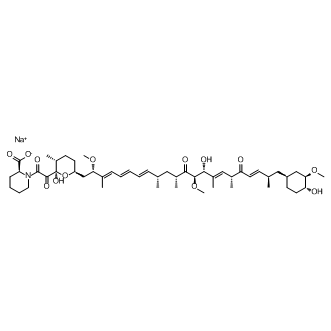
Seco Rapamycin sodium salt
CAS No. 148554-65-8
Seco Rapamycin sodium salt( Secorapamycin A monosodium )
Catalog No. M12049 CAS No. 148554-65-8
Seco-rapamycin is the first in vivo open-ring metabolite of rapamycin that does not affect mTOR.
Purity : >98% (HPLC)
 COA
Datasheet
HNMR
HPLC
MSDS
Handing Instructions
COA
Datasheet
HNMR
HPLC
MSDS
Handing Instructions
| Size | Price / USD | Stock | Quantity |
| 5MG | 412 | Get Quote |


|
| 10MG | 647 | Get Quote |
|
| 25MG | 1176 | Get Quote |
|
| 50MG | 1882 | Get Quote |
|
| 100MG | Get Quote | Get Quote |
|
| 200MG | Get Quote | Get Quote |
|
| 500MG | Get Quote | Get Quote |
|
| 1G | Get Quote | Get Quote |
|
Biological Information
-
Product NameSeco Rapamycin sodium salt
-
NoteResearch use only, not for human use.
-
Brief DescriptionSeco-rapamycin is the first in vivo open-ring metabolite of rapamycin that does not affect mTOR.
-
DescriptionSeco-rapamycin is the first in vivo open-ring metabolite of rapamycin that does not affect mTOR.
-
In VitroDisposition of Seco Rapamycin in Human Tissue Homogenates and Caco-2 Cell Monolayers. To determine whether Seco Rapamycin (D2) can be metabolized to dihydro Sirolimus (M2), 20 μM Seco Rapamycin is incubated with human liver, jejunal mucosal, and Caco-2 homogenates. All of these homogenates produced M2 in an NADPH-dependent manner. Ketoconazole, at a high concentration (100 μM), has no effect on the formation of M2 in any of the homogenates examined. To determine whether Seco Rapamycin can be metabolized to M2 in intact cells, 20 μM Seco Rapamycin is added to Caco-2 cell monolayers. When applied to the apical compartment, little Seco Rapamycin is detected in the basolateral compartment and in the cellular fraction after 4 h. In addition, little M2 is detected. LY335979 has little effect on the distribution of Seco Rapamycin after an apical dose, although M2 became detectable in the apical compartment. In contrast, when Seco Rapamycin is applied to the basolateral compartment, both Seco Rapamycin and M2 are readily detected in the apical compartment; LY335679 decreases the flux of Seco Rapamycin to the apical compartment and increases the amount of M2 in both apical and basolateral compartments.
-
In Vivo——
-
SynonymsSecorapamycin A monosodium
-
PathwayPI3K/Akt/mTOR signaling
-
TargetmTOR
-
RecptormTOR
-
Research AreaInflammation/Immunology
-
Indication——
Chemical Information
-
CAS Number148554-65-8
-
Formula Weight936.1537
-
Molecular FormulaC51H78NNaO13
-
Purity>98% (HPLC)
-
SolubilityDMSO: ≥ 46 mg/mL
-
SMILESCC1CCC(OC1(C(=O)C(=O)N2CCCCC2C(=O)[O-])O)CC(C(=CC=CC=CC(C)CC(C)C(=O)C(C(C(=CC(C)C(=O)C=CC(C)CC3CCC(C(C3)OC)O)C)O)OC)C)OC.[Na+]
-
Chemical Name2-Piperidinecarboxylic acid, 1-[oxo[tetrahydro-2-hydroxy-6-[14-hydroxy-22-(4-hydroxy-3-methoxycyclohexyl)-2,13-dimethoxy-3,9,11,15,17,21-hexamethyl-12,18-dioxo-3,5,7,15,19-docosapentaenyl]-3-methyl-2H-pyran-2-yl]acetyl]-, monosodium salt, [2R-[2α,2(S*),3α
Shipping & Storage Information
-
Storage(-20℃)
-
ShippingWith Ice Pack
-
Stability≥ 2 years
Reference
1. Osmulski PA, et al. Mol Pharmacol. 2013 Jul;84(1):104-13.
2. Cai P, et al. Drug Metab Dispos. 2007 Sep;35(9):1554-63.
molnova catalog



related products
-
NV-5138
NV-5138 is a selective and orally active activator of brain mTORC1, with antidepressant effects.
-
mTOR inhibitor 9c
mTOR inhibitor 9c is a selective mTOR inhibitor with IC50 of 0.7nM and 825nM for mTOR and PI3Kα, respectively.
-
Rapamycin
A macrolide compound that has potent immunosuppressive and antiproliferative properties by inhibiting mTOR (IC50=0.1 nM).
